Faisal booked two demos in one week. Both platforms looked capable. Both had long feature lists, clean dashboards, and a salesperson who knew the script.
In the second demo, he asked a small question. One of his customers in Sharjah had moved from two jars a week to three. What happens now? The salesperson clicked into the account, deleted the standing order and started building a new one. Faisal watched the customer’s six-month history disappear from the screen.
That is the problem with evaluating bottled water delivery software. The demo shows you what the product does well. It rarely shows you what happens on a Thursday when a real customer changes their mind.
This guide is a testing method, not a feature list. Every item below comes with a question to ask and something to watch while they answer it.
Reason Feature Lists Don’t Tell You Anything
Every vendor in this category will tick “route planning.” Every one of them will tick “recurring orders” and “driver app” and “reporting.”
Those ticks tell you nothing. Route planning can mean a system that intelligently sequences a repeating round, or it can mean a screen where you drag customer names into an order by hand every morning. Both are route planning. Only one of them is worth paying for.
The same is true of recurring orders. Almost every platform can save an order that repeats. Far fewer can handle the order that repeats with variation, which is the only kind that exists in a real water business.
So stop asking whether a feature exists. Ask the platform to perform your Thursday. Bring one real customer with a messy history and make the vendor process them live, in front of you.
What Should Bottled Water Delivery Software Actually Do?
Bottled water delivery software is a system that manages standing orders, delivery routes, riders, jar and bottle balances, deposits, collections, and reporting as one connected workflow, so a change made at the doorstep updates the customer’s account, their balance, and the month’s bill without anyone re-entering it.
You will find the same category under several names. Online bottled water delivery software usually means the cloud-hosted version of the same thing. Water jar delivery software describes the container side. Water delivery service software is the generic label. Water delivery app normally refers to the rider’s phone, not the whole system.
They are not separate products. They are parts of one operation, and a platform worth buying connects all of them. If you want the full picture of the category first, the complete water delivery software guide covers what the software is for and whether you need it yet. This article assumes you have already answered that.
The Six Areas Worth Testing
Do not read these as features. Read them as tests, and run every one of them inside the trial or the demo.
Recurring orders:
Change a customer’s standing quantity mid-cycle. Two jars to three, starting next Tuesday. Then check whether their history survived and whether the bill splits correctly across the change.
Route and zone planning:
Add one new customer to a route that is already full. Watch what the system does with the sequence. If it appends the new stop to the end of the list, the routing is cosmetic. This matters enough that it has its own article in this series, Water Delivery Routing Software: Why Route Planning Quietly Decides Your Margin.
Jars and empties.
Issue three jars, take back two, then ask the system for that customer’s balance. If you have to work it out yourself from a delivery log, the container tracking is not real. Water Jar Delivery Software: Running 19L and 5-Gallon Jar Routes Without Losing Count goes deeper on the 19L and 5-gallon workflow.
Rider app:
Hand the phone to someone who was not in the demo. A rider, an office assistant, anyone. Ask them to complete a delivery. If they need help, your team will need help every day for a year.
Collections:
Record a part payment against a customer who already has a running balance and an unreturned jar. Then ask for their statement. Most systems handle a clean payment. Fewer handle a partial one against a mixed account.
Reporting:
Ask for yesterday, broken down by rider, without exporting anything. If the answer involves a spreadsheet, you have bought a data entry system, not a management one. The feature lists what a connected reporting layer covers, from operation summaries to item ledgers.
What Happens When the Order Changes?
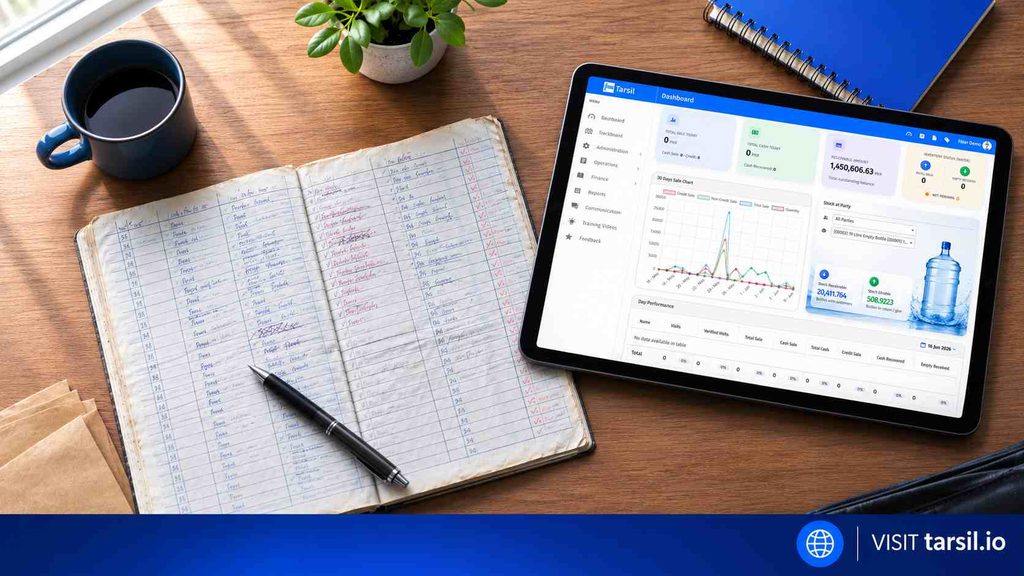
This is the dividing line in the category, and it is the section most buyers skip.
Quantity changes mid-cycle:
A customer takes two jars every Monday and Thursday. In week three of the month, they ask for three on Thursdays only. In week four, they go back to two.
That is one customer, one month, three different arrangements. The bill has to reflect all three, and the rider has to be told the right number on the right day without anyone phoning him. If a platform handles this by deleting the old order and creating a new one, you have lost the history that proves what was delivered.
Skips, holds and returns:
Customers travel. Offices close for a week. Households pause during Ramadan or over the summer, and businesses across Dubai, Riyadh and Doha see the pattern every year.
A skip is not a cancellation. A hold is not churn. If your software treats them the same way, you will bill people for deliveries that never happened, and you will lose customers who were only ever going to be away for ten days.
Rate changes that shouldn’t rewrite history
You raise your price in March. The bill for February must still calculate at February’s rate.
It sounds obvious. A surprising number of systems apply the current rate retroactively to every past delivery, which turns a routine price change into a month of arguments with your best customers.
The common failure behind all three is the same. Most delivery platforms model an order as an event that happens once. It sells a standing agreement that the team adjusts constantly and settles at the end of the month. Faisal’s two-to-three-minute question was not a small question. It was the whole product test, asked in eight words.
Does Online Bottled Water Delivery Software Solve This on Its Own?
No, and it is worth saying plainly because “cloud-based” is doing a lot of marketing work in this category.
Being online means your office, your riders, and you are looking at the same record instead of three versions of it. That is genuinely useful. It is also table stakes in 2026, not a differentiator, and it does nothing about the standing-order problem above.
A spreadsheet with a login screen is still a spreadsheet. Online Water Delivery Software: What Cloud Access Actually Changes on a Route covers where the real benefit sits.
Generic Delivery and Courier Software
Generic delivery software follows a short chain. Order comes in, address is assigned, rider delivers, status changes to delivered, job closed.
A water business runs a longer one. A standing order exists, route position is set, delivery happens, empty jar is collected, deposit balance adjusts, payment is recorded against the account, and the month gets billed from all of it.
Put simply: generic software finishes at the doorstep, and a water business’s transaction is only half done there. Everything expensive happens after the delivery, in the part courier tools were never built to hold.
If you are comparing across categories more broadly, Water Supply Management Software vs. Water Delivery Software: Two Different Products sorts out the terminology, because utility and delivery software get confused constantly in search results.
What Bottled Water Distribution Companies Need That Retail Delivery Doesn’t
If you supply offices, hotels, labour accommodation, restaurants or other businesses, you are running a second business alongside the household one.
Bottled water distribution companies deal with account-level pricing rather than a single rate card, credit terms instead of cash at the door, a procurement contact who is not the person receiving the jars, and monthly invoices that get checked line by line. Some also sell through sub-dealers, which adds a layer between you and the end customer.
Ask any vendor how they price a customer differently from the default list, and who is allowed to change that price. The answer tells you whether the platform was built for retail delivery or for distribution.
Questions to Ask in the Demo
Group your questions by area so nothing gets skipped when the demo runs over time.
- Customers. Can I set a different rate for one account, and can I see when it changed and who changed it?
- Customers. Show me a customer’s full history, including deliveries, payments, and jars, on one screen.
- Routes. Add a customer to a full route and show me the sequence afterwards.
- Routes. What happens when a rider is absent, and someone else takes the round?
- Assets. How many jars does this customer hold right now, and what deposit is recorded against them?
- Money. Record a partial payment against an account with an outstanding balance, then produce the statement.
- Money. Show me what was collected yesterday, by rider, without exporting.
- People. What can a rider see that my manager can see, and what can neither of them see?
- Cost. What is the total for my number of riders and customers, in my local currency, including setup and support? Tarsil’s pricing is published, and any vendor who will not give you a number in the first call is telling you something.
Bring one real customer’s messy month to the demo. Not a clean example the vendor prepared. The messy month is where the difference shows.
Where does Tarsil fit
Tarsil holds the whole chain in one place: customer, standing order, route, rider, delivery, returned jar, deposit, collection, and report. Not more modules, just fewer gaps between them.
That is why the two-to-three jar change is not an event in Tarsil. It is an adjustment to an agreement that already exists, with the history intact and the month’s bill calculating around it. Faisal’s question has a one-word answer here, and it took six months of demos to find a platform that could give it.
Tarsil runs delivery operations for 400+ businesses across 77+ cities in Pakistan, the GCC, and Africa, with an average 10x return reported in the first year. You can see how the pieces connect, and the operational details are on this page.
The Bottom Line
The best bottled water delivery software is not the one with the longest feature list. It is the one that survives your worst customer’s most complicated month without losing the record.
Ready to run your real Thursday through Tarsil?
Start Your Free 14-Day Trial → No credit card. You will be live in a few minutes.
FAQs: Questions Buyers Ask About Bottled Water Delivery Software
At minimum: standing orders that survive changes, route and zone planning, a rider app your team will actually use, jar and deposit tracking per customer, collections against running balances, and reporting you can read without exporting. The test is not whether each exists, but whether they update each other.
Generic software ends when the delivery is marked complete. Water delivery software continues through the returned jar, the deposit adjustment, the balance update, and the monthly bill. That second half is where the money in a water business is won or lost.
A good platform can, and this is the single most useful thing to test. Change a standing quantity mid-cycle, then check that the customer’s history is intact and the bill splits correctly across the change.
It should track both, per customer, as a live balance rather than a delivery log you have to add up yourself. Container and deposit tracking is what separates real water delivery software from a courier tool with a water label on it.
Only when it connects the office, the rider, and the ledger. Cloud hosting on its own is not the benefit. A spreadsheet with a login screen has the same problems as a spreadsheet.