Every water delivery business hits the same wall eventually.
More customers. More routes. More drivers. More bottles and jars moving in and out every day.
Somewhere in that growth, a simple delivery operation starts feeling like a full-time coordination problem.
Water delivery software fixes this. It replaces scattered registers, spreadsheets, and phone calls with one connected system that runs the whole operation.
Yusuf is checking his phone at 7:30 AM in Dubai. Three trucks are leaving the depot. One covers households across Dubai, while another handles office accounts near Sharjah. A third truck runs a mixed route where customers order different quantities on different days.
Nothing looks wrong — until a customer calls to say yesterday’s delivery never arrived. Another asks if her empty jars were logged. The driver insists he collected cash, but the office hasn’t updated the ledger yet.
Yusuf doesn’t have a staffing problem. He has a visibility problem.
That’s exactly what good water delivery software fixes. This guide covers what it should manage, which features matter for bottled and 5-gallon operators, how to evaluate a system, and when it’s time to move off manual processes.
What Is Water Delivery Software?
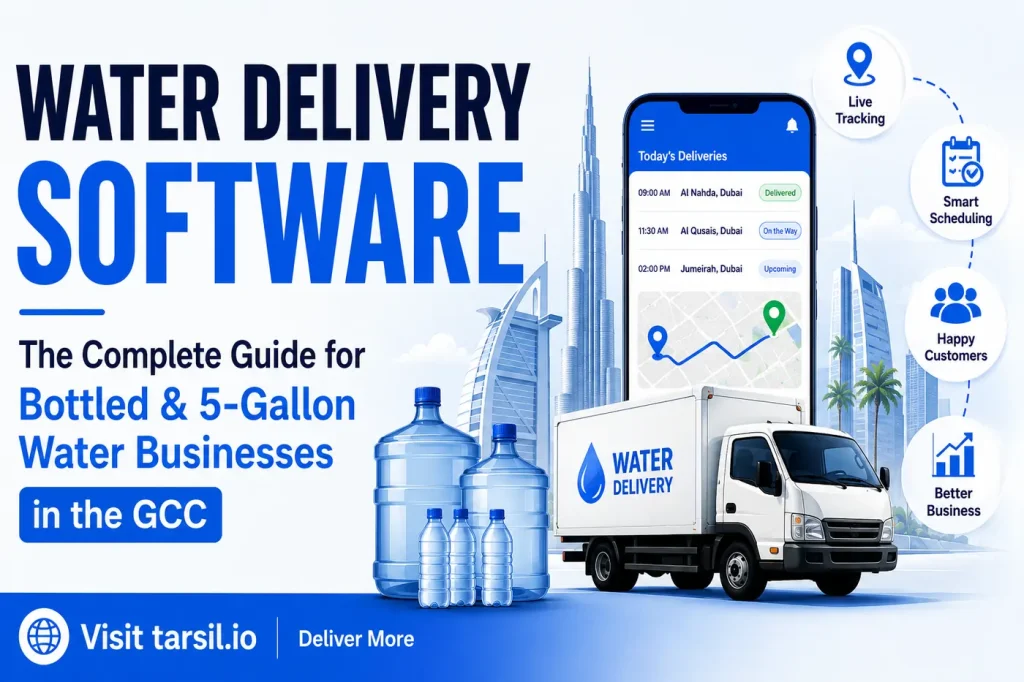
Water delivery software is business management software built for bottled, jar, and 5-gallon water operators. It typically combines customer scheduling, recurring orders, route planning, driver dispatch, delivery verification, billing, collections, and returnable-container tracking into a single system.
You’ll see it marketed under different names — bottled water delivery software, water delivery management software, online water delivery software. The label changes, but the problem is always the same: how do you run thousands of recurring deliveries without depending on memory, paper, and constant calls between the office and the road?
(Note: If your operation manages bulk utility distribution rather than bottled distribution, see our detailed breakdown on Water Supply Management Software vs. Water Delivery Software: Two Different Products.)
Why a Delivery Business Needs More Than an Order System
Taking an order and sending a truck is the easy part.
A real customer relationship usually involves:
- A recurring delivery schedule
- Different quantities on different days
- Multiple bottle or jar sizes
- Empty-container returns and deposits
- Customer-specific pricing
- Cash or digital collections
- Missed or rescheduled stops
- End-of-day reconciliation
A basic ordering app records the sale. A real operational system explains what happened before, during, and after the delivery.
For a deeper look into building scalable infrastructure, explore our guide on Systems Behind a Water Delivery Business That Scales.
Here’s why that gap matters: if 500 bottles leave the depot today, “how many did we sell?” isn’t the useful question. You need to know how many reached customers, how many came back, how many are still out there, and whether the deposits and inventory numbers match.
What Should Water Delivery Software Actually Handle?
The core capabilities worth checking for:
- Recurring orders — manage customers on daily, weekly, or alternate-day schedules automatically.
- Route planning — group stops logically so drivers aren’t crisscrossing the same streets twice. For a deeper breakdown on how optimized routes directly protect your bottom line, see our guide on Water Delivery Routing Software: Why Route Planning Quietly Decides Your Margin.
- Driver execution— give drivers everything they need without having to call the office every hour. Curious how this works in practice? See exactly [what cloud access actually changes on a route] for your field team.
- Delivery verification — record what was delivered, skipped, returned, or collected.
- Container and deposit tracking — know how many bottles and jars are out with customers, and where.
- Collections — match every payment to the right customer and transaction.
- Reporting — give owners one clear view of sales, collections, stock, and performance.
The number of features doesn’t matter much. Whether they work together does.
Water Delivery Management Software: Coordinating the Whole Operation?
Water delivery management software connects the operational side of the business — schedules, orders, routes, drivers, collections, and inventory — into one shared record, instead of five separate systems the office has to reconcile by hand.
Without it, a normal morning looks like this:
Customer calls → office writes it down → driver gets a message → delivery happens → payment is “remembered” → ledger updated hours later.
With water delivery management software, it looks like this instead:
Schedule → order → route → driver → delivery → collection → report.
At 50 customers, that difference is manageable. At 500, it’s the whole business.
Once you’re convinced of that, the real question is what to check when a vendor demos it to you — a buyer’s checklist you can actually run in a demo.
Container and Deposit Tracking: The Piece Everyone Underestimates
For jar-based and 5-gallon operators, this is often where money quietly disappears. If you’re struggling to locate returnable inventory across routes, see our deep dive on Empty Jar Tracking: The Asset Your Business Owns and Can’t Find to fix container leakage.
A customer can hold three or four containers without anyone noticing. Without tracking, the depot just sees fewer jars in stock — with no record of where they went or which deposits are still outstanding. To stop this cash leak, read our guide on Water Bottle Security Deposit: Setting Terms That Protect Your Working Capital to ensure your container policies are actually protecting your bottom line
For a deeper look into preventing container loss on daily routes, read our guide on Water Jar Delivery Software: Running 19L and 5-Gallon Jar Routes Without Losing Count.
Water Delivery Software vs. Generic Delivery Software
Generic delivery software can technically move water from A to B. That’s not the real question.
The real question: does it understand the business model behind the delivery?
Generic platforms usually cover orders, dispatch, drivers, and basic tracking. Water delivery operations also need recurring schedules, customer-specific pricing, bottle and jar deposits, repeated routes, and inventory movement tied to collections.
A useful test: ask any provider to walk through one real customer journey — recurring order, quantity change, route assignment, delivery, payment, container return — end to end. If it handles that naturally, the software is built for the job. If you need workarounds at every step, “water delivery software” is just a label on generic tech.
If no ready platform fits well enough, the alternative is building one yourself — here’s how that decision actually breaks down.
Still running routes on paper and WhatsApp?
See how Tarsil delivery management features connect orders, routes, and collections in one place. Free Sign-up — 14-Day Free Trial.
Water Delivery Software in the GCC: What Changes?
Operators across the UAE, Saudi Arabia, Kuwait, Qatar, Oman, and Bahrain operate in different markets, but face the same core challenge: coordinating recurring deliveries across customers, routes, drivers, inventory, and collections.
Regional operators typically serve a mix of:
- Residential households
- Offices and commercial accounts
- Hotels and restaurants
- Labour accommodation
- Multi-branch or multi-emirate operations
Demand also shifts with the seasons — summer heat and Ramadan both move volume, and a business running routes across Dubai and Sharjah, or Riyadh and Jeddah, feels that shift fast. As your customer base spreads across more areas, route planning and day-to-day visibility get harder to manage with spreadsheets alone.
Managing corporate accounts requires balancing higher volume with fixed delivery windows—for a deeper strategy on onboarding business clients without disrupting daily efficiency, see our guide on Corporate Water Delivery: Winning Office Accounts Without Wrecking Your Route
When Should You Move to Water Delivery Software?
There’s no magic customer count. Watch for these signs instead:
- You’ve become the dispatcher, answering routine questions all day
- Customers report missed deliveries before your team does
- Drivers keep crossing the same areas or returning to the depot unnecessarily
- Nobody can say with confidence where the bottles and jars are
- Collections get recorded late, or reconciled by hand
- A basic sales report takes an hour and three spreadsheets to build
- One employee’s day off creates a real information gap
None of this means digitizing everything for its own sake. It means removing dependencies before they get expensive. If you are in the early stages or planning your setup, see our guide on How to Start a Water Delivery Business (And What to Systemize Before Customer 50) to get your workflows right from the start.
What to Check Before Buying Water Delivery Software
Don’t shop by feature list — the features that actually decide whether you should buy aren’t always the ones vendors lead with. Test the areas where your operation actually loses time and money:
- Scheduling & pricing — can you change quantities and rates without rebuilding the customer record?
- Routes & drivers — can recurring customers be grouped into efficient routes, with exceptions flagged automatically?
- Containers & deposits — can the system track returnable assets and tie deposits to the right customer?
- Billing & collections — can payments be recorded against the correct transaction, with clear cash visibility for management?
- Reporting & access — can an owner understand the business from one dashboard, without asking three people first, even from outside the office?
What Makes Tarsil Different
ERPs run the back office. Tarsil runs the field.
Tarsil isn’t a back-office ERP or a standalone tracker bolted onto delivery. It’s built as an operating system for the field. By understanding what your riders actually need from a water delivery app, Tarsil connects scheduling, routes, driver execution, and collections into a seamless workflow.
The idea behind it is simple: control the business, not just the delivery. An owner shouldn’t only know whether a truck moved. They should know which customers were served, what was collected, where the containers are, and which routes need attention — today, not at month-end.
Missed deliveries, late collections, and untracked containers are all forms of revenue leakage — money the business earned but never actually collected. That’s the gap Tarsil is built to close, and it shows in the numbers: Tarsil customers see a 12.9x average ROI in year one, alongside a 16% lift in sales per rider, 30% faster collections, and churn dropping from 32% to 7%. Over 400 delivery businesses across 77 cities already run on it.
Want to see how field automation lowers churn?
Read Water Delivery Customer Retention: Catching the Customer Who Quietly Stopped Ordering to protect your recurring revenue base.
Treat that ROI figure as a starting point, not a guarantee — your route density, pricing, and labour costs will shape your own number. But it’s a useful benchmark for the questions worth asking:
How much does manual admin cost every month?
What amount of revenue slips through missed deliveries or slow collections?
Furthermore, think about the working capital tied up in untracked containers.
Free Signup — 14-Day Free Trial. See what those numbers look like on your own routes.
How to Evaluate Water Delivery Software with One Real Week?
Don’t decide from a demo. Test it on your actual operation:
- Pick one real route — real customers, real schedules, real conditions.
- Load the real workflow — different quantities, pricing, and delivery patterns.
- Run it live — let your driver use the system for a normal week, not a staged demo.
- Force some exceptions — a missed delivery, a return, a price change.
- Check the back office — can management see what happened without calling the driver?
- Ask what still needs a spreadsheet. This one question tells you most of what you need to know.
A good system doesn’t just look good in a sales pitch. It survives a normal Tuesday.
Frequently Asked Questions
Does water delivery software work if drivers lose internet connection during a delivery?
Good systems are built for field conditions, not just office Wi-Fi. Most water delivery software lets drivers keep recording deliveries, collections, and container swaps even with a weak or dropped signal, then syncs everything back to the office automatically once the connection returns.
What happens to my existing customer and delivery records when I switch to water delivery software?
A proper onboarding process should import your existing customer list, pricing, and outstanding balances before you go live, so you’re not starting from zero. Ask any provider directly how they handle data migration — a serious one should have a clear, specific answer.
Can office staff, drivers, and accountants use water delivery software with different access levels?
Yes, this is standard in most water delivery software. Drivers typically see only their assigned route and delivery tasks, while office staff and accountants get broader access to scheduling, reporting, and collections — so sensitive business data isn’t open to everyone by default.
Can water delivery software track returnable bottles and jar deposits?
Yes. This is one of the most important features for bottled and 5-gallon operators. A proper system tracks which containers are with which customers, ties deposits to the right transaction, and flags containers that have been out longer than expected.
Is water delivery software only for large fleets, or does it work for small operators too?
Both. Small operators benefit early by avoiding growth-related chaos — missed deliveries, untracked cash — before it compounds. Larger fleets need it to manage complexity across multiple routes, drivers, and branches. The right signal to adopt it is operational, not a fixed customer count.