
One water distributor told our team that before using bottled water distribution software, bottles kept disappearing from customer sites. Fuel bills climbed, and riders spent route time on personal work. Over time, the business shrank from five riders to three.
This guide explains what the software does and how one route close should reconcile. It also lists 12 features to test before you buy, plus billing, ERP overlap, ROI and how to choose.
Examples marked illustrative are Tarsil marketing research team scenarios, not customer records. We paraphrased the customer story from what a Tarsil customer told us.
What Is Bottled Water Distribution Software?
Bottled water distribution software tracks stock, route sales, bottle returns, invoices and payments from warehouse to customer and back.
Unlike standard bottled water delivery software, it follows the money and the containers after the drop. And unlike a municipal water system, it manages packaged stock, not pipes. Returnable 5-gallon bottles (19-litre in Pakistan) need balance tracking, while one-way packs only need stock counts.
Why Manual Distribution Breaks as Routes Grow
With two riders, an owner can check every bottle and payment from memory. But with five, the gaps multiply. For example, a price change can be missed on one route. Then empties go unrecorded, so customers hold more bottles than anyone knows. Meanwhile, cash and credit sales sit in the same notebook. As a result, every decision on stock, pricing or credit rests on numbers nobody trusts.
How Bottled Water Distribution Software Works
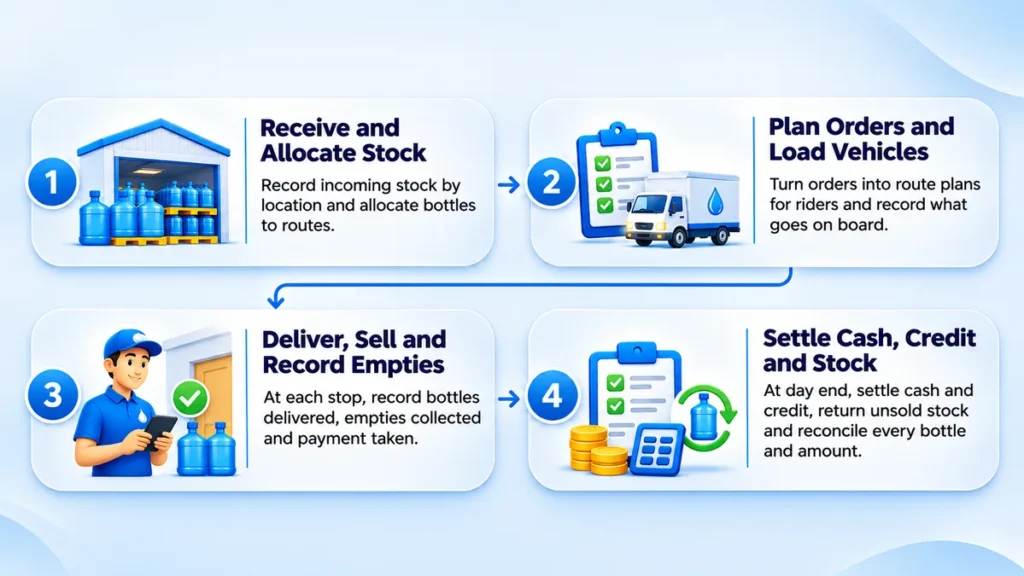
The flow has four steps, and each one hands a record to the next.
Step 1: Receive and Allocate Stock
Once stock arrives at a warehouse or branch, the system records it by location. Then managers allocate bottles to routes, so every unit has an owner.
Step 2: Plan Orders and Load Vehicles
After that, orders become a route plan for each rider. Before the van leaves, the team records what goes on board.
Step 3: Deliver, Sell and Record Empties
At each stop, the rider records bottles delivered, empties collected and payment taken. So the customer’s bottle balance updates at the door.
Step 4: Settle Cash, Credit and Stock
At day end, cash goes to the office and credit sales move to receivables. And unsold stock returns to the warehouse. Then managers check that every bottle and every amount has a place.
Worked Example: Closing One Delivery Route
The Tarsil marketing research team built this route close as an illustration. It assumes a GCC distributor using water-delivery software for 5-gallon bottles, 8 each.
| Record | Count | Check |
| Full bottles loaded | 100 | Counted before the van leaves |
| Delivered and sold | 84 | 60 paid now, while 24 go on credit |
| Unsold full bottles | 15 | Then back to the warehouse |
| Damaged full bottles | 1 | Recorded separately, not as a sale |
| Empties collected | 78 | Returnable bottles received |
| Customer-held change | +6 | 84 delivered minus 78 returned |
| Sales value | 672 | 84 × 8 |
| Cash collected | 480 | 60 × 8 |
| New credit | 192 | 24 × 8 |
| Cash handed to office | 470 | So a variance of 10 needs review |
Full stock balances: 100 = 84 + 15 + 1. However, cash is 10 short, and customers now hold 6 more bottles. So the gap needs investigation before anyone assigns blame. Deposits sit outside this example, since they need their own record.
See How Tarsil Works → Check how Tarsil records water deliveries, bottles and collections.
Operations and Inventory Features to Check (1 to 6)
Because demos can be staged, use the live demo checklist and ask each vendor to run these tests live with your own customers and prices.
| # | Feature | Live test |
| 1 | Customer records and price lists | Give two customers different rates, then check both invoices |
| 2 | Order management | Turn a phone order into a delivered quantity without duplicates |
| 3 | Branch and warehouse stock | Transfer stock once, then check the issue and the receipt |
| 4 | Route planning and rider app | Assign a route, then test weak signal and resync |
| 5 | Rider activity and live tracking | Show live rider locations, then the day’s visited stops |
| 6 | Bottle balances | Deliver 8, collect 6 empties, then confirm the customer holds 2 more |
Also, if a vendor needs a spreadsheet to pass a test, treat that feature as missing.
Sales and Finance Features in Bottled Water Distribution Software (7 to 12)
Next, test the money side, because small gaps here turn into lost cash.
| # | Feature | Live test |
| 7 | Deposit records | Record a deposit, then keep it apart from sales |
| 8 | Delivery confirmation | Record a partial delivery and a missed stop, then show the history |
| 9 | Billing and credit | Bill actual quantities, then post a partial payment |
| 10 | Payment reminders | Send a reminder, then check the customer’s open balance |
| 11 | Cash collection | Compare rider cash with recorded receipts, then flag a shortfall |
| 12 | Reports and permissions | Show sales, stock and aging, while hiding them from riders |
Then score each test 0, 1 or 2, so vendors compare on evidence.
Tracking Filled Bottles, Empty Returns and Deposits
Returnable bottles carry three separate records. First, you own the bottle as an asset. Second, the customer holds a balance of your bottles. Third, a deposit is money you may owe back, so it is not sales revenue.
Missing and damaged bottles also need their own entries. Otherwise, losses hide inside customer balances until a count fails. One-way packs are simpler, because nothing comes back.
Stock records also matter when quality comes into question. In August 2026, ARY News reported that Pakistan’s PCRWR declared 29 bottled and mineral water brands unsafe. The council had tested 230 samples from 20 cities. So a distributor should know where its stock sits: in which warehouse, van or customer site.
Managing Branches, Warehouses and Customer Types
Each branch needs its own stock count, while head office needs one combined view. A transfer should leave one site and arrive at another exactly once. Otherwise, in-transit stock gets counted twice. Also, give each team access to its own location only.
Customer types also add another layer. Households, for example, take small, frequent drops. But offices usually need agreed prices and monthly invoices. Meanwhile, wholesalers buy in bulk on price tiers and credit, so their accounts need closer watching.
Connecting Bottled Water Distribution Software With Billing and Collections
Order-to-cash starts with delivered quantity times price. Then the invoice, the payment and the remaining balance follow. Meanwhile, riders hand cash to the office, and the system matches it against receipts. Because deposits are liabilities, keep them out of revenue. Also, every approved adjustment needs a record of who made it.
Bottled Water Distribution Software vs Traditional ERP
Some distributors also run an ERP already. The two overlap in places, but their strengths differ.
| Need | Distribution software | Traditional ERP |
| Dispatch and routes | Built in | Often needs add-ons, so check the cost |
| Offline field work | Expected | Varies by system |
| Container balances | Expected | Varies by system |
| Accounting depth | Basic to moderate | Strong, because finance is its core |
| Manufacturing | Not covered | Strong |
| Quality control | Not covered | Often covered |
So a bottling plant may need an ERP for production, while its distribution arm runs on field software. In that case, ask how data moves between the two.
Before choosing a system, make sure you know the difference between water supply management software and water delivery software.
How to Calculate ROI on Bottled Water Distribution Software
Because every route differs, use your own numbers. The Tarsil marketing research team built this illustrative model.
- Avoided bottle losses: 20 bottles × 25 each = 500 a month.
- Admin time redeployed: 12 hours × 30 = 360 a month.
- Avoidable fuel and rework: 140 a month.
So the gross benefit is 1,000 a month. Against an assumed subscription of 300, the net benefit is 700. With a one-time setup of 1,400, payback takes 2 months. First-year ROI is (12,000 − 5,000) ÷ 5,000 = 140%.
However, faster collections improve cash flow, not profit. And saved hours count only if staff use them productively. Also, these are assumed inputs, not Tarsil prices or customer results.
How to Choose Bottled Water Distribution Software
Start with the 12 live tests, then check the rest:
- Access controls for riders, managers and finance staff.
- Full data export, in a usable format.
- Support hours, implementation fees and data migration.
Then pilot one branch or route before rolling out. Once the pilot starts, check opening bottle balances, test the exceptions and sign off on the results.
Where Tarsil Fits in Bottled Water Distribution
Tarsil runs customers, orders, deliveries, bottle balances, deposits, billing and collections in one system. Riders use an offline-capable app, while managers get route planning, live tracking and reports. It also supports multiple branches, warehouse stock transfers, user roles, payment reminders and an Arabic interface.
The distributor from our opening shared what changed. First, they started tracking bottles, cash leakage and rider activity. Then reminder messages improved their payment recovery. They gained clearer visibility of the business. Now the owner spends about an hour at day’s end, instead of watching operations all day.
This section does not claim Tarsil covers every test above, so run the same live demo on Tarsil.
Start Your Free Signup → Try Tarsil with your own customers and bottles.
FAQs About Bottled Water Distribution Software
What is bottled water distribution software?
It tracks stock, route sales, bottle returns, invoices and payments for water distributors. So owners see bottles and cash in one place.
How is distribution software different from water delivery software?
Delivery software mainly focuses on orders and drops, so it stops at the door. Distribution software also covers branch stock, transfers, container balances and settlement.
Can it manage returnable bottles and deposits?
Yes, good systems track customer-held bottles and deposits separately. Ask the vendor to show 8 delivered with 6 empties returned.
Can one system manage multiple branches?
It should show stock by branch, while also giving one combined view. Then test a transfer between two sites.
How do cash and credit sales reconcile?
Cash sales match rider handovers, while credit sales move to receivables. Each payment then reduces the open balance.
What should a distributor test before buying?
Run the 12 live tests with your own data. After that, pilot one branch before full rollout.