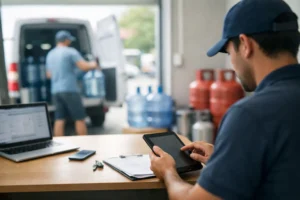

Cash on delivery management records, collects, checks, and reconciles cash payments for completed water deliveries. It gives a water delivery business a clear record of what the customer received, what the driver collected, and what the driver handed over at the end of the route.
This process matters when drivers handle bottles, deposits, returned containers, and customer balances during one shift. Without a consistent system, paper receipts and verbal updates can create gaps. A driver may deliver four bottles, collect payment for three, take back two empty containers, and agree to collect the remaining balance later. The business needs to record every part of that transaction so the office, driver, and customer have the same information.
From order assignment to payment collection
The process usually starts when the business assigns an order to a driver. The order record includes the customer name, delivery address, bottle quantity, expected payment, previous balance, and any container deposit. Drivers can review these details before they arrive, which reduces their dependence on handwritten route sheets.
At the delivery location, the driver confirms the quantity delivered and records any returned bottles or containers. The customer then pays the amount due in cash. The driver enters the amount collected in the delivery app or route accounting system and marks the order as paid, partly paid, or unpaid.
This distinction matters because a completed delivery does not always mean the customer paid the full amount. Some regular customers pay several invoices at once, while others carry an outstanding balance. Recording payment status separately from delivery status prevents staff from treating unpaid orders as settled transactions.
A digital receipt or payment confirmation also supports the record. Proof of delivery may include the customer’s signature, a photo, a delivery timestamp, or confirmation entered by the driver.
Bottles, deposits, and customer balances
Water delivery transactions often involve more than the price of the water. Returnable bottles and dispensers may require deposits, and customers may exchange empty containers during delivery. Cash on delivery management should connect payments with container movements.
For example, if a customer receives five full bottles but returns only four empty bottles, the account may include a charge or deposit for the missing container. If the driver records only the cash received, the office may not know why the payment differs from the usual amount.
A customer ledger, which is a record of account activity, keeps these details visible. It can show previous invoices, cash collections, credits, container deposits, and outstanding balances. When a customer questions an amount, the team can review the transaction history instead of relying on the driver’s memory.
Tarsil combines delivery tracking with operational automation. Connecting order, payment, and bottle records in one system reduces repeated data entry between dispatch teams and accounts staff.
Cash reconciliation after the route
When the route is complete, the driver returns the collected cash to the office or a designated cashier. The system calculates the expected cash total from all payments recorded during the shift. Staff then compare that figure with the physical cash handed over.
The reconciliation process should account for partial payments, customer credits, cancelled orders, and approved expenses. If the recorded collection total differs from the cash handover, the supervisor can review each delivery record.
A cash handover record creates accountability for both the driver and the person receiving the money. It should identify the route, collection date, driver, expected total, submitted total, and any difference. Both parties can confirm the handover, reducing uncertainty later.
Real time delivery tracking can provide useful context during this review. Dispatch staff can see which stops the driver completed and whether the driver entered payment information at the customer location or much later. This does not replace a cash count, but it can help managers investigate missing entries or unusual changes.
Managing exceptions
Not every water delivery follows the planned order. A customer may request an extra bottle, return fewer empty containers, pay an older invoice, or ask to settle later. Drivers need a controlled way to record these exceptions without deleting or overwriting the original order.
Permissions also matter. A driver may record a partial payment but should not erase a confirmed collection. A supervisor may need to approve a discount, credit, refund, or balance adjustment. Recording who made each change protects the transaction history.
Regular reconciliation can reveal repeated operational issues. Frequent cash shortages on one route may point to weak handover practices, while recurring unpaid balances may show that customer account limits need attention. If physical cash and recorded collections do not match, the business can keep the delivery open for review until staff check the difference and supporting receipt.