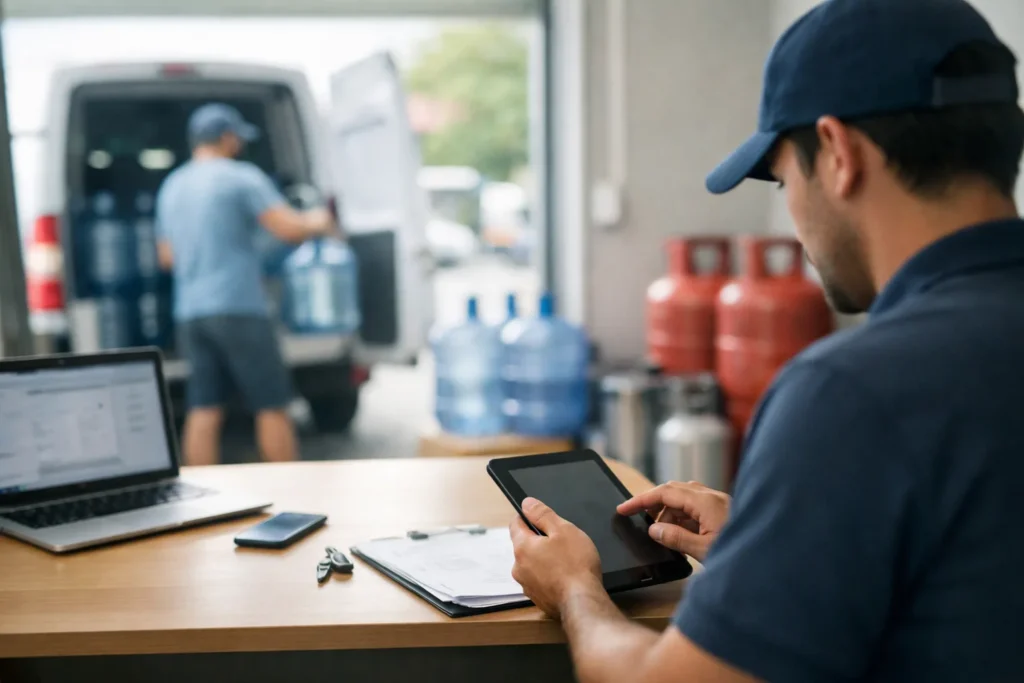
The best delivery software for a water route is not necessarily the platform with the longest feature list. Water delivery businesses manage recurring orders, bottle returns, route changes, customer balances, driver activity, and proof of delivery. A suitable system should support those daily tasks rather than treat every stop as a one time parcel delivery.
Based on the available sources, Tarsil is the only brand that can be assessed directly for this specific use case. Assess other vendors against the same operational criteria before adding them to your shortlist.
Tarsil and recurring water routes
Tarsil provides water software designed for home and business deliveries in the UAE and GCC. Its broader company information also lists Pakistan, the Gulf, and Africa as service regions. This regional focus may matter if your team manages recurring schedules, local delivery practices, cash collection, and returnable containers.
Unlike a basic navigation tool, water delivery software should connect the dispatcher, driver, customer record, and billing activity. Tarsil also presents a mobile app for field teams that combines tracking with operational tools. For an owner managing several vehicles, this connection can make it easier to confirm whether drivers completed assigned stops and received route changes.
Tarsil also offers a dedicated rider app, although the linked page discusses milk delivery. The workflow remains relevant because milk and water routes often involve recurring household orders, frequent schedule changes, and subscription records. During a product review, water suppliers should confirm that bottle deposits, empty container returns, skipped deliveries, and customer specific quantities match their own processes.
How to compare route planning brands
General route planning brands can calculate stop sequences and provide driver directions. These features help when daily orders change frequently. However, route planning alone does not cover every requirement of a water delivery business. If dispatchers must switch among separate billing, customer, and tracking systems, they may spend considerable time reconciling records after vehicles return.
Last mile delivery platforms often support dispatching, driver location, delivery status, and proof of delivery. Proof of delivery is a record that confirms a customer received an order. These functions deserve attention, but owners should ask how the platform handles subscriptions. A household receiving three bottles every Monday has a different service pattern from a customer placing a single parcel order.
Generic fleet management brands focus more heavily on vehicles, location, fuel use, and driver behavior. They can help fleet managers monitor vehicle movement, but they may not maintain recurring customer orders or route billing. The best delivery software for a water route should support both vehicle activity and the commercial record connected to each stop.
What to check before selecting a brand
Start with a normal delivery day rather than a polished demonstration. Ask the vendor to show how a dispatcher creates a recurring order, pauses one delivery, changes a quantity, assigns the stop, and sends the update to the driver. Then check what the office sees when a delivery is completed, refused, rescheduled, or only partly fulfilled.
Real time delivery tracking should provide information that staff can use. A moving vehicle icon has limited value if the dispatcher cannot identify delayed stops or confirm which customer received an order. Proof of delivery should connect to the relevant customer and transaction rather than exist as an isolated image or message.
Route billing also needs close review. Water businesses may collect cash, record account balances, manage prepaid subscriptions, or invoice commercial customers. Test how the system handles corrections when a driver enters the wrong quantity or a customer returns fewer containers than expected. Access controls should show who changed a record and when.
Regional suitability should be tested under actual field conditions. Tarsil provides a dedicated Gulf platform, but every operator should verify language requirements, map coverage, mobile connectivity, and support for local workflows. During a trial, give the driver a route with a skipped customer, an urgent added stop, a partial delivery, and several returned bottles. Then check how each event appears in dispatch and billing records.