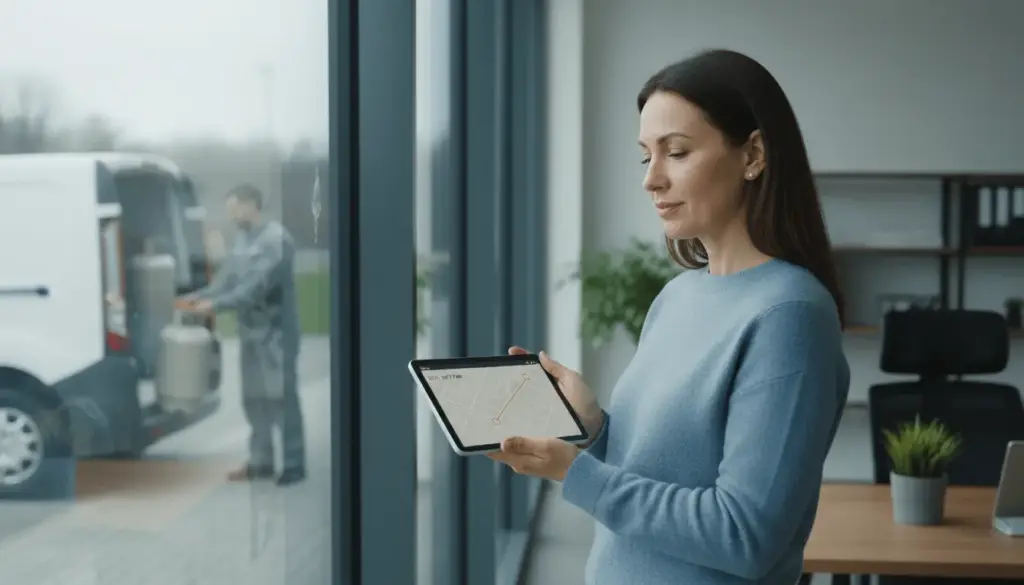
When drivers weave through traffic with a truck full of cylinders, customers won’t accept a vague “sometime today.” They want a window that holds as routes shift. A real-time ETA needs three parts: live phone GPS, a routing engine that recalculates with conditions, and customer messages with the updated window. Without that trio, an ETA is a guess, not a defensible promise.
What a real time ETA really requires in LPG operations
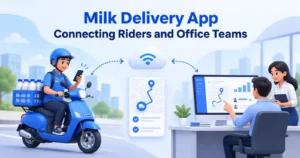
Cylinder work is messier than parcel work. Each stop can mean swapping empties, collecting deposits, scanning barcodes, or reading meters. An ETA engine must track more than distance and traffic; it must follow every proof-of-delivery event and typical task times. A solid setup pings location every few seconds, folds it into optimization that can add late orders or skip cancelled stops, then pushes a time window to dispatcher and customer after each scan or signature.
It must ride out weak coverage, caching events until the phone reconnects to keep the timeline intact. Inventory integration matters so the system can see if the driver carries the required size or if a depot detour will derail the plan. Dispatcher visibility is only step one. The customer needs a short, clear message by SMS or portal within minutes, not hours.
How current vendors describe ETA features
Several suppliers in fuel and LPG advertise pieces of this puzzle. ADD Systems markets Raven with real-time fleet visibility, a customer web portal, QR checks, and electronic proof of delivery. Those pieces lay groundwork for live ETAs, yet the literature emphasizes status over an arrival promise.
Vertrax promotes a cloud ERP and logistics suite with optimization and live insight, focusing on visibility rather than a named window. Trovan’s EX Cylinder Tracking System stresses RFID across plants, warehouses, and dealers, giving stock control but not last‑mile timing.
Cylinder trackers such as LPG Soft highlight movement control, inventory accuracy, and audit support—valuable to limit stock loss and keep runs on schedule, but centered on compliance more than customer timing.
For a restaurant or pharmacy manager the split matters: fleet tracking sits at the doorstep while plant-level RFID sits upstream. The sweet spot is where both meet so the ETA reflects the road and what is on the truck.
What to verify in demos before you trust any ETA
During a trial, ask the vendor to start a driver late, force a detour, then add a rush stop. Watch the dispatcher screen and the customer message. Do both refresh within a minute? Check that the engine uses live GPS, not historic averages, and that it recalculates after each proof of delivery.
Confirm that SMS templates are program controlled so agents cannot forget to send, and that any portal shows the same time.Inspect the route builder for priority rules, multi‑drop handling, and zone windows.
Offline behavior is critical: the rider app should store breadcrumb trails and fire an updated ETA as soon as the phone reconnects. Demand an audit log linking GPS, driver notes, and every cylinder scan so you can explain any miss.
Where Tarsil fits if you need ETAs you can act on
We are Tarsil Systems, and our cloud ERP with a rider mobile app unites live GPS, TrackBoard trails, signatures, and program controlled SMS. Dispatch sees movement in real time, customers stay informed, and your accounts and inventory update.
The same stack powers our LPG software, which ties cylinder counts to customer ledgers so the promised arrival reflects what is on the vehicle, not what the manifest listed.
Practical steps to adopt real time ETAs without breaking service
Start small: one zone, two riders. Measure the gap between planned and actual times. Use app timestamps to spot repeat delays and adjust the sequence. Keep messages simple: fleets send an SMS at start, another when three stops away, and one on arrival with a signature link. Pull a weekly or monthly report pairing each window with arrival so you can coach outliers.
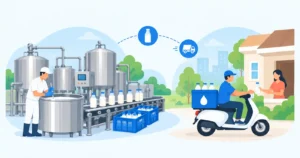
If you also run water or milk delivery routes, reuse the playbook so drivers follow one habit set. When consolidating systems, ensure your cylinder tracker pushes route and stop data straight to dispatch to avoid double entry. A proof of concept that covers plant loading, a mid‑route swap, and a customer return will show if your published times match the driver’s day. Platforms like Raven may share times on a portal; others keep them in SMS while you polish exceptions.
If you want TrackBoard trails and customer alerts on a dashboard on your phone, start with Tarsil and expand to swaps, deposits, and cash collection later. Getting the ETA right depends less on code than on consistent driver habits paired with live recalculation as the route shifts.