Daily LPG cylinder reconciliation answers one question: where did every cylinder and payment go today? On 15 November 2026, Dubai’s petroleum regulatory committee reported more than 19,252 counterfeit gas cylinders seized since June 2022. But inside your yard, the test is simpler. Can you prove which cylinders left, which came back, and what customers paid?
This guide shows how to reconcile filled cylinders, empties, and payments before the end of each day. It covers the records you need, six steps, a worked closing, and what to do when numbers differ. Then it shows where Tarsil fits.
The advice rests on desk research into published reports and regulator announcements, plus the Tarsil team’s workflow analysis. Still, the worked figures are calculations, not customer data.
What Is Daily LPG Cylinder Reconciliation?
Daily LPG cylinder reconciliation is the end-of-day check that filled stock, empties, and payments each match the day’s records.
Because each of the three must close on its own, a balanced filled count says nothing about empties or cash. So a finished delivery round is not the same as a reconciled one.
Why a Daily LPG Close Matters: Three Real-World Signals
Three recent reports show how quickly cylinder control can slip.
The same 15 November report also says that inspection campaigns found more than 275 sites storing or distributing counterfeit cylinders. So a gate check lets a distributor catch a foreign or counterfeit shell before it enters saleable stock.
But prices can move just as fast. Reuters reported that a 12 kg cylinder in Pakistan rose from PKR 4,500 to 7,000 within days. That followed border closures with Iran on 17 October 2026. So a daily close should check each invoice against that day’s approved rate.
Meanwhile, Kenya’s regulator EPRA issued new trader rules in February 2026. The Star reported that they require a record per cylinder sold: brand, serial number, net weight, price, and any deposit.
What Records Does LPG Cylinder Reconciliation Need?
Start with records your team already creates, since each one answers a different question.
| Record | What it proves | Who owns it |
|---|---|---|
| Warehouse issue slip | What left the yard, by cylinder size | Store keeper |
| Vehicle loading sheet | What the rider took | Rider and supervisor |
| Delivery and collection record | Filled deliveries and empties collected at each stop | Rider |
| Warehouse receiving count | What came back, filled and empty | Store keeper |
| Invoices | What was billed, and on what terms | Accounts |
| Cash and digital receipts | What customers actually paid | Accounts |
| Sign-off | Who accepted the close | Supervisor |
Keep quantities by cylinder size, because sizes never offset each other.
How to Reconcile LPG Cylinders From Loading to Delivery
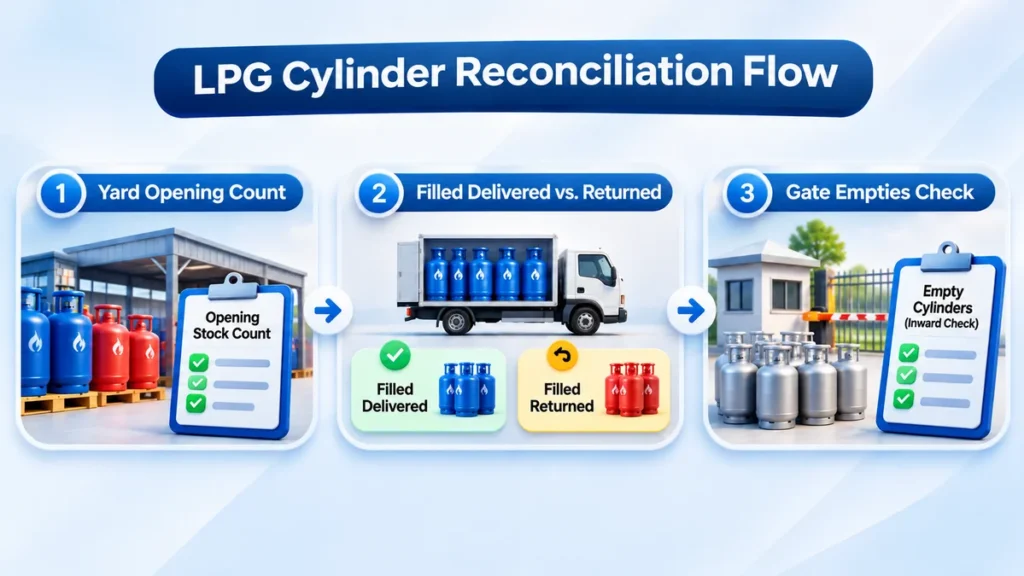
Step 1: Verify Opening LPG Stock and Vehicle Loads
Count the yard against last night’s closing figure before the first truck leaves. Then log each loaded cylinder as a warehouse-to-vehicle transfer, because a sale entry would hide whatever comes back unsold.
Step 2: Match Filled LPG Delivered and Returned
Before closing, filled cylinders loaded must equal filled delivered plus filled returned. For example, 76 delivered and 24 returned account for 100 loaded. So any gap points to a missing stop record or a miscount.
Step 3: Compare LPG Empties Collected With Warehouse Receipts
Count every returning cylinder at the gate before the rider parks. Check seals, valves, and brand markings while counting. Afterwards, compare the rider’s collection records with the warehouse receiving count. Because exchange terms vary, a gap between delivered and collected is not automatically a shortage.
How to Complete LPG Cylinder Reconciliation at Day End
Step 4: Log Damaged, Missing and Disputed LPG Stock
Move damaged, foreign-branded, or doubtful cylinders into a separate quarantine count, since they must not enter saleable stock. Then record missing and disputed cylinders with a reason, so the difference stays visible. Never hide a gap by shifting numbers between sizes, because each size closes on its own.
Step 5: Verify LPG Cash, Credit and Digital Payments
Reconcile three money lines separately: cash handed over, verified digital receipts, and credit invoices. Because rates can change in days, check each invoice against that day’s approved rate. Also keep refundable deposits out of sales collections.
Step 6: Review Exceptions and Approve the LPG Closing
Before anyone signs, give every open exception an owner, evidence to collect, and a resolution date. Afterwards, the rider and supervisor both sign, and the note lists what stays open. A documented open exception is a valid close, but a forced zero hides the problem.
LPG Cylinder Reconciliation Example: A Complete Delivery Round
This worked example is the Tarsil team’s calculation, not customer data. It also assumes one cylinder size, one price, and no other stock movements.
| Check | Record | Quantity |
|---|---|---|
| Filled | Dispatched | 100 |
| Filled | Delivered | 76 |
| Filled | Returned unsold | 24 |
| Filled | Unexplained difference | 0 |
| Empties | Collected from customers | 59 |
| Empties | Received at warehouse | 57 |
| Empties | Open difference | 2 |
| Money | 76 deliveries billed at 100 each | 7,600 |
| Money | 26 credit deliveries | 2,600 |
| Money | 50 paid deliveries | 5,000 |
| Money | Cash handed over plus digital receipts | 4,900 + 100 |
| Money | Unreconciled difference | 0 |
The filled count closes, because 76 plus 24 equals 100. The money closes too, because cash and digital receipts cover all 50 paid deliveries. Still, the 26 credit deliveries stay as receivables.
But the day is still not closed, because two collected empties never reached the warehouse. Assign an owner, log the evidence, and record the outcome before you sign. Besides, 76 delivered against 59 collected is not automatically a 17-cylinder shortage. Exchange terms and earlier customer balances decide how many empties were due.
How to Investigate LPG Stock and Cash Differences
Investigate before you adjust. Recount the stock, check the handover times, then speak to the people involved.
| Difference | Likely causes | Evidence to check | Action |
|---|---|---|---|
| Empties collected exceed received | Timing, miscount, unconfirmed handover | Collection record, gate count, receipt | Recount, then log owner and date |
| Filled cylinders unaccounted for | Missing stop record, wrong size | Loading sheet, delivery record | Correct from the source records |
| Cash short or over | Wrong rate, unrecorded credit, entry error | Invoice, receipt, rate sheet | Trace to the invoice |
| Cylinder still missing | Verified loss | Signed recount, rider statement | Approve the adjustment with a named reviewer |
Never edit an original record to force a balance, because that erases the evidence. Instead, add a dated correction with a reason. Four mistakes also make every difference harder to trace:
- Treating loads as sales, because that hides what comes back unsold.
- Counting bank receipts as physical cash, since the rider never handled them.
- Mixing refundable deposits with revenue, because the money may go back.
- Posting adjustments with no explanation, so nobody can review them.
Daily Closing for LPG Distributors in the UAE and GCC
Dubai’s Roads and Transport Authority reported 4,322 inspections of household gas distribution between 2023 and mid-2025. Those produced 1,098 violations and about 170 impounded vehicles. The RTA said its oversight aims to find counterfeit or untraceable cylinders. So daily records make each cylinder easier to trace.
Operations with several vehicles or branches should close each vehicle first, then combine totals. Rules differ across emirates and GCC countries, so confirm local requirements with your compliance adviser.
Manual vs. Digital LPG Day-End Closing
Paper sheets work for one yard and a few trucks. But beyond that, every extra vehicle adds another set of numbers to match by hand.
| Area | Manual closing | Digital closing |
|---|---|---|
| Traceability | Spread across sheets and notebooks | Each entry links to a record |
| Shared data | Warehouse and accounts see different copies | One record for every team |
| Review steps | Done at day’s end from memory | Reviewed from logged entries |
| Audit history | Overwritten or lost | Can keep a name and time |
| Entry risk | Retyped at each stage | Entered once, if the team logs it |
Still, digital records are only as good as the entries behind them.
Where Tarsil Fits Into LPG Cylinder Reconciliation
Tarsil brings customers, orders, deliveries, cylinders, deposits, billing, payments and collections into one system. Riders log delivered and collected quantities from the driver app at each stop. So the warehouse count has a recorded figure to check against. Its finance modules also include aging and credit reports, plus the main financial reports. Still, your supervisor reviews every exception and signs the close.
See How Tarsil Works → See how stock, returns and cash records fit together.
LPG Cylinder Reconciliation Checklist
Run this checklist at day end:
- Before the first truck leaves, verify opening stock and each vehicle load by size.
- Then match filled, delivered, and returned to filled loads.
- Afterwards, compare empties collected with the warehouse receiving count.
- While counting, quarantine damaged or doubtful cylinders and log disputes.
- Finally, check cash, digital receipts, and credit invoices separately.
- Since every gap needs an owner, add evidence and a date to each open exception.
Book Your Free Demo Today → See how this would work for your own LPG delivery business.
FAQs About LPG Cylinder Reconciliation
What is daily LPG cylinder reconciliation?
It is the end-of-day check that filled stock, empties, and payments each match the day’s records. Each one must close on its own.
How do LPG distributors reconcile filled and empty cylinders?
Match filled loaded to filled delivered plus returned. Then compare empties collected with the warehouse count, because the two checks are independent.
How do you calculate an LPG cylinder stock difference?
Subtract the received count from the recorded count for each size. For example, 59 collected minus 57 received leaves 2 to investigate.
What should a rider’s daily LPG settlement include?
Filled, delivered and returned, empties collected, cash handed over, digital receipts and credit invoices. Both the rider and supervisor sign afterwards.
How do LPG distributors reconcile cash and credit deliveries?
Split paid deliveries from credit ones. Then match cash and digital receipts to paid invoices, and keep credit invoices as receivables.
What happens when empty returns do not match warehouse records?
Recount first, then check handover times and collection records. Log an owner and evidence, but correct only verified quantities.