Anyone researching how to start a milk delivery business usually starts exactly where Sipho did. Initially, he’d been dropping off milk for a few neighbors in Johannesburg for months. He picked it up from a cooperative on his way home from work. Friends kept asking if he could supply them too.
So Sipho had to turn a favor into a real business. That meant real numbers: startup cost, routes that didn’t waste his evenings, and a price that still left a margin.
This guide follows that same path, step by step. It covers choosing a business model, sourcing milk, and getting licensed. Then it moves into startup costs, routes, and pricing per liter.
The later sections cover the billing problem that catches most new owners by month two. They end with a 30-day plan for your first month. Each major number comes with a worked example, so you can check it against your own city.
Is a Milk Delivery Business Profitable?
When researching how to start a milk delivery business, profitability is usually the first question. However, profit comes from recurring volume and tight routes, not from any single sale.
Why Recurring Customers Change the Economics
A one-off sale barely covers the cost of the trip. Instead, a subscriber who orders daily turns one stop into dozens of sales over a month. That’s revenue on a route you already planned.
What Actually Determines Profitability
Three things decide the outcome: route volume, spoilage and skipped stops, and whether your price covers delivery cost. Get any one of those wrong and the other two can’t save the route.
Choosing a Milk Delivery Business Model
| Model | How It Works | Best Fit |
| Traditional door-to-door | Rider sells whatever’s loaded, stop by stop | Dense, established neighborhoods |
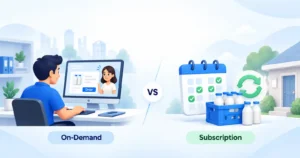
| Subscription | Customer commits to a standing daily or weekly order | Predictable, recurring revenue |
| On-demand | Customer orders once, with no commitment | New customers trying you out |
| Hybrid | Runs subscription and on-demand on the same route | Most dairies, once they grow |
Most new operators start with one model. Then they add the second once the first route is stable.
Sourcing Milk and Packaging for Your Milk Delivery Business

Finding Reliable Suppliers
Many small dairy markets run on fragmented supply. In Pakistan, the Asian Development Bank reports something telling about that fragmentation. Roughly 80% of the dairy sector consists of small-scale farmers with one to three milking animals (ADB, 2025). So a single supplier rarely covers your full route alone, even early on.
Choosing Bottles, Crates or Sachets
Returnable glass bottles and crates cost more upfront but recover value over years. On the other hand, sachets or disposable bottles lower your starting cost. Still, they raise your per-unit packaging spend every single day.
Licensing Your Milk Delivery Business: Safety Rules Nobody Enjoys
Food-handling registration and milk-safety rules vary by country. So check your local regulator before you deliver a single liter. Cold storage matters too, since a missed detail here costs you more than a fine.
Guidance varies by jurisdiction, but keeping milk consistently refrigerated is standard practice everywhere perishable dairy moves through a supply chain. Still, a license on paper means nothing if your cold chain breaks at the first stop.
Milk Delivery Startup Costs: What You Actually Need to Budget For
One-Time Startup Costs
Budget for a cooler box or small fridge, plus your first batch of bottles or crates. Add a bike or vehicle, and whatever registration fees your region requires.
The Crate and Bottle Deposit Float
Returnable packaging needs a float. You’ll have crates and bottles sitting at customer doorsteps before they come back. So budget for that stock separately from daily cash.
Ongoing Running Costs and Working Capital
Fuel, replacement packaging, and supplier payments all recur. Suppliers often expect daily or weekly payment, while customers pay monthly. So you need working capital to cover that gap.
Setting Up Your First Milk Delivery Routes
| Factor | Dense Route (short stop spacing) | Scattered Route (long stop spacing) |
| Stops per hour | Higher | Lower |
| Fuel cost per stop | Lower | Higher |
| Driver hours per stop | Lower | Higher |
| Cost per successful delivery | Lower | Higher |
Grouping Customers by Zone and Time Window
Group new customers by street, not by who called first. A route built around geography beats one built around your sign-up order every time.
Calculating Delivery Cost per Stop
Divide your route’s total cost, fuel and driver time included, by the number of stops it actually completes. So that number tells you whether a new customer is worth adding to an existing route.
Pricing Your Milk Delivery Business
Calculating Your True Cost per Liter
| Line (illustrative example) | Per Liter |
| Selling price | $1.50 |
| Milk procurement | -$1.00 |
| Packaging and handling | -$0.10 |
| Delivery expense | -$0.15 |
| Other variable costs | -$0.05 |
| Contribution per liter | $0.20 |
These figures are hypothetical, not a market average. Instead, run your own numbers in place of these before setting a real price.
Setting a Price That Still Leaves a Margin
Your price has to cover procurement, packaging, and delivery, with something left over. Otherwise, every extra customer just adds more work for the same thin result.
Managing Daily Orders in Your Milk Delivery Business
Customers skip days, add extra orders, and occasionally miss a delivery entirely. Still, each change hits the same record a rider works from each morning. Otherwise, your billing and your actual deliveries drift apart within weeks. Then every month-end becomes a small argument instead of a quick, correct number.
A paper notebook can hold this for a handful of customers. Past that, scaling requires evaluating dedicated dairy industry software; otherwise, changes called in one morning get forgotten by evening
The Month-End Billing Problem in a Milk Delivery Business
Monthly bills rarely match what a customer expects, because skips and extra orders both change the final number. Here’s a simple worked example of how that plays out over 30 days.
| Line (illustrative example) | Value |
| Scheduled | 30 liters |
| Skipped | -3 liters |
| Extra orders | +2 liters |
| Billable accepted quantity | 29 liters |
| Unit price | $1.50 |
| Monthly invoice | $43.50 |
Without a daily record behind that final number, a customer has no way to check it, and neither do you. That gap is where trust breaks down, usually right as a new customer is deciding whether to stay. Implementing dedicated milk delivery software for daily routes and monthly billing eliminates revenue leakage and subscriber disputes.
Common Mistakes to Avoid When Starting a Milk Delivery Business
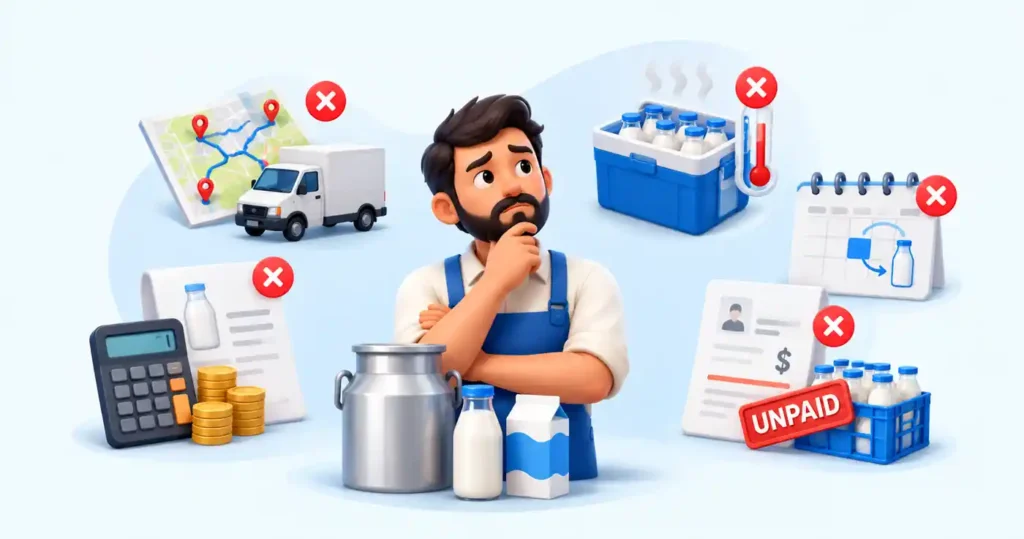
- Starting with too large a delivery area: A scattered first route costs more per stop than it earns.
- Setting prices without including delivery cost: A price based only on procurement cost quietly loses money on every stop.
- Ignoring spoilage and cold-chain basics: One warm delivery can cost you a customer for good.
- Not recording subscription changes: Skips and extra orders you don’t write down become disputes at month’s end.
- Letting unpaid balances pile up: A small gap per customer adds up fast once you’re running several routes.
Where Tarsil Fits Into Your Milk Delivery Business
Tarsil won’t choose your business model or set your price for you. But once you’re running real routes and subscriptions, that record matters. It keeps every customer’s schedule, skip, extra order, and payment in one place. So a rider sees the correct route each morning. Then billing matches what was actually delivered, not just what was scheduled. Tarsil already supports dairies like this across 77+ cities.
See how Tarsil keeps routes, subscriptions, and billing on one record.
Your First 30 Days Running a Milk Delivery Business
Spend week one settling your model, your supplier, and your first delivery area. In week two, set your pricing and sort out licensing before you deliver anything. Then run a small pilot route in week three, close to home. Get your first real customers from people who already trust you.
Then by week four, review your actual numbers against what you planned. Fix whatever the real data shows, not what the plan assumed. That’s the whole first month, in order, and it leaves you with a working route instead of a guess.
The Bottom Line
Starting a milk delivery business comes down to a handful of honest numbers. What it costs you, what a route earns, and what price covers both. Sipho didn’t need a perfect plan to start. Instead, he needed his own real costs, one working route, and a record that didn’t lose track of either.
Once your routes are running, route density keeps deciding your margin every single day, and once you’re past a handful of customers, billing by hand stops scaling fast. That’s really the whole answer to how to start a milk delivery business that still works a year from now.
Ready to run your new milk delivery business on one system from day one?
Start Your 14-Day Free Trial → No credit card required. Most dairies go live within three to four minutes of signing up.
FAQs: How to Start a Milk Delivery Business
How much money do I need to start a milk delivery business?
It depends on your market and scale. Budget for a cooler or fridge, first packaging stock, a vehicle, and local registration fees before your first delivery.
Is a milk delivery business profitable?
Yes, but margins per liter are thin. Profit comes from recurring volume on tight routes, not from any single sale.
How do I find customers for a milk delivery business?
Start with people who already know you, then build outward by street. A dense first route earns more per stop than a scattered one.
What is the best milk delivery business model?
Most operators start with one model, subscription or on-demand, then add the other once that first route is stable.
How do I calculate the profit margin on milk delivery?
Subtract procurement, packaging, and delivery costs from your selling price. What remains is your contribution margin per liter.
How do milk delivery businesses manage monthly billing?
By keeping a daily record of what was scheduled, skipped, and added. That record is what makes the final number match what actually happened.