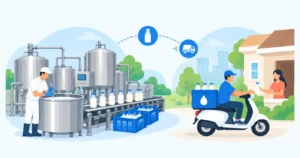
Milk delivery models come down to two basic shapes. Farhan ran both of them badly for two years before he understood why. His dairy in Dubai delivered to standing subscribers every morning. It also took same-day orders through WhatsApp whenever a household ran short. Same riders, same crates, same depot. Still, there was no real separation between the two.
Then a spot-order surge during one busy week threw his subscription routes off for days. So he finally asked what was actually going wrong. The answer wasn’t his riders or his software. Instead, it was that he’d never decided how the two milk delivery models should work together.
Explore the full category first: Milk Delivery Software: The Complete Guide to Daily Routes and Monthly Billing
What Are the Two Main Milk Delivery Models?
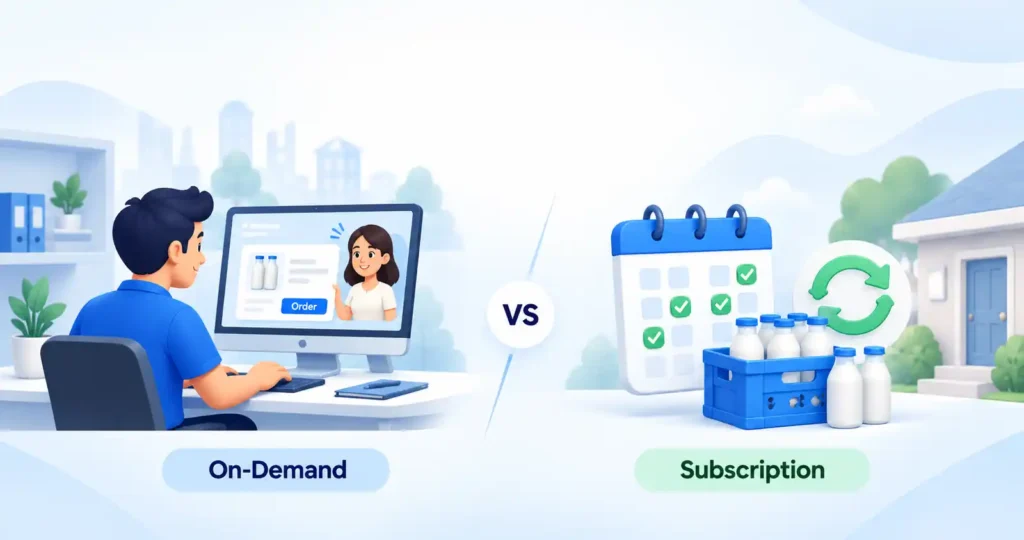
Dairies run on two milk delivery models. Subscription means a customer commits to a standing daily or weekly order. On-demand means a customer orders once, with no commitment to repeat. Most dairies end up running some mix of both, whether they planned to or not.
How Subscription-Based Milk Delivery Works
A subscriber sets a quantity and a schedule once. Then the order repeats until they change it. So the rider already knows what to deliver before the route starts. Billing runs monthly against an agreed rate, not order by order.
How On-Demand Milk Delivery Works
An on-demand customer places a single order for one delivery. That usually happens through a call, an app, or WhatsApp. Nothing repeats unless they order again. Instead, payment is typically settled at the door, not on a monthly cycle.
On-Demand vs. Subscription Milk Delivery: Key Differences
The two milk delivery models pull against each other on almost every operational measure that matters to a dairy owner.
| Factor | Subscription Milk Delivery | On-Demand Milk Delivery |
|---|---|---|
| Delivery cost per order | Lower, routes are fixed | Higher, often a detour |
| Revenue predictability | High, known in advance | Low, varies day to day |
| Customer acquisition | Slower, needs commitment | Faster, no commitment needed |
| Flexibility for the customer | Low, set schedule | High, order anytime |
| Route efficiency | Strong, planned in advance | Weak, disrupts the plan |
| Billing complexity | Simple, one monthly cycle | Simple per order, messy at scale |
Neither model wins on every row, which is why most dairies end up needing both.
Where the Subscription Milk Delivery Model Wins
Subscription orders win when a dairy needs to know tomorrow’s numbers today.
Route Density Makes Subscription Orders Cheaper to Deliver
A subscriber’s address doesn’t move, so a rider’s stop sequence barely changes day to day. That stability is what keeps the cost of each subscription delivery low. Adding a subscriber on an existing street costs almost nothing extra. But adding one three streets away does.
Recurring Subscription Orders Make Cash Flow More Predictable
Once Farhan separated subscribers from walk-in orders, he could forecast next month’s volume within a few liters. So a dairy running mostly subscriptions knows its demand before the month even starts. That certainty shapes everything from procurement to staffing.
Where the On-Demand Milk Delivery Model Wins
On-demand orders solve a problem subscriptions can’t: getting a new customer to try you at all.
On-Demand Orders Let New Customers Try Your Dairy
Nobody commits to a daily subscription from a brand they’ve never bought from. Instead, a single on-demand order lets a household test your milk and your service first. Subscriptions tend to follow, not lead.
Flexible Ordering Serves Customers Who Don’t Want Subscriptions
Some households travel often, or simply prefer to order only when they need to. Still, refusing on-demand orders doesn’t convert those customers into subscribers. It just sends them to a competitor who will take the order.
Which Milk Delivery Model Is More Profitable?
Neither milk delivery model is more profitable in the abstract. Instead, the answer depends on numbers specific to your own routes and customers.
Compare Delivery Costs and Profit per Order
Work out your actual cost per stop for a subscription route. Then do the same for a typical on-demand detour. The gap, not a generic rule, tells you the real story. It shows which model carries your margin and which one you’re subsidizing.
Calculate Customer Lifetime Value and Retention
A subscriber who stays two years is worth far more than one on-demand sale. That holds even at a thinner delivered margin. So track how many on-demand customers convert to a subscription within three months. That conversion rate turns a low-margin acquisition channel into a profitable one.
Why Dairies Struggle to Run Both Milk Delivery Models
Most dairies don’t choose to run both milk delivery models badly. Instead, they just never separate the two until something breaks.
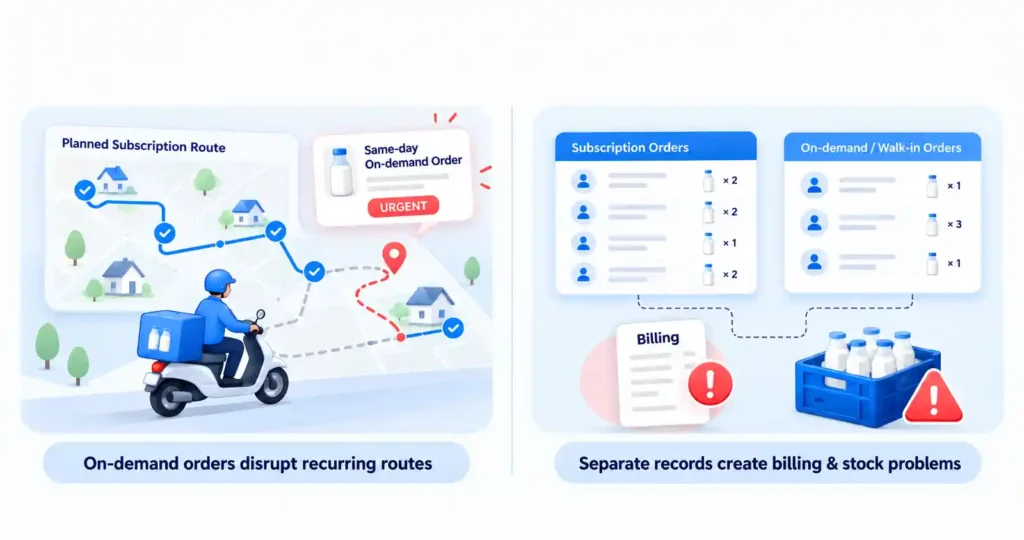
One-Off On-Demand Orders Disrupt Recurring Delivery Routes
A rider finishing a planned subscription route has no room for a same-day order landing mid-morning. Operational research on last-mile delivery backs this up. Scheduled deliveries arrive in a concerted, predictable pattern. On-demand orders arrive dynamically and put real-time pressure on a route (Boysen, Fedtke & Schwerdfeger, OR Spectrum, 2021). Treating both as one route plan is what breaks the schedule.
Separate Milk Delivery Records Create Billing and Stock Problems
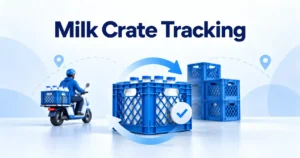
A subscription order and a walk-in order often get logged in different places, by habit more than design. Without proper milk crate tracking, that split makes it hard to know exactly which crates went where. So it gets harder still to bill accurately at month’s end.
How to Run a Hybrid Milk Delivery Model Successfully
Once a dairy stops treating on-demand orders as interruptions, a hybrid milk delivery model works.
Build Routes Around Recurring Subscriptions
Plan each route around its fixed subscriber stops first. Instead, treat that sequence as the backbone, not something to renegotiate every time a new order comes in.
Set Order Cutoff Times for On-Demand Deliveries
Give on-demand customers a clear cutoff, say two hours before a route leaves. Orders placed after that go on the next run. Then a rider can slot same-day orders into gaps that already exist, instead of detouring mid-route.
Keep Milk Delivery Billing and Inventory Connected
Every order, subscription, or one-off should hit the same account ledger and the same stock count. Otherwise, a dairy ends up reconciling two separate systems by hand every month.
How Milk Delivery Software Supports Both Models
Once it can run both milk delivery models in one system, milk delivery software earns its place.
Manage Recurring and One-Time Orders in One System
A subscription schedule and a same-day order should live on one customer record, not separate ones. That’s what lets a rider see a single, correctly sequenced route each morning, whatever mix of orders it contains.
Track Milk Deliveries, Stock and Customer Payments
Office teams need one view of what left the depot and what reached a customer. Using a milk delivery app connects riders directly to the back office, ensuring that view also covers what’s still owed across both order types.
Choosing Milk Delivery Models Across Pakistan, the GCC and Africa
In Dubai, Farhan’s dairy sits inside dense apartment clusters. So his subscription routes carry most of the daily volume. On-demand orders fill the gaps.
GCC dairies generally see the same pattern repeat in Riyadh and Doha, where standing household orders dominate denser neighborhoods. Meanwhile, operators in Nairobi and Accra often see the opposite mix. On-demand orders carry more volume early on.
Then subscriptions grow once route density builds up enough to support them. Pakistani cities like Lahore tend to sit somewhere between the two, depending on the neighborhood. Still, no single mix is correct everywhere. The two milk delivery models simply need to match local order patterns, not a template.
How Tarsil Helps Manage Milk Delivery Models
Tarsil runs subscription and on-demand orders on the same customer record, route plan, and billing cycle. So a rider sees one sequenced list each morning, whatever mix of order types built it. The office sees every order’s status, payment and stock movement in one place, no matter which model it came from. Dairies running both milk delivery models through Tarsil report 12% more deliveries per day on the same fleet. Most of that comes from fitting on-demand stops into routes that were already running efficiently.
See how one system runs both order types without splitting your records.
See How Tarsil Works → Walk through recurring billing, one-off orders, and unified routing in one system.
Which Milk Delivery Model Should Your Business Choose?
Most dairies don’t need to pick one milk delivery model over the other. Farhan didn’t drop either one. Instead, he just stopped running them as a single undifferentiated route.
Subscriptions should carry your predictable volume and your cash flow. On-demand orders should stay open as the door new customers walk through first. The two feed each other once they’re managed deliberately instead of by accident.
If daily quantity changes, skips, and rate adjustments across both models still feel like separate headaches, that’s worth solving next.
Ready to run both milk delivery models without the chaos?
Book a Free Demo → Bring your actual order mix. We’ll show you how it runs as one system.
FAQs: Milk Delivery Models Questions
What is the difference between on-demand and subscription milk delivery?
Subscription delivery repeats on a set schedule until a customer changes it. On-demand delivery is a single order with no commitment to repeat.
Which milk delivery model is more profitable?
It depends on your actual cost per stop and your subscriber retention rate, not a fixed rule. Compare both before deciding where your margin sits.
Can a dairy business offer both subscription and on-demand delivery?
Yes, and most do, often without realizing it. It works best once routes, billing, and stock records treat both order types as one connected system.
How does milk delivery software help manage both models?
It keeps subscriptions and one-off orders on one customer record and one route plan. Both share a single billing cycle, instead of two systems to reconcile by hand.
Does a hybrid milk delivery model work for a small dairy?
Yes. Even a handful of routes benefit from separating subscription stops from on-demand ones. That disruption doesn’t depend on fleet size.
How do subscription and on-demand milk delivery differ across Pakistan, the GCC and Africa?
The split shifts with route density more than geography. Dense GCC neighborhoods lean subscription-heavy, while many African markets see on-demand volume lead until density builds.