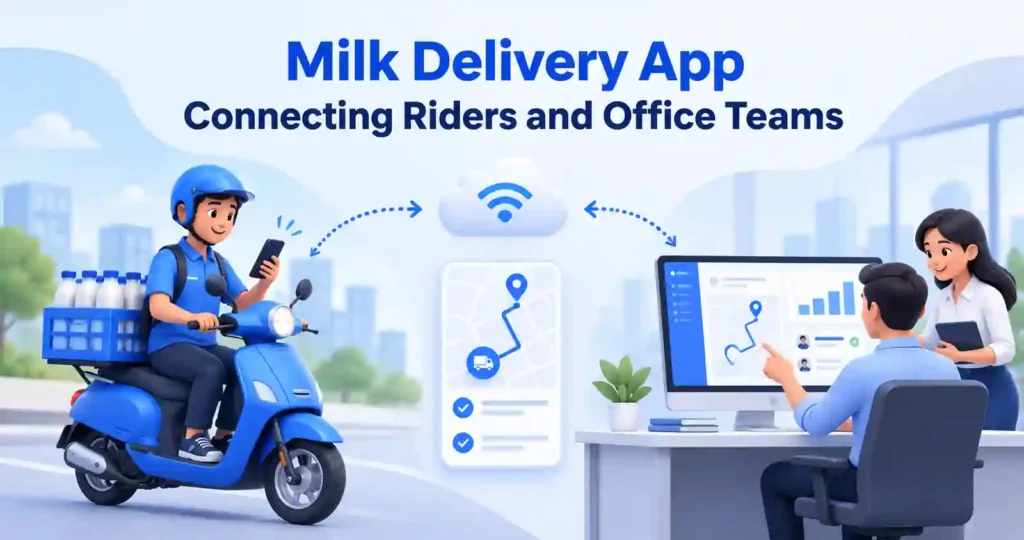
A milk delivery app exists to keep two groups working off the same information. One is the rider on the route. The other is the office team back at the depot. Danish runs nine routes out of his dairy in Karachi. Until recently, his riders and his office worked from two different versions of the same day.
The gap wasn’t theft. Instead, it was distance. Nothing connected what a rider did on the route to what the office actually saw.
What Is a Milk Delivery App?
A milk delivery app is the software a dairy’s own riders use to run their route. It records what’s delivered, what’s paid, and what’s returned at each stop, then shares that record with the office. This article covers that rider-facing tool, sometimes called a milk delivery driver app, dairy rider app, or milkman app. That’s different from a customer-ordering app carrying the same generic name.
So the confusion is understandable. Search the term, and you’ll find apps built for households ordering milk, not for the rider delivering it. A dairy running standing orders needs the rider-side tool first to feed accurate data back into their core milk delivery software. That’s where the daily numbers actually get created
Why Riders and Office Teams Drift Apart Without a Milk Delivery App
A delivery leaves a trail everywhere else in the business. So riders and office teams drift out of sync at exactly the one point nothing else catches.
What the Rider Remembers vs. What the Office Records
A rider finishes eighty stops a day. So each one is a quick exchange of crates, cash, and a few words at the gate. He remembers most of it. Still, “most” is the problem. By evening, the details from stop twelve blur into the details from stop forty.
Cash Collected at the Gate Is Easy for a Rider to Lose Track Of
Cash changes hands at dozens of doors before it reaches an office ledger. A rider carrying loose notes from eighty stops has no real way to tie each payment back to its account. Not unless something records it at the gate.
How a Milk Delivery App Connects Riders to the Office in Real Time
A milk delivery app connects riders to the office only if it captures the exchange as it happens, not later, from memory.
Offline Entry for When the App Has No Signal
Many delivery rounds run through patchy signal, early in the morning before networks catch up with traffic. A 2020 study in BMC Medical Informatics and Decision Making looked at offline data capture in disconnected rural settings. It found that delayed sync between field entry and the central database was the main limitation of an offline-first design. So a driver app has to capture data offline, then sync fast once signal returns. It shouldn’t just lose the entry.
A Signature or Doorstep Confirmation at Every Stop
Still, a delivery without proof is just a claim. A signature, a tap, or a photo at the door turns the rider’s record into something both sides agree happened.
What Office Teams See the Moment a Rider Makes a Delivery
The connection only matters if the office side actually uses it. The moment a rider confirms a stop, the office sees the same quantity, payment and signature. So a dispute doesn’t wait for the rider to return to the depot. Instead, the office can call a customer back within minutes if a number looks off.
That immediacy is what separates a connected milk delivery app from one that just stores data for later. Office teams get a live view of the route, not an end-of-day summary they have to reconcile by hand.
Why Language Support Matters in a Dairy Rider App
Riders don’t always share one language with the office that built the software. This is why proper milk delivery app development must include multi-language support, so a rider enters the same exchange the same way every time.He does it in the language he actually thinks in.
Milk Delivery Mobile App vs. Relying on a Rider’s Memory
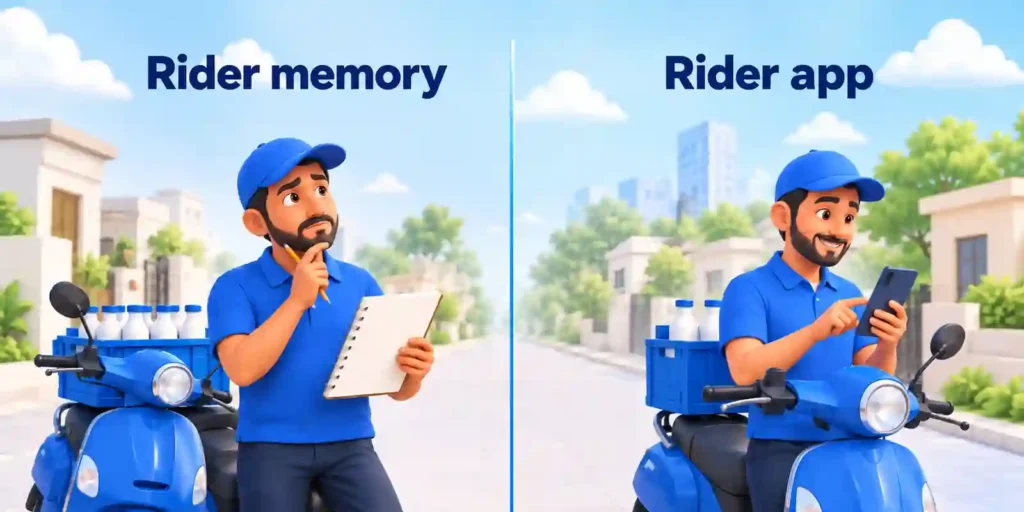
Danish ran his nine routes on memory and a shared notebook for years. Still, that worked, mostly, until a rider left mid-month. His replacement had no record of which customers owed what.
A milk delivery mobile app doesn’t depend on any one person’s memory surviving a bad week. Instead, every stop’s record lives on the account, not in someone’s head.
Milk Delivery Apps Across Pakistan, the GCC and Africa
In Karachi, Danish’s riders cover dense, traffic-heavy routes. Every minute at the gate counts twice there.
Meanwhile, GCC dairies running rounds out of Dubai or Riyadh often cover fewer stops across longer distances. So each handover carries more value per visit. In Africa, operators delivering across Nairobi or Accra face the same core problem at a different scale. A rider’s memory is not a record, wherever he’s riding.
Where Tarsil Fits Into the Milk Delivery App
Tarsil’s rider app runs in multiple languages and captures an electronic signature as proof of transaction at every stop. So a rider confirms quantity, payment, and returns at the gate. Then the office sees the same record right away, not after a shift ends.
Ready to connect your riders and your office?
Start Your 14-Day Free Trial → No credit card required. Most dairies go live within three to four minutes of signing up.
FAQs: Milk Delivery App Questions
What is a milk delivery app?
It’s the software a dairy’s own riders use to run their route, recording deliveries, payments, and returns at each stop. It differs from a customer-facing ordering app.
Why does the rider-to-office handover cause so many disputes?
Because it usually isn’t recorded at all. A rider remembers most of eighty stops, not all of them. Those gaps turn into arguments once billing starts.
What should a milk delivery driver app capture at the door?
Quantity delivered, payment received, and any returns, confirmed with a signature or tap. It should work offline and sync once signal returns, not lose the entry.
Does language support actually matter in a dairy rider app?
Yes. Working in a language he doesn’t think in pushes a rider toward shortcuts or memory. That brings back the exact problem the app exists to solve.
How does a milk delivery app connect riders and office teams?
It syncs each doorstep record to the office the moment a rider confirms it. So the office sees quantity, payment, and signature together, not a summary compiled later.
Do milk delivery apps need to work the same way in Pakistan, the GCC, and Africa?
The core requirement doesn’t change by region. Riders in Karachi, Dubai, or Nairobi all need the same doorstep capture. Route density and stop value differ by market.