
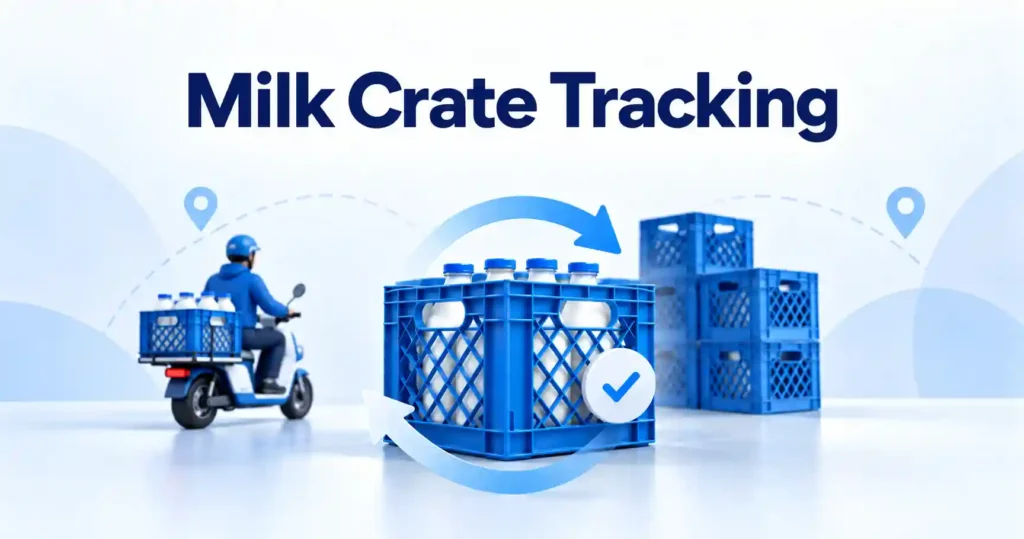
Milk crate tracking is the part of a dairy’s inventory that nobody budgets for until the crates stop coming back. Kofi delivers to roughly 600 households across Accra. Each morning his riders load crates, bottles, and cans. Then each evening, fewer come back than went out. Nobody is stealing them in any dramatic way. Instead, they scatter a few at a time across a few hundred kitchens.
So the losses stay invisible for months. Then the dairy hits peak season, runs short of crates, and buys a fresh batch it shouldn’t have needed.
What Is Milk Crate Tracking?
Milk crate tracking is the practice of recording every crate, bottle, and can a dairy lends out. It then matches those items against what comes back. It treats returnables as circulating inventory rather than packaging. Each item stays tied to the customer holding it. It’s also called returnable crate management or reusable container tracking.
That distinction matters more than it sounds. Packaging is a cost you absorb once. Instead, returnable stock is an asset you keep buying back. So dairies that treat crates as packaging never spot the leak. Nothing in their records expects a crate to return—which is why purpose-built milk delivery software treats these items as circulating inventory tied directly to the customer.
Why Milk Crates and Bottles Go Missing
Crates rarely vanish in one visible loss. Instead, they drain away through small gaps nobody writes down.
The Crate Handover Nobody Signs For
A rider drops full crates and picks up empties. Both halves happen in about twenty seconds at a gate. And usually nobody records either one. So the only account of that exchange sits in the rider’s head. By evening, he has made eighty more stops.
One Missing Crate a Day Adds Up Fast at Scale
Take a dairy that loses two crates a day. Across roughly 300 delivery days, that comes to 600 crates a year. Treat that as an illustration, not a statistic. Still, the arithmetic is worth running on your own numbers before the next purchase order. Each lost crate costs you twice: once to replace, and again when you run short in peak season.
How to Prevent Milk Crate Losses
Prevention comes down to one principle. Record the exchange where it happens, not where it’s convenient.
That means counting at the gate rather than at the depot. A rider confirms what he left and what he collected, customer by customer, while he’s standing there. Then every crate has an owner at all times, either the dairy or a named household.
It also means setting an expected holding per customer. Two crates out, two crates back, every delivery. So anything above that shows up as an exception the same week, not six months later.
How to Manage Milk Crate and Bottle Returns
Returns need a running balance per customer, not an annual stocktake. Dairy empties reconciliation works when it answers one question: who is holding what, right now?
Milk Bottle Return Tracking vs. a Paper Tally
A paper tally gives you a total. Milk bottle return tracking gives you a name attached to each missing item. But the difference becomes obvious when a rider leaves. His replacement inherits the route but not the mental ledger. Then every balance on that round turns into guesswork.
Getting Crate Deposit Management Right
Deposits only work while they hurt to lose. Many dairies set a deposit years ago and never revisited it. Meanwhile, crate prices rose. So the deposit now sits below replacement cost, and keeping the crate becomes the cheaper option for the customer.
Research on returnable transport items makes the same point from the supply side. A 2019 study in the Journal of Cleaner Production looked at that incentive directly. It found that the party able to reduce container losses acts only when doing so lowers its own cost. So incentives have to sit with whoever holds the item. So review your deposit against today’s replacement cost, not the price you paid when you set it.
Milk Crate Tracking Across Pakistan, the GCC and Africa
In Accra, Kofi’s returnable stock turns over daily, and losses compound quickly at that frequency. Lagos operators running similar household rounds face the same pattern. Volume, not geography, drives the leak.
Meanwhile, GCC dairies in Dubai or Doha often run smaller rounds with higher-value glass. Fewer items move, yet each one costs more to replace. In Lahore, crate volumes climb again, and deposits tend to be lower. Still, the mechanics hold everywhere: an item with no owner in your records is an item you will buy twice.
Where Tarsil Fits Into Milk Crate Tracking
Tarsil tracks non-disposable stock against each customer account, including security amounts, returns, and breakage or wastage. A rider records what he left and collected at the doorstep. Then the balance updates against that customer immediately, and deposits sit on the same ledger as the crates themselves.
See how returnables stay tied to the customer holding them.
See How Tarsil Works → Walk through returnable stock, deposits and customer balances in one system.
What Most Dairies Learn About Milk Crate Tracking Too Late
Three patterns show up again and again once a dairy grows past a few hundred customers.
Most Crate Losses Leave With Churned Customers
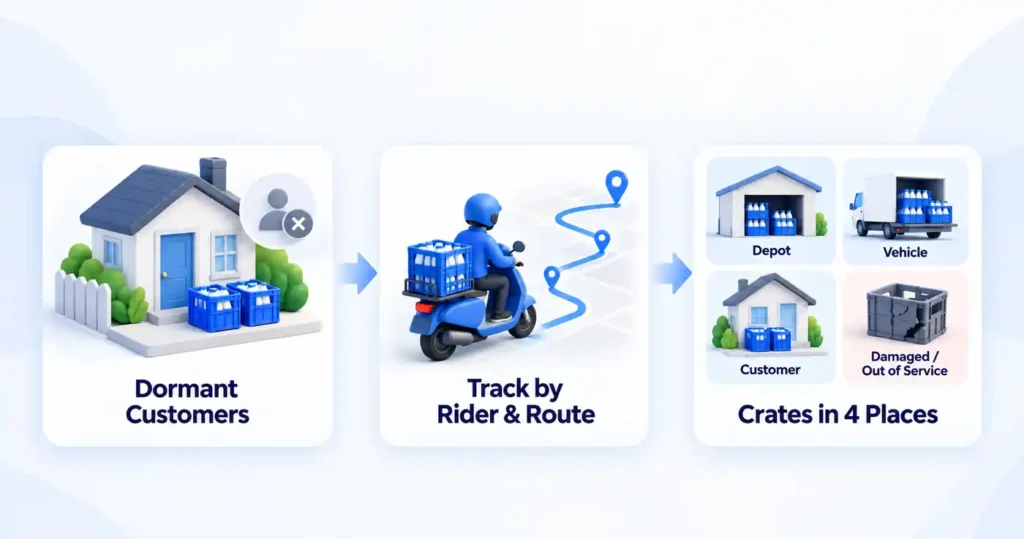
Owners look for theft on the route. In practice, the quieter leak matters more. A customer stops ordering, the account goes dormant, and the crates stay in their kitchen. So a dormant account needs a crate balance check, not just a sales follow-up.
A Monthly Crate Count Gives You a Number, Not a Cause
Counting depot stock once a month tells you how many crates went missing. It never tells you where. Per-rider and per-route balances make the loss attributable, and attributable loss is the only kind that stops.
Depot Stock Isn’t Your Crate Inventory
Crates sit in four places at once. Some are at the depot, some on vehicles, some with customers, and some out of service through breakage or warping. So owners who count only the yard underestimate circulating stock, then over-order every season. Bringing that circulating stock under control—and handling the chaos of fluctuating routes—is where purpose-built milk delivery management software becomes essential.
Kofi now runs milk crate tracking against every account rather than a monthly yard count. Nobody argues about who has what, because the rider recorded it at the gate.
Ready to stop buying the same crates twice?
Start Your 14-Day Free Trial → No credit card required. Most dairies go live within three to four minutes of signing up.
FAQs: Milk Crate Tracking Questions
What is milk crate tracking?
It’s the practice of recording every crate, bottle, or can you lend out and matching it against returns. Each item stays tied to the customer holding it.
Why do dairies lose so many crates?
Because the handover is never recorded. A rider exchanges full crates for empties in seconds, and nothing captures it. Those small gaps compound across hundreds of stops.
How often should dairy empties reconciliation happen?
Daily, at the point of exchange. Monthly depot counts tell you the size of the loss, never the cause. So they can’t help you recover anything.
Does a deposit actually stop crate losses?
Only while it costs more to keep the crate than to return it. A deposit set years ago often sits below today’s replacement cost, which quietly removes the incentive.
What’s the difference between crate tracking and normal inventory?
Normal inventory leaves and never returns. Returnable crate management tracks items that circulate. So every crate needs an owner at all times, either you or a named customer.
Can reusable container tracking work across different item types?
Yes. Crates, glass bottles, cans, and pallets all follow the same logic. Set an expected holding per customer, record each exchange, and keep a running balance.