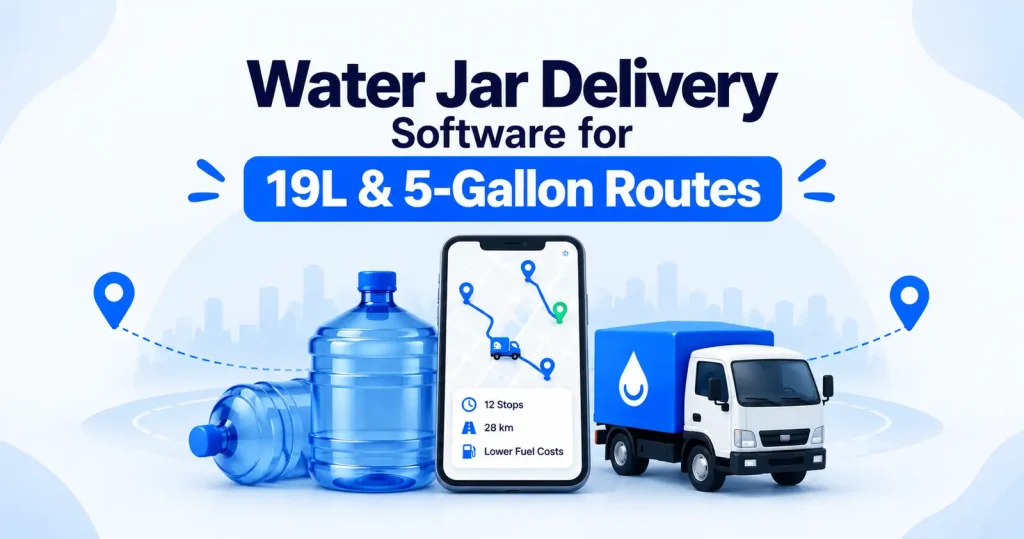
Water jar delivery software has one job above all else: know where every container is, at all times. Rashid runs that count every Tuesday morning in Dubai, checking 5-gallon bottles against his customer list before the trucks leave Al Quoz.
Meanwhile, the same count happens in Nairobi, except the container is a 20-litre can. In Karachi, it happens again with a 19-litre jar. So the label changes by city, yet the underlying problem stays the same: a container leaves full, comes back empty, and someone has to track both ends.
This guide bridges all three terms, shows what proper jar delivery management actually requires, and explains why the container itself deserves more attention than most delivery software gives it.
The Jar Is the Product, Not Just the Container
Most delivery software treats the container as packaging, something to note and forget once the order ships. That assumption breaks down fast in this business.
A jar or bottle is a tracked asset, often worth more than the water inside it. Because it moves back and forth between your warehouse and your customer for years, a single lost jar can outweigh the profit on dozens of deliveries. As a result, any software built for one-way parcels simply was not designed for this.
What Is Water Jar Delivery Software?
Water jar delivery software tracks returnable water containers alongside orders, routes, and payments. It covers 19-litre jars in South Asia, 5-gallon bottles across the GCC and much of the world, and 20-litre cans across East Africa, treating each as the same core problem: a container that must be issued, tracked, returned, and reconciled against a deposit.
You will also hear this referred to as jar delivery management, though the label shifts depending on where you operate. Bottled water distribution companies across all three regions face the same challenge under different names—a challenge we explore in depth in our complete operating guide to Water Delivery Software for Bottled, Jar, and 19L Businesses.
Same Container, Three Names Across Three Regions
Here is where the confusion usually starts, so let us settle it with real numbers.
-
5-gallon water delivery software: the GCC and international standard
Across the UAE, Saudi Arabia, Oman, Qatar, Bahrain, and much of the world, the 5-gallon bottle is standard. In Dubai, Abu Dhabi, Sharjah, Riyadh, Jeddah, Muscat, and Doha, operators size their trucks, racks, and deposit terms around this one format.
According to NIST’s official measurement tables, a US gallon equals 3.785411784 litres exactly, so five gallons works out to roughly 18.9 litres (NIST Handbook 44).
-
Water can delivery software: the East Africa standard
Across Kenya, Nigeria, Ghana, Tanzania and South Africa, a 20-litre can is the everyday container. Operators in Nairobi, Lagos, Accra, Dar es Salaam and Johannesburg run the same delivery model, only slightly larger per unit, which changes how many stops a single truckload can cover.
-
19-litre water jar delivery: the Pakistan standard
Across Karachi and Lahore, the 19-litre jar dominates. It is functionally almost identical to the GCC’s 5-gallon bottle, just measured in metric rather than imperial units.
So whichever region you read this from, the operational challenge is the same. Only the number on the container changes.
What Jar Delivery Management Actually Requires
Good jar delivery management rests on two habits most spreadsheets never manage properly.
-
Tracking full and empty separately
A jar in a customer’s kitchen and an empty one waiting for collection are two different states, not one line item. Consequently, your system needs to know both counts at once, for every customer, without you asking the rider to remember.
-
Tying deposits to the right container size
If your business runs multiple sizes, each deposit has to match its container exactly. Otherwise, a 20-litre can refunded at 5-gallon pricing creates a dispute nobody can resolve later, because nobody wrote down which size applied.
Why Container Weight Changes Your Route
A 20-litre can is heavier than a 5-gallon bottle, which is heavier again than some smaller formats. Therefore, a truck that comfortably carries 200 lighter bottles might only manage 160 heavier cans before it hits capacity.
That single fact changes route density, stops per load, and how often a truck needs to return to base. Because route planning has to account for container weight rather than just distance, it is often the factor that quietly decides your profit margin.
What Happens When a Jar Doesn’t Come Back
Eventually, containers go missing. A customer moves house, a jar cracks, or nobody notices a can sitting unreturned for months.
Without a system tracking this actively, those losses stay invisible until a stock count reveals a gap nobody can explain. Worse, the deposit tied to that container often stays unresolved too, sitting as a liability on your books indefinitely.
Where Tarsil Fits
Tarsil tracks every container format inside one system, whether your business runs 5-gallon bottles in Dubai, 20-litre cans in Nairobi, or 19-litre jars in Karachi. Full and empty counts stay live per customer, and deposits stay tied to the correct size automatically.
That single view is what turns Rashid’s Tuesday morning count from a guessing game into a two-minute check. You can see how container tracking connects to the wider system on the features page.
The Bottom Line
Whatever you call your container, treat it as a tracked asset, not packaging. Know what is full, what is empty, and what deposit sits against each one.
Get that right, and water jar delivery software pays for itself in jars that stop disappearing.
Ready to track every jar, bottle, and can in one place?
Start Your Free 14-Day Trial → Load your real container counts and see the gap close.
FAQs: Water Jar Delivery Software Questions Operators Ask
What is water jar delivery software?
It tracks returnable water containers alongside orders, routes, and payments, covering 19-litre jars, 5-gallon bottles, and 20-litre cans as the same core problem.
Is a 19-litre jar the same as a 5-gallon bottle?
Nearly. Five US gallons equals roughly 18.9 litres, so the two formats are functionally identical, just measured in different systems.
What does water can delivery software mean in East Africa?
It refers to the same delivery and tracking model, applied to 20-litre cans rather than jars or bottles. The operational challenge stays unchanged.
How does jar size affect route planning?
Heavier containers reduce how many a single truck can carry, which changes stops per load and how often trucks return to base.
Can one system handle multiple container sizes at once?
Yes, provided deposits and counts are tracked separately per size. Mixing sizes without that separation is exactly where disputes start.
Does it work outside Pakistan, the GCC, and Africa?
Yes. Wherever a business delivers returnable containers, water jar delivery software applies the same tracking logic, regardless of which local name the container carries.