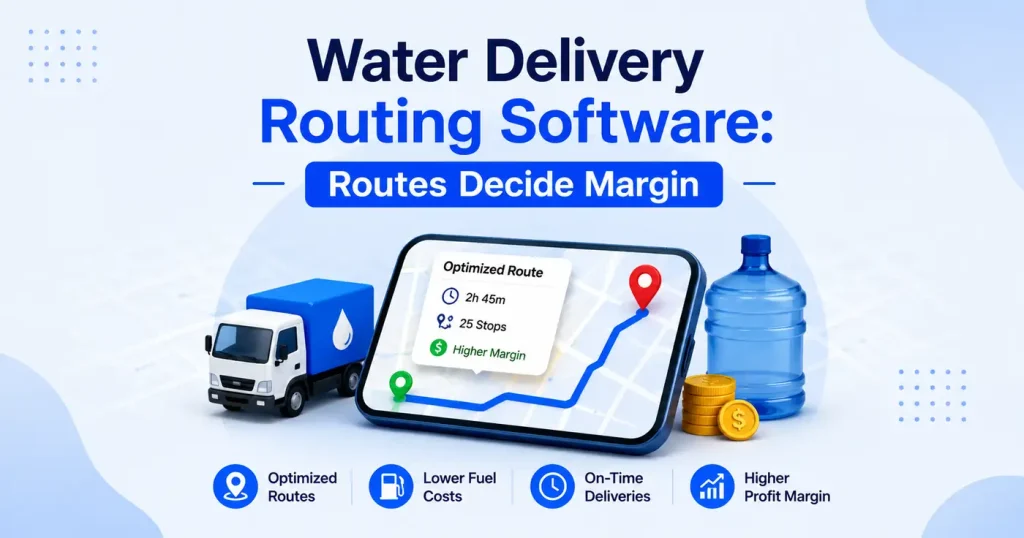
Water delivery routing software rarely makes it onto an owner’s shopping list, yet it decides more of the profit than almost anything else. Ali’s route across Faisalabad looks fine on paper. His fuel bill keeps climbing anyway, two riders finish late most days, and three customers called this week about jars that never arrived (a classic sign of poor empty jar tracking).
Nothing looks broken. Still, the margin leaks a little more each month, and the reason hides inside the daily route. Because a bad route never sends an alert, most owners feel the cost long before they find the cause.
So this guide shows how route planning shapes your margin, what routing software actually fixes, and how to test it on one real route before you commit.
Routing Is Where Water Businesses Quietly Lose Money
Poor routing announces itself in the worst way: slowly, and disguised as something else.
You see it as a fuel bill that creeps up. You feel it as overtime, because riders finish late. Customers notice it as missed jars and shrinking trust. None of those look like a routing problem at first glance, yet all three trace back to the same root.
That is why routing hides. A broken invoice is obvious, but a wasteful route sits there, costing you money every single day without ever raising its hand.
What Is Water Delivery Routing Software?
Water delivery routing software plans and sequences the stops on a delivery round. It groups customers by location and day, orders the stops to cut distance and time, balances the load across riders, and turns a messy list of addresses into a route a rider can actually follow.
You will also hear it described as water-delivery route planning or route-planning software. The idea stays the same: get the right jars to the right doors in the smartest order.
This is an old, well-studied problem. Researchers have worked on the “vehicle routing problem” since the late 1950s, when it first appeared as a truck-dispatching challenge (vehicle routing problem overview).
Today, this routing technology acts as the engine behind comprehensive Water Delivery Software: The Complete Operating Guide for Bottled, Jar and 19L Delivery Businesses, putting that maths to work for your entire operation.
Why Recurring Water Routes Aren’t Parcel Routes
Most delivery route planning software assumes every day is new. A water business works the opposite way, so generic tools miss what matters.
The same customers, the same days
Your customers repeat. Ali visits the same streets every Monday and Thursday, for the same households, with roughly the same order. As a result, you should build a strong route once and reuse it, rather than solve a fresh puzzle each morning. Parcel software, built for one-off drops, never sees that pattern.
The load changes at every stop
A water round is not just deliveries. Full jars go out, and empties come back, so the vehicle’s load shifts at every single stop. Because of that, routing has to think about capacity and returns together, not just the next address. Generic tools track the drop and ignore the return, which is exactly the half where water businesses lose jars.
Using specialized Water Jar Delivery Software ensures you run 19L and 5-gallon jar routes efficiently without ever losing count of empties or inventory.
What Route Optimization for Water Delivery Actually Does
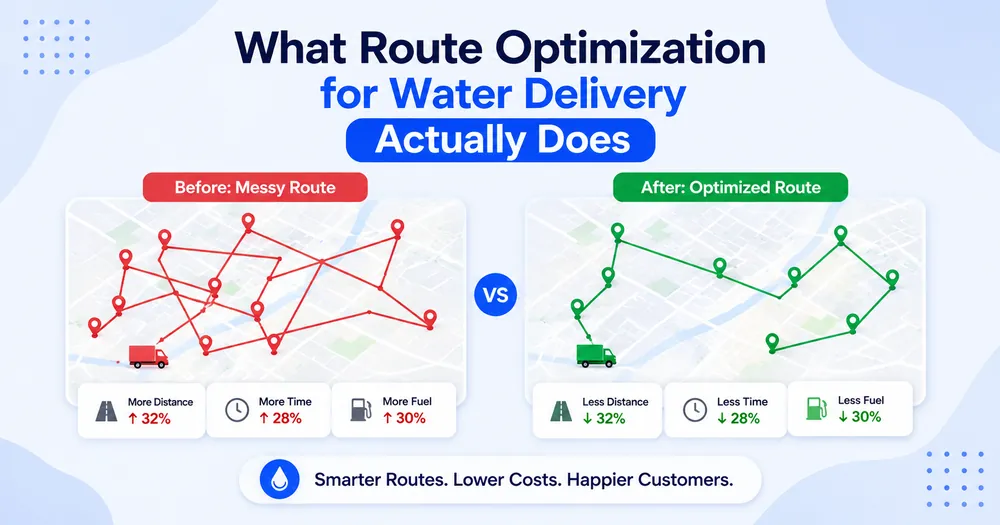
Good route optimization for water delivery works on three fronts at once.
It sequences stops to cut distance and fuel
The software orders your stops so the rider drives the shortest sensible path, not a zig-zag built by habit. Consequently, the same customers get served with fewer kilometres and less fuel.
It balances load fairly across riders
One rider crawling home at 7 pm while another finishes by 3 pm is a planning failure, not an effort problem. Routing software spreads stops and load evenly, so nobody carries a broken round.
It builds the route once, then maintains it
Instead of re-planning daily, the system holds a solid route and adjusts only when customers join or leave. Tarsil operators report up to 27% lower operating costs this way, though you should always test the savings against your own fuel and hours rather than trust a headline. Picture two versions of one 40-stop round: an ad-hoc order might run 120 km over nine hours, while a planned order covers the same stops in 95 km and seven hours. Same customers, very different cost.
Routing, Zones and Daily Visits: How They Fit Together
Routing works best when it sits on top of clear zones and a visit plan.
Why zones make routes repeatable
A zone is simply a patch of the city one rider owns. Once you divide your customers into zones, routes stop overlapping, riders learn their area, and coverage becomes easy when someone is off.
Daily visit planning that holds as you grow
Zones feed a daily visit plan: who gets served, on which day, by whom. So as you add customers, you slot them into an established zone instead of redrawing everything. Mastering zone-wise delivery planning for water routes turns daily routing from a hectic scramble into a smooth, predictable routine.
What Routing Software Won’t Fix on Its Own
Routing software is powerful, but it is not magic, so be honest about its limits.
It cannot force a rider to follow the plan if he prefers his old order. It cannot fix wrong customer locations, because a route is only as good as the pin behind each stop. Furthermore, it cannot help if the owner overrides the sequence every morning out of habit. Fix those human and data gaps, and the software finally earns its keep.
Building Water Delivery Route Management Into Daily Work
Software only pays off when it becomes a habit, so treat water delivery route management as a daily rhythm, not a one-time setup.
Each morning, dispatch the planned routes to riders. Throughout the day, adjust for the real exceptions, such as a customer who calls to skip. Then, once a month, review the routes against fuel, time, and missed stops, and tidy any that have drifted as customers changed. This simple loop keeps routes efficient long after the first plan.
How to Test Routing Software on One Real Route
You do not need to trust a sales pitch. Instead, run a fair test.
- Map one real route exactly as it runs today, with its current fuel and finish time.
- Let the software re-plan the same stops.
- Run the old route and the new plan for one week each.
- Compare fuel used, hours worked, and stops missed.
- Decide on the numbers, not the demo.
If the planned week beats the old one, you have your answer in black and white.
Where Tarsil Fits
Tarsil builds zone-wise routing and daily visit planning directly into the wider system, so the route connects to customers, riders, jars, and collections rather than sitting in a separate map.
That connection is why Ali’s Faisalabad leak turned out to be the route, not the riders. Once the stops were sequenced and the zones were clean, his fuel settled, and the late finishes stopped.
Today, 400+ delivery businesses across 77+ cities in Pakistan, the GCC, and Africa run their rounds this way. You can explore the routing tools on the features page.
And if you want to see how routing sits inside the full operation, the water delivery software page lays out the whole picture.
The Bottom Line
Treat the route as a business decision, not a daily guess. Plan it once, keep it clean, and measure it every month.
Do that, and water delivery routing software pays for itself in fuel, hours, and jars that actually arrive. Ignore the route, and the margin keeps leaking where nobody thinks to look.
Want to see what a planned route saves you?
Start Your Free 14-Day Trial → Map one route and compare the numbers yourself.
FAQs: Water Delivery Routing Software Questions Operators Ask
What is water delivery routing software?
It plans and sequences the stops on a delivery route, groups customers by area and day, and balances load across riders. In short, it turns an address list into a route riders can follow.
How is it different from a map or navigation app?
A map finds the way between two points. Routing software decides the order of many stops and which rider takes them, which is a far bigger job.
How much can better routing actually save?
It varies by city and route, so test it. Tarsil operators report up to 27% lower operating costs, mostly from less fuel and fewer late finishes.
Do I need it if my routes rarely change?
Yes, because a stable route is exactly where a one-time optimization pays off for years. You plan it well once and simply maintain it.
Will my riders have to follow a fixed order?
They follow a smart order, not a rigid one. You can still adjust for real exceptions, such as a customer who asks to skip a day.
Does it handle jars and empties, not just stops?
Good software does. It plans for full jars going out and empties coming back, so the load and returns stay under control.
Does it work across Pakistan, the GCC, and Africa?
Yes. Operators run water delivery routing software the same way across Pakistan, the GCC, and Africa. Only distances, traffic, and address formats differ.