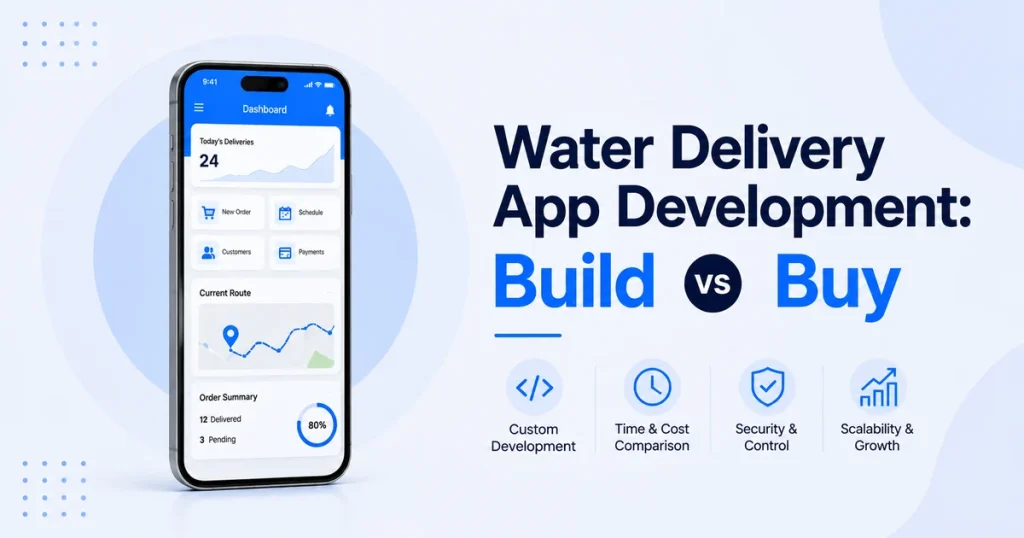
Water delivery app development always starts with a quote that looks reasonable. Ali got one in Riyadh, glanced at the number, and almost said yes. Then he looked closer. The quote covered version one, and nothing else.
It did not cover hosting. It did not cover updates. It did not cover the second developer, or the day a new phone model breaks the app. So the real question was never “what does it cost to build.” Instead, the question is “what does it cost to own for three years.”
This guide walks through that honest cost, shows the few cases where building your own app makes sense, and helps you decide before you sign anything.
The Quote Is the Cheapest Part
A build quote prices the first version. But an app is not a one-time purchase, so that number hides most of the real cost.
Think of it like a delivery van. The purchase price is easy to see. Fuel, servicing, tyres and repairs are where the money actually goes. Software works the same way, because code needs constant upkeep once it meets real users.
So judge any build on its three-year cost, not its launch price. That single change of view decides most of these decisions.
What Does Water Delivery App Development Actually Involve?
Water delivery app development is the work of designing, coding, testing, and maintaining a custom system for a water delivery business. It usually means a customer app, a rider app, a back office for staff, a server to run it all, and ongoing maintenance to keep every part working as phones and rules change.
You will also see this called water delivery software development or a custom build. The scope stays wide, though, because each of those pieces has to be built, connected, and kept alive.
For context, industry data helps. According to Clutch, most custom app projects run between $10,000 and $50,000 for a first version, and larger builds climb well beyond that (Clutch app development pricing). So a “simple app” quote rarely stays simple once real features arrive.
Before committing to that scope and cost, it’s worth comparing it against what ready-made platforms already cover — see the complete water delivery software operating guide.
When a Custom Water Delivery App Is the Right Call
Building your own app is sometimes the smart choice. So let us be fair about when.
1. You have a workflow no platform supports
Most water businesses share the same needs: standing orders, routes, jars, deposits and collections. But if your operation does something genuinely unusual that no ready platform handles, then a custom water delivery app can fit where a bought one cannot.
2. You already have a development team
If you employ developers who will maintain the app for years, the maths changes. Because the hardest part of a custom build is not launch, it is the upkeep, and an in-house team can carry that.
Still, for most operators, neither case is true. So the honest answer, most of the time, is buy.
Where Water Delivery Software Development Gets Expensive
The build quote is quiet about three costs. Yet these are exactly where custom projects overrun.
1. Maintenance never stops
Phones update their operating systems twice a year. New handsets arrive constantly. So an app that works today can break next month, and someone has to fix it every single time. As a result, maintenance is not a one-off; it is a permanent line on your budget.
2. The asset and deposit logic is harder than it looks
Generic developers underestimate jars. A jar goes out, sometimes comes back, and carries a deposit that has to sit correctly on the customer’s account for years. So the balance, the empties, and the refund all have to agree. Because this logic touches money, small mistakes turn into real disputes.
3. Routing is a specialism, not a feature
A map API shows a road. It does not plan a recurring route across the same customers, on the same days, in the smartest order. So routing is its own discipline, and building it well takes far longer than most quotes assume.
What a Water Delivery App Development Company Won’t Tell You
A water delivery app development company will happily quote version one. But a few things rarely make the sales call.
First, version two always comes. Your business changes, so the app must change with it, and that means a maintenance retainer. Second, the knowledge lives in one or two people. So when they leave, the ability to safely change your app can leave with them. Third, “you own the code” sounds reassuring, yet owning code you cannot easily change is a trap, not an asset.
So ask any agency what year two and year three actually cost. Their answer tells you a lot.
Build vs Buy: A Three-Year View
Look at both paths across three years, not three months.
1. The build path over three years
You pay for the build, then wait months, then launch. After that, you pay to fix, to host, to update, and to add whatever you forgot the first time. So the cost never really stops, and your attention stays split between running deliveries and running a software project.
2. The buy path over three years
You start on a ready platform in minutes, not months. Updates, hosting and fixes come included, because the vendor spreads that cost across every customer. So your money buys deliveries, not debugging. Even an on-demand water delivery app feature you might want later is usually already built and tested.
If you’re leaning toward buy, the next step is knowing what to actually test before you commit — a buyer’s checklist you can actually run in a demo.
Where Tarsil Fits
Tarsil is the buy path, ready to run. So instead of a six-month build, you go live in three to four minutes, with the customer record, rider app, routes, jars, deposits and collections already connected. Updates and hosting are included, because that is the point of a platform.
That is why Ali paused on the Riyadh quote. It never mentioned year two, and year two is where custom projects hurt.
Today, 400+ delivery businesses across 77+ cities in Pakistan, the GCC and Africa run on Tarsil rather than a custom build. So you can see the connected system for yourself on the features page.
And because the three-year cost is the real question, the pricing page is published in full, with no build quote to decode.
The Bottom Line
Price the three years, not the launch. Build only if you have an unusual workflow or your own developers. Otherwise, buy, and spend your time on deliveries instead of debugging.
For most operators, water delivery app development is a slower, dearer road to a platform that already exists. So test a ready one first.
Want to compare a ready platform against your custom quote?
Book a Free Demo → Bring the quote. We will walk through the three-year picture together.
FAQs: Questions About Water Delivery App Development
What is water delivery app development?
It is building a custom system for a water business: a customer app, a rider app, a back office, and a server. It also includes the ongoing work to keep them running.
How much does a custom water delivery app cost?
Clutch data puts most first versions between $10,000 and $50,000, and complex builds run higher. Maintenance, hosting and updates then add cost every year after launch.
Is it cheaper to build or buy?
For most operators, buying wins. A ready platform spreads hosting, updates and fixes across many users, so you avoid the full lifetime cost alone.
How long does a custom water delivery app take to build?
Usually several months for a first version, and longer if routing and deposits are done properly. A ready platform, by contrast, can start in minutes.
What ongoing costs come after launch?
Hosting, operating-system updates, bug fixes, new features and support. So the launch price is only the start, not the total.
Can a ready platform handle jars, deposits and routes as well as a custom app?
Yes, and often better. Those features are already built and tested, so a ready platform usually beats a fresh water delivery app development on the parts that matter, and it is used daily by hundreds of businesses across three regions.