Water supply management software and water delivery software sound almost identical, yet they solve completely different problems. Buyers mix them up every week, and some sign up for the wrong one before they notice. That confusion is understandable, because the names overlap while the products do not.
So let us clear it up early, before you waste a demo. Do you run a utility, a pipeline network, or a treatment plant? Then this guide points you elsewhere, and that is the honest answer. Do you deliver bottled water, jars, or cans to customers by vehicle? Then stay, because you are in the right place.
Below, you will see exactly how the two differ, and which one your business actually needs.
What Is Water Supply Management Software?
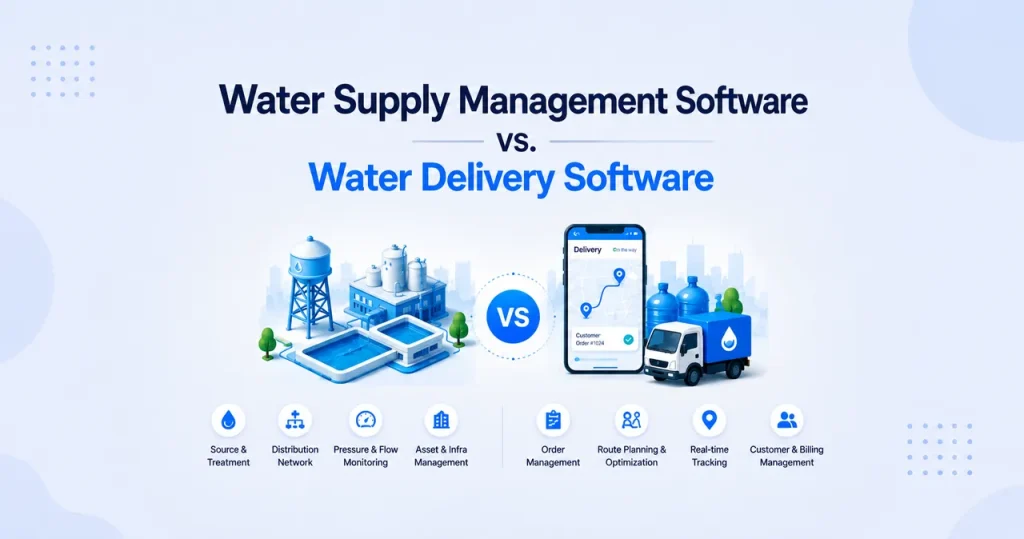
Water supply management software runs water infrastructure. It manages treatment plants, pipe networks, pumps, pressure, metering, and the distribution grid that carries water to taps. Utilities, municipalities, and water authorities use it to keep a public supply flowing safely, not to run a delivery business.
You may also hear it called a water management system. Whatever the label, the focus stays on infrastructure and public supply.
To picture the scale, think about what a utility actually controls. According to the US EPA, drinking water distribution systems link treatment plants to homes through a vast network of pipes, storage tanks, valves, and pumps (EPA drinking water distribution systems). Software for that world tracks pressure and water quality, not customers and jars.
What Is Water Delivery Software (And How It Differs)?
Water delivery software runs a delivery business. It manages customers, recurring orders, delivery routes, riders, jars and bottles, deposits, collections, and reports. Bottled and jar water operators use it to bring water to a door, track what each customer owes, and know where every jar has gone.
Here is the distinction the whole article turns on: supply software manages the network that moves water, while delivery software manages the business that brings it to a door. One thinks in pipes; the other thinks in customers.
Where “Water Distribution Software” Sits Between Them
The truly confusing term is “distribution,” because both worlds use it. So a quick test settles almost every case.
When distribution means the pipe network
Utility people say “distribution” to mean the grid of mains and pumps that carries treated water across a city. In that sense, water distribution software and water distribution solutions belong firmly on the supply side, alongside metering and pressure tools.
When distribution means your delivery business
Delivery operators say “distribution” to mean their routes, riders and dealers. Used that way, the software they need is delivery software, not utility software, whatever the search box called it.
One question resolves it every time: does water reach your customer through a pipe or through a vehicle? Pipe means supply. Vehicle means delivery.
Do You Need Water Utility Software or Delivery Software?
Match yourself to one of these two lists, and the decision becomes obvious.
Signs you need water utility software
You operate physical infrastructure. Metering connections, pressure monitoring, treatment and quality management fill your day, and public-supply rules govern all of it. In that case, water utility software fits your job, and delivery tools will feel irrelevant.
Signs you need water delivery software
You plan routes and assign riders. You take standing orders, track jars and deposits, and collect payment at the door. If that describes your day, delivery software is your category, full stop.
Very few businesses sit in both worlds at once, so most readers already know which list theirs is.
What a Water Delivery System Handles That Supply Software Never Will
A water delivery system handles several everyday tasks that a utility platform has no concept of.
It holds a standing order that changes week to week. It records a returned jar and the deposit attached to it. Moreover, it keeps a running balance per customer, plans a rider’s route, and captures cash collected on the doorstep. Utility software never models any of that, because a water authority has no jars, no rounds, and no doorstep cash.
If you want to see exactly how these pieces connect day to day, check out our comprehensive Water Delivery Software: The Complete Operating Guide for Bottled, Jar and 19L Delivery Businesses
Where Tarsil Fits
Tarsil is delivery software, and we will say that plainly. It does not run pipelines, treatment plants, or public supply networks, so a utility should look elsewhere.
For a delivery or distribution business that brings water to customers by vehicle, though, this is the right category. You can see the connected workflow on the features page and decide in minutes whether it matches how you actually work.
The Bottom Line
Match the software to how water reaches your customer. Through a pipe, you need utility tools. Through a vehicle, you need delivery tools.
Get that right, and the rest of the buying process gets easier. Confuse water supply management software with delivery software, and you will pay for features you can never use.
Not sure which category you’re in?
See How Tarsil Works → Two minutes will tell you whether it fits your delivery business.
FAQs: Water Supply vs. Water Delivery Software Questions
What is water supply management software?
It manages water infrastructure: treatment, pipe networks, pumps, pressure, and metering. Utilities and municipalities use it to keep a public supply flowing, not to run deliveries.
What’s the difference between water supply and water delivery software?
Supply software manages the network that moves water through pipes. Delivery software manages the business that brings water to customers by vehicle. Different jobs, different tools.
Is water distribution software the same as either one?
It depends on the meaning. “Distribution” can mean a utility pipe network or a delivery operation’s routes and dealers, so check which sense applies to you.
Do I need utility software to run a water delivery business?
No. A delivery business needs routes, riders, jars, deposits, and collections. Utility software handles none of those, so it would only get in your way.
Can one system do both supply and delivery?
Rarely, and usually not well. The two jobs are so different that most businesses pick the one category that matches how water reaches their customers.
Which one does a bottled- or jarred-water business need?
Delivery software, every time. Bottled and jar operators run routes and accounts, not pipe networks, so water delivery software is the correct fit, and water supply management software would only add cost you can never use.