
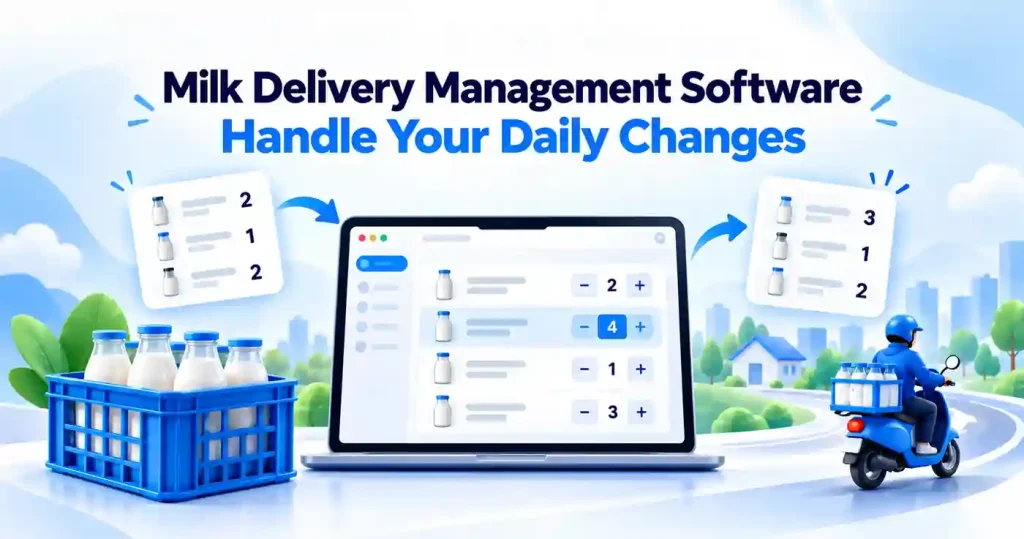
Usman runs milk delivery management software for 900 standing orders out of his dairy in Lahore. On any given morning, dozens of those orders aren’t quite the same as they were yesterday. One customer wants half a litre less. Another is away for the week. A third just agreed to a new rate starting Monday. None of that is unusual. It’s just what a standing order does once real households are on it.
So that’s the problem milk delivery management software exists to solve. A standing order isn’t a fixed number you set once and forget. Instead, it’s a moving target. The software tracks every change without losing the thread back to the bill. This article walks through how that works, change by change.
What Is Milk Delivery Management Software?
Milk delivery management software tracks a dairy’s standing orders as they change daily. It still produces one correct bill at month-end. It covers daily quantity edits, skip days, temporary holds, and rate changes. Each one carries through to billing without manual reconciliation. It’s also called milk subscription management or dairy delivery management.
Still, those names describe the same job from different angles. So subscription management emphasises the recurring order. Dairy delivery management emphasises the operation around it. Either way, paper and spreadsheets can’t hold a number that changes daily and still reconcile a month later.
If you are managing recurring dairy orders, understanding how automated systems handle changes across daily schedules is essential. For a comprehensive breakdown of operational workflows, check out Milk Delivery Software, which covers everything from daily route adjustments to automated billing reconciliation.
How Milk Delivery Management Software Handles a Daily Quantity Change
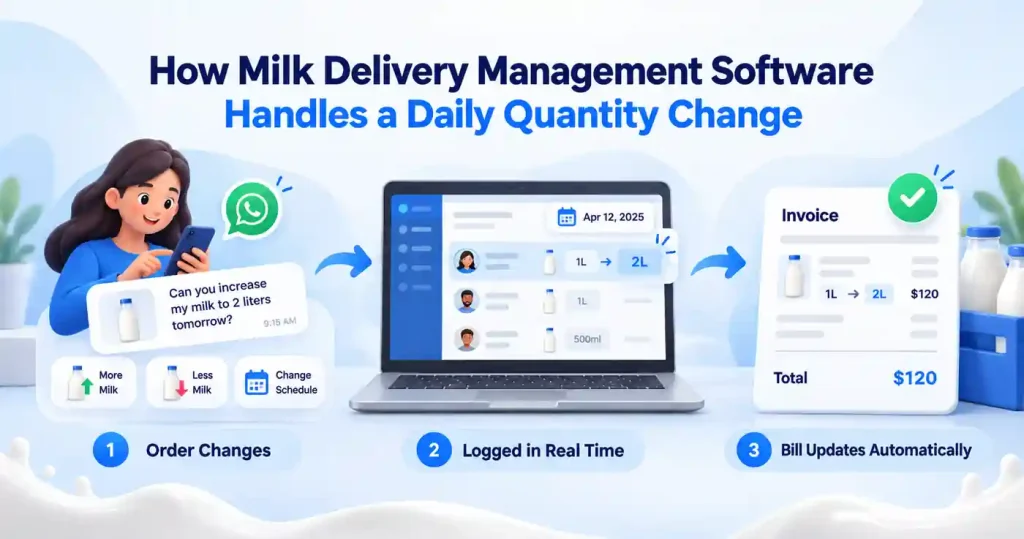
A quantity change sounds small. Handled badly, it’s the single biggest source of billing disputes in a delivery diary. So here’s what should happen, in three steps.
The order changes
Maybe a customer calls, messages on WhatsApp, or tells the rider directly. They want more milk, less milk, or a different schedule. That request needs one place to land, not three.
Milk quantity change tracking logs it in real time
So good milk delivery management software records the change against that account the same day, with a date stamp. It doesn’t wait for someone to update a notebook later.
The bill reflects it automatically
At month-end, the bill totals what riders actually delivered, day by day. That includes every mid-month change. Nobody re-adds anything by hand, and nobody argues about what ” usually” gets delivered.
How to Handle Skip Days and Holds in Milk Delivery Scheduling
Sometimes customers travel, fall ill, or just skip a day without warning. Still, each skip has to subtract from the bill, not just disappear from the rider’s memory.
A temporary hold works differently: a skip costs a single missed day, nothing more. A hold means a customer saying “pause me for two weeks.” They expect delivery on the date they gave. So milk delivery scheduling needs to handle both cases. One skip touches a single invoice line. A multi-day hold touches a whole date range, and nobody should have to remember to switch the account back on.
If a hold doesn’t resume on schedule, the dairy loses a week of revenue. Then it risks annoying a returning customer with missed deliveries. Still, both outcomes are avoidable with a system that tracks the hold’s end date as carefully as its start.
How Milk Delivery Management Software Handles a Mid-Month Rate Change
Meanwhile, rates change too. Then a new price takes effect. A promotional rate ends. Or a customer moves to a different product tier mid-month. Applying the new rate going forward isn’t the hard part. The hard part is billing correctly across that split. The old rate applies before the change, the new rate after, inside one invoice.
Still, get this wrong, and the customer either overpays or underpays. Either way, they notice. So milk delivery management software has to split that invoice line by date and apply both rates correctly. The customer still gets one clean bill, not a confusing two-part statement.
Milk Subscription Management vs. One-Off Milk Delivery Scheduling
Often, most dairy demand isn’t one-off. It’s a standing relationship: the same customer, most days, with small variations. Because of that, milk subscription management treats changes as edits to an existing order, not brand-new transactions.
One-off milk delivery scheduling suits a different customer, one who orders occasionally rather than daily. A subscription operation needs an accurate, reliable, and timely way to track subscriptions, not a one-off transaction. Occasional-order logic skips that step entirely. Instead, it processes a transaction and moves on, rather than tracking a relationship that changes daily.
So a dairy running mostly on standing orders, like Usman’s, should judge software on subscription handling first. One-off ordering is a secondary feature, not the core one.
Read more: Milk Delivery Models: On-Demand vs. Subscription – Which Is Better for Your Business?
Milk Delivery Management Software Across Pakistan, the GCC and Africa
In Lahore, for example, Usman’s 900 subscriptions produce plenty of mid-month changes every day. Volume alone explains why. And that same pattern holds wherever milk gets delivered on a standing basis.
Then in the GCC, dairies serving Doha or Dubai households run smaller rounds. Yet they face the same billing logic. A quantity change on day 12 still has to resolve correctly by day 30. Likewise, in Africa, operators in Nairobi or Lagos running home delivery subscriptions hit the identical problem. Still, only the scale differs. The mechanics don’t shift by region.
Where Tarsil Fits Into Dairy Delivery Management
Tarsil tracks every quantity edit, skip day, hold, and rate change against the customer record the moment it happens. Then it carries all of that into one monthly bill automatically. Dairies running on Tarsil see 12% more deliveries completed per day. Riders and office staff simply stop reconciling changes after the fact.
Ready to handle daily order changes without the manual work?
Book a Free Demo → Bring a messy month. We’ll show you how it resolves automatically.
FAQs: Milk Delivery Management Software Questions
How do you handle a daily order change in milk delivery management software?
The customer’s request gets logged against their account the same day, with a date stamp. The system carries that change into the monthly bill automatically, so nobody has to re-enter it later.
What’s the difference between milk subscription management and on-demand delivery?
Subscription management tracks a standing, recurring order and its daily edits. On-demand delivery processes individual, occasional transactions. Most dairies need subscription handling first, since most of their volume is recurring.
How do skip days and holds affect the monthly bill?
A skip day subtracts a single delivery from that invoice. A hold pauses billing across a date range and should resume automatically on the date the customer gave, without manual follow-up.
Can a mid-month rate change apply without billing errors?
Yes, if the software splits the invoice by date: the old rate for days before the change, the new rate after, shown to the customer as one clean bill rather than two separate line items.
What is milk quantity change tracking, exactly?
It’s the record of every edit to a standing order’s daily amount, time-stamped and tied to that customer’s account, so the month-end bill reflects exactly what was delivered rather than an estimate.
Does this work the same way in Pakistan, the GCC, and Africa?
The underlying logic doesn’t change by region. A dairy in Lahore, Doha, or Nairobi all need the same quantity-change, skip-day, and rate-change handling. Only the volume of daily changes differs by market.