Milk delivery software exists because one number never stops moving: the daily order. Khalid runs a dairy in Doha serving 600 households and a dozen labour-camp mess halls, and no two days look the same. One household adds a litre on Tuesday. A mess hall cuts its order the week before Eid. Somehow, by month’s end, all of that has to become one bill everyone agrees on.
For years, Khalid’s office reconciled that gap by hand, and it nearly broke them every single month. This guide walks through what milk delivery software needs to handle, how it differs from the water and jar delivery world, and what to check before you buy.
What Is Milk Delivery Software?
Milk delivery software manages recurring daily subscriptions, per-customer quantity changes, rider routes, crate and bottle returns, monthly billing and collections for dairies and milk delivery businesses, replacing handwritten registers and verbal order-taking with one connected system.
You will also see this sold as milk delivery software solutions or simply milk round management tools. The label shifts, but the underlying job stays the same: hold a daily-changing order steady enough to bill once a month without an argument.
Running a mixed fleet?
If you also manage 19L jars alongside dairy, the operational challenges shift. Read our companion guide: Water Delivery Software: The Complete Operating Guide for Bottled, Jar and 19L Delivery Businesses.
Why Milk Delivery Software Exists: The Order That Changes Every Day
Milk is the hardest delivery model in this whole industry, because the order changes daily while the bill only happens once a month. Everything below follows from that single fact.
Before choosing your operational stack, you need to evaluate whether a traditional recurring model or an instant fulfillment model fits your customer base. To weigh the pros and cons of both setups for your route planning, read our deep dive on Milk Delivery Models: On-Demand vs. Subscription – Which Is Better for Your Business?
Daily quantity changes
A customer takes two litres on Monday, three on Thursday, then asks for one extra jug because relatives are visiting. Multiply that across hundreds of accounts, and a paper register turns into guesswork within a week. Using a dedicated Milk Delivery App lets field riders log these adjustments instantly from their phones.
If you are struggling with late-night WhatsApp edits and morning manifest errors, check out our guide on Milk Delivery Management Software: How to Handle Daily Order Changes to see how automated cut-off rules prevent route delays.
Skip days and holds
Customers travel. Offices close for holidays. A skip is not a cancellation, yet plenty of manual systems treat it that way, which means someone gets billed for milk that never arrived.
The monthly bill that has to make sense of it all
By the end of the month, every quantity change, skip, and hold has to add up to one number the customer can check and trust. Get that wrong once, and you spend the next call defending a bill nobody can verify.
See how a connected system handles all of this at once.
Start Your Free 14-Day Trial → No credit card, live in minutes.
Milk Delivery Software Solutions: What They Should Include
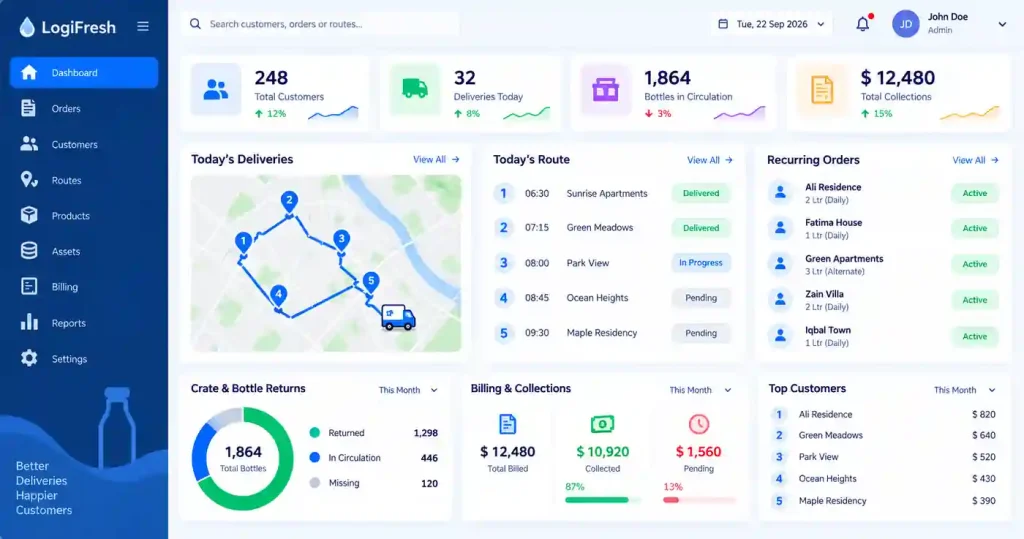
Test any platform against these four areas before you commit to it.
Before evaluating core route features, ensure you aren’t confusing a distribution tool with a full farm-to-factory system. Choosing robust Dairy Industry Software requires balancing both downstream distribution workflows and upstream processing needs. Read our detailed comparison on Dairy Management System vs. Milk Delivery Software: Which Does Your Business Need? to pinpoint your exact operational scope.
Recurring orders:
The system should hold a standing quantity per customer and let it change mid-cycle without losing the history behind it.
Routes and rider accountability:
Morning rounds run on a tight clock, so the software needs to show exactly who delivered what, where, and when. Getting your morning dispatch right is critical—explore our breakdown on Milk Delivery Route Planning to see why successful rounds are won or lost before 6 AM
Crate and bottle returns:
Milk moves in reusable containers as often as it moves in bags, so returns need tracking with the same care as the milk itself. Unmanaged plastic loss silently eats into margins faster than spilled milk ever could—learn how to plug these gaps in our deep-dive guide on Milk Crate Tracking: How to Prevent Losses and Manage Returns.
Collections and monthly billing:
Every quantity change, skip, and hold from the month should flow automatically into one bill, not a spreadsheet somebody rebuilds by hand.
Milk Round Software vs. Milk Delivery Software: Same Job, Different Name
Plenty of buyers search for milk round software and land here instead, which makes sense, because the two terms describe the same category from different angles. “Round” leans on the tradition of a fixed daily route; “delivery software” leans on the modern platform behind it.
Neither label changes what the system actually has to do. For a deeper breakdown of how route management, recurring orders, and billing align under this model, read our complete guide on Milk Round Software Explained: Routes, Orders and Billing in One System.
Does Online Milk Delivery Software Actually Help?
Being online is not the whole answer, and it is worth saying that plainly. Cloud hosting means your office and your riders see the same record, which genuinely helps.
However, hosting alone does nothing for the deeper problem of a daily-changing quantity, since a cloud-based spreadsheet still behaves like a spreadsheet.
The real question is whether the system connects orders, routes, and billing into one flow, not just whether you can reach it from a browser.
Looking at broader enterprise tools instead? Read our guide on Online Milk Delivery Software: What a Small Dairy Actually Needs (and an ERP Won’t Give You) to see why traditional ERPs fall short on dynamic daily route management.
Dairy Delivery Software Across the GCC, Africa and Pakistan
Dairy operations look different from Doha to Nairobi to Lahore, yet the daily-order problem never changes.
Across the GCC, labour-camp mess halls and household routes often sit on the same truck, so a single rider might juggle bulk institutional orders alongside a residential round. In Nairobi and Lagos, dense urban rounds dominate, often running early to beat the day’s heat. Pakistan’s dairy delivery, centred on cities like Lahore, tends to combine both patterns at once.
Global demand only reinforces why this matters. The Food and Agriculture Organization notes that world milk production and trade keep climbing steadily, with demand growing fastest in exactly the regions this software serves (FAO dairy market overview). Whatever the region, dairy delivery software has to flex around local order patterns while keeping the billing logic identical underneath.
Milk Delivery Management Software: What to Check Before You Buy
Before signing anything, run a demo through your real numbers, not the vendor’s clean example.
If you are weighing a SaaS platform against custom software, check our breakdown on milk delivery app development to see what traditional agency quotes leave out.
Ask how the platform handles a mid-cycle quantity change, and watch whether the customer’s history survives it. Check whether crate returns tie back to a specific customer automatically. Finally, generate a sample monthly bill and see if it reconciles every change from the month without you touching a spreadsheet.
When Should You Move Off the Register?
A few signs tell you the paper register has already failed, even if nobody has said so out loud.
- Month-end reconciliation regularly takes more than a day.
- Customers dispute quantities you cannot independently verify.
- Riders rely on memory rather than a written or digital record.
- Nobody can say, right now, how many crates are actually out with customers.
For a detailed look at operational failure points, read our guide on Milk Delivery System: What Actually Breaks When You Outgrow the Register.
Where Tarsil Fits
Tarsil connects the standing order, the route, the crate return, and the monthly bill into one system, so a quantity change on Tuesday shows up correctly on the invoice weeks later without anyone re-entering it. You can explore how these pieces fit together on the features page.
That single connection is exactly what would have spared Khalid’s office in Doha its worst month-end scrambles, since every change a household or mess hall made would already sit inside the bill before anyone had to reconcile it by hand.
Today, 400+ delivery businesses across 77+ cities in Pakistan, the GCC, and Africa run their operations this way.
The Bottom Line
Milk is the hardest delivery model in this business, because the order changes daily and the bill only happens once. Everything worth buying software for comes down to holding that gap closed.
Get milk delivery software that connects orders, routes, and billing into one flow, and month-end stops being the week your office dreads.
Ready to close the gap between daily orders and monthly bills?
Book a Free Demo → We’ll walk through your real order patterns together.
FAQs: Milk Delivery Software Questions Dairy Operators Ask
What is milk delivery software?
It manages standing orders, routes, crate returns, and monthly billing for milk delivery businesses in one connected system, replacing paper registers and verbal order changes.
How does it handle daily quantity changes?
A good system lets a customer’s standing order change mid-cycle while keeping full history, so every change flows correctly into the monthly bill.
How is milk round software different from milk delivery software?
They describe the same category. “Round” points to the traditional daily route, while “delivery software” points to the platform running it today.
Is online milk delivery software worth it for a small dairy?
Cloud access helps your office and riders share one record, but it only solves half the problem. The bigger win is connecting orders, routes, and billing.
How much does milk delivery software cost?
Pricing usually scales with routes, riders, or customers. Most platforms, including Tarsil, offer a free trial so you can test real numbers before committing.
Can it track crates and bottle returns?
Yes, a proper system tracks returns per customer alongside the delivery itself, so nothing depends on a rider’s memory at the end of a long morning.
When should I move off a paper register?
As soon as month-end reconciliation takes longer than a day, or customers start disputing quantities nobody can independently verify.
Does it work across the GCC, Africa and Pakistan?
Yes. Dairy operators across Doha, Nairobi, Lagos and Lahore all run milk delivery software the same way, adjusting only local route patterns.