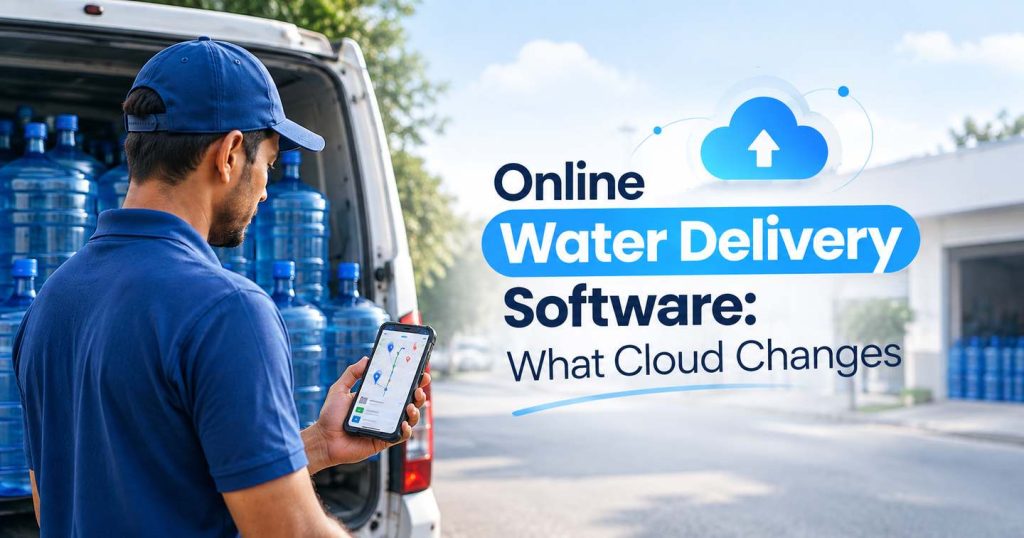
It is 7 am at Ali’s water depot in Karachi, and his online water delivery software has not settled a single argument yet. The office says a customer holds four jars. The rider’s notebook says six. The customer swears he returned two last week. So the business went online a year ago, but all three numbers still disagree.
That gap is the whole point of this article. Because going online did not fix the disagreement, the truth is simpler than most vendors admit: being on the cloud was never the real problem, and it was never the real fix either.
So here is what cloud access genuinely changes on a route, what it leaves untouched, and how you can tell the difference before you pay for it.
“Cloud-Based” Is Not a Feature
Almost every vendor now says “cloud-based.” As a result, the phrase has stopped telling you anything useful. In 2026, hosting your system online is normal, not special.
So stop asking where the software lives. Instead, ask a better question: what becomes true the moment your office, your riders, and your ledger all read from the same record? That single shift, and not the hosting, is what you are really buying.
What Is Online Water Delivery Software?
Online water delivery software is a system you reach through a browser or an app, where your team shares one live record instead of separate copies. So an order taken in the office, a delivery marked on the route, and a payment recorded at the door all update the same customer account in real time.
You will also see it sold as cloud water delivery software, water delivery software online, or online bottled water delivery software. The label changes, but the promise is the same: one shared source of truth.
If you want the broader category first, and then the buying details, then read this article for deeper information.
It helps to know what “the cloud” actually means in plain terms. In short, your data sits on secure servers you reach over the internet, rather than on one computer in your office (a useful plain-English explainer here).
What Cloud Water Delivery Software Changes
When the shared record works, three things change quickly.
1. The office and the road see the same day
An order comes in at 9 am. Then, a second later, it appears on the rider’s phone. So nobody phones the route to pass the message, and nobody forgets. As a result, the office and the road finally work from the same picture.
2. The owner stops being the database
Today a customer calls, and you call the rider to answer. With cloud water delivery software, though, you open the account yourself, from anywhere, and reply in seconds. So the business stops depending on your memory.
3. The record updates once, not three times
A delivery marked at the door updates the jar balance, the deposit, and the month’s bill together. So the same fact is entered once, not copied by three people who each get it slightly wrong.
What It Doesn’t Change on Its Own
Cloud access is not magic, though. Two problems survive the move, and honest buyers should expect them.
1. Bad data just spreads faster
The cloud syncs a mistake as quickly as it syncs good work. So if a rider records the wrong jar count, everyone now sees the wrong number instantly. In other words, online systems reward clean habits and punish sloppy ones, only faster.
2. A hosted spreadsheet is still a spreadsheet
If the parts do not connect, going online simply shows you the same disconnected records on more screens. So a login page is not the same as a joined-up system. The app has to write back to routes, balances and collections, or you gain nothing but a browser tab.
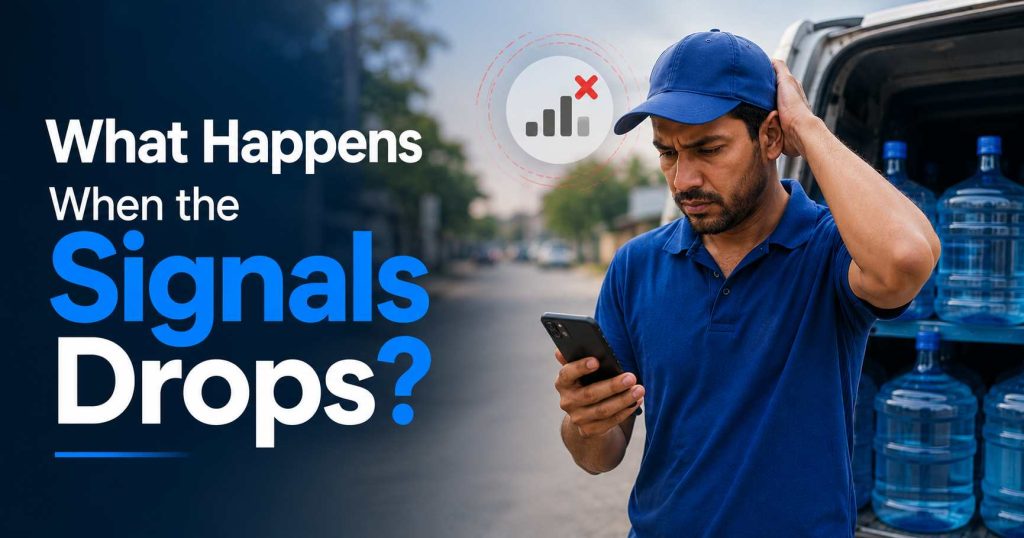
Water Delivery Software Online: What Happens When the Signal Drops?
 1. Offline has to work on a real route
Signal drops in basements, in stairwells, on rural stretches, and in the dead zones every city hides. Across Nairobi, Lagos and the edges of Karachi, patchy coverage is normal, not rare. In fact, the GSMA reports that Sub-Saharan Africa remains the least-connected region in the world, with wide gaps in everyday mobile use (GSMA State of Mobile Internet Connectivity 2025). So a water delivery software online tool that dies without signal will fail at exactly the wrong moment. Instead, it must capture the delivery offline and sync once the signal returns.
2. How to test it in five minutes
You do not need a technical review to check this. First, put the phone in airplane mode. Then complete a delivery inside the app. Next, switch the signal back on and watch. If the delivery syncs cleanly, without duplicating, the tool passes. But if it stalls or double-counts, then “online” has quietly become a liability.
Who Sees What in Your Online System
Once the business lives online, access matters more, not less. So decide early who sees what.
A rider needs today’s route and stops. A rider does not need your margins or your full customer list. Good water delivery business software sets permissions by role, so each person sees only their part. That protection matters most on the day a staff member leaves, because otherwise they can walk out with everything.
Where Tarsil Fits
Tarsil keeps the office, the rider, and the owner on one live record. So the same delivery updates the balance, the deposit, and the bill at once, with no second system to reconcile later. The app also works offline and then syncs, and permissions run by role.
That is why Ali’s 7 am problem disappears here. Once all three people read from one record instead of three copies, the jar count simply stops disagreeing.
Today, 400+ delivery businesses across 77+ cities in Pakistan, the GCC, and Africa run this way. You can see how the pieces connect on the water delivery software page.
The Bottom Line
Cloud hosting is table stakes, so do not pay a premium for the word. Instead, buy the shared record underneath it. Then test that record offline, because that is where cheap tools break.
Judge online water delivery software on one thing: does everyone finally see the same day? If so, the disagreements at 7 am go away.
Want to see the shared record in action?
See How Tarsil Works → One live record for the office, the rider, and you.
FAQs: Questions Operators Ask About Online Water Delivery Software
What is online water delivery software?
It is a browser- or app-based system where your whole team shares one live record. So an order, a delivery, and a payment all update the same account instantly.
Is it better than a spreadsheet?
Yes, but only when it connects the office, the rider, and the ledger. Otherwise, a hosted spreadsheet just shows the same disconnected data on more screens.
Does it work when my rider has no internet?
It should. A good app records the delivery offline, then syncs once the signal returns. So always test this before you buy.
Is my customer data safe in the cloud?
Reputable systems store data on secure servers with backups and role-based access. So ask any vendor how they protect data and who can see it.
What’s the difference between “online” and “connected”?
Online means you reach it over the internet. Connected means the parts update each other. You want both, because online alone changes very little.
Does it work across Pakistan, the GCC and Africa?
Yes. Operators across Pakistan, the GCC and Africa run online water delivery software the same way. Only container sizes, payment methods and coverage differ.