

A water bottle security deposit only protects you if you can prove what you are holding. Haroon learned that lesson in Manama last week. A customer asked for his deposit back; Haroon refunded it on the spot, and only later discovered the customer still had two of his bottles.
No record showed how many containers that customer actually held. So Haroon paid out the money and lost the bottles too, a double loss on a single account. The deposit had failed at the one job it existed to do.
This guide covers how to set deposit terms that genuinely protect your working capital, which deposit model to choose, and how to end refund disputes before they start.
Looking for a broader overview of operational tools? Check out our Water Delivery Software: The Complete Guide for Bottled & 5-Gallon Water Businesses in the GCC.
Why a Water Bottle Security Deposit Exists at All
A deposit is not a fee, and treating it like extra revenue causes most of the trouble. Instead, think of it as a promise that the container comes back.
Every jar you hand out is money you have already spent. So the deposit sits against that container as protection, covering you if it never returns. When you frame it that way, the whole system makes sense: the deposit guards your working capital, and it quietly encourages customers to return what they borrowed. Lose sight of that purpose, though, and the deposit becomes a number nobody tracks properly.
What Is a Water Bottle Security Deposit?
A water bottle security deposit is a refundable amount a customer pays against each container they hold, returned when they give the container back. It protects the supplier from the cost of lost jars or bottles, and it gives the customer a reason to return empties instead of keeping them.
You will also hear this called jar deposit management or a returnable container deposit. The same logic drives government-run bottle schemes worldwide, where a refundable deposit is attached to each container to make sure it comes back (how container-deposit systems work).
Three Deposit Models: Full, Partial or None
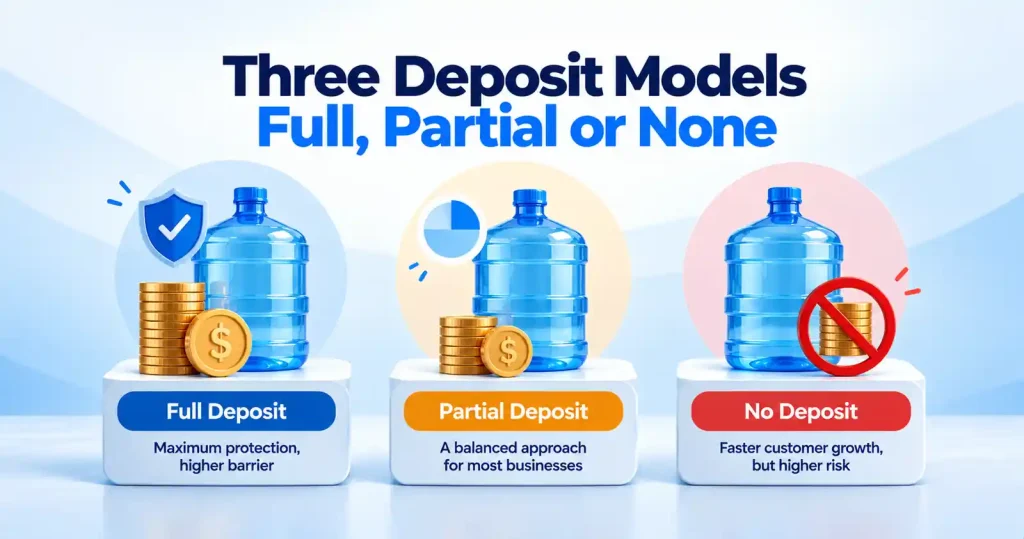
Every water business picks one of three approaches. Each protects your capital differently, so choose deliberately rather than by habit.
1. Full deposit: maximum protection, higher barrier
Here the customer pays the container’s full cost as a deposit. It protects you completely, since a lost jar is already paid for. However, a large upfront amount can scare off price-sensitive new customers.
2. Partial deposit: the common middle ground
Most operators land here, charging part of the container’s value. It lowers the entry barrier while still giving you meaningful cover and the customer a reason to return empties. The trade-off is obvious: a lost container leaves a gap between the deposit and its real cost.
3. No deposit: when it works, and the risk you carry
Some businesses skip deposits to win customers fast. That can work in tight, trusted communities, yet it leaves your containers completely exposed. Without a deposit, every unreturned jar is a straight loss.
Not sure which model fits your business?
See How Tarsil Works → See how deposits, balances, and refunds connect in one record.
Returnable Container Deposit: Setting the Right Amount
Getting the number right matters as much as choosing a model. A returnable container deposit should reflect the container, not a round figure you picked casually.
Match the deposit to the container’s real cost
Base the deposit on what the container actually costs you to replace, in your local currency. Set it too low, and it fails to protect you; set it too high, and you lose new customers. Aim for an amount that covers most of the replacement cost while still feeling fair.
Handling multiple sizes and a water can security amount
If you run different sizes, each needs its own figure. A 20-litre unit costs more than a smaller one, so a water can security amount should sit higher than a small-jar deposit. Keep the amounts tied clearly to each size, or refunds turn messy fast.
Deposit Refund Policy for Delivery: Where Disputes Actually Start
Almost every deposit argument traces back to one thing: weak records. A clear deposit refund policy for delivery prevents the fight Haroon walked into.
The refund argument nobody records
A customer claims they returned three jars. Your rider remembers two. Nobody wrote it down, so now it is one person’s word against another’s. That gap is where money and goodwill both leak away.
A refund policy customers can’t argue with
Put the terms in writing, and keep a live balance of every container each customer holds. Then a refund becomes simple: check the balance, return the deposit for what came back, and hold the rest. When the record is clear, and the customer can see it, the argument disappears before it begins.
Bottle Deposit Accounting: Keeping Deposits Off Your Profit
Here is a mistake that quietly wrecks the books: recording deposits as sales. Proper bottle deposit accounting treats a deposit as a liability, not income.
The reason is simple. A deposit is money you may have to return, so it belongs on your books as a liability, not income. Count it as profit, and you will overstate your income, then scramble when refunds come due. Keep deposits separate, and your real financial picture stays honest.
Signs Your Deposit System Is Leaking Money
A few red flags show up before the losses do.
- You refund deposits without first checking the customer’s container balance.
- Deposits appear in your books as sales rather than money owed.
- You have no written deposit terms customers can see.
- Customers regularly dispute how much deposit they are owed.
Fixing these leaks is just one component of building the operational systems behind a water delivery business that actually scales.
Where Tarsil Fits
Tarsil tracks security amounts, returns, and customer-wise rates against every account, so a refund always checks against a real, live balance. You can see how deposits and container tracking connect on the features page.
That single record is what would have saved Haroon in Manama. With a live balance in front of him, he refunds only the bottles actually returned, and the two missing ones stay on the customer’s account.
The Bottom Line
Set your deposit to protect your capital, write the terms down, and never refund without checking the balance first. Keep deposits off your profit line, where they belong.
Do that, and a water bottle security deposit stops being a source of arguments and starts doing its real job: protecting the containers your business runs on.
Ready to end deposit disputes for good?
Book a Free Demo → We’ll show you how deposits and balances stay matched in one record.
FAQs: Water Bottle Security Deposit Questions Operators Ask
What is a water bottle security deposit?
It is a refundable amount a customer pays against each container they hold, returned when they give the container back. It protects you from the cost of lost jars.
How much should a returnable container deposit be?
Base it on the container’s real replacement cost in your local currency. High enough to protect you, but fair enough not to scare off new customers.
Should I charge a deposit at all?
Usually yes. Skipping deposits wins customers faster, but it leaves every container exposed, so each unreturned jar becomes a straight loss.
How do I handle deposit refunds without disputes?
Keep a live balance of each customer’s containers and put your terms in writing. Then refund only for what actually came back.
Is a jar deposit counted as income?
No. A deposit is money you may return, so proper bottle deposit accounting treats it as a liability, not a sale. Counting it as profit distorts your books.
Does a deposit system work across the GCC, Africa, and Pakistan?
Yes. Operators in Manama, Dubai, Nairobi, Accra, and across Pakistan all use a water bottle security deposit to protect their containers, adjusting only the amount to local costs.