
Zone-wise delivery planning solves a problem most owners blame on their riders instead. Bilal watched it play out in Lahore last month. Two of his riders kept crossing paths on the same street, both serving a handful of the same houses, while a block three streets over got missed by both.
The fuel bill told one story. The riders told another, each certain the other one was quietly grabbing the easy stops. Neither was lying, though. Nobody had ever drawn a clear line between them, so the overlap was baked in from the start.
This guide shows how to divide a city into zones that actually hold, using a simple method, and how to handle the part nobody warns you about: the arguments.
Why Zone-Wise Delivery Planning Fixes More Than Fuel
Cut the overlap and yes, the fuel bill drops. That part is obvious. The bigger win is quieter, and it lasts longer.
When every customer belongs to exactly one rider, the daily confusion disappears. Nobody double-serves a house, nobody skips one assuming a colleague has it, and nobody argues about whose stop it was. As a result, the whole operation gets calmer, not just cheaper. That clarity, more than the saved fuel, is what makes zones worth the effort.
What Is Zone-Wise Delivery Planning?
Zone-wise delivery planning divides your service area into clear zones, assigns each zone to one rider, and schedules deliveries by area rather than by scattered individual stops. Each customer sits inside one zone, so responsibility, routing, and coverage all become obvious instead of improvised.
You will also hear this called delivery zone management or delivery scheduling by area. The idea behind every label is the same: draw the lines once, so the daily work stops being a guess.
The logic is not unique to water delivery, either. Businesses have balanced sales and service territories for decades precisely because clear areas reduce cost and prevent staff from under- or over-serving customers (sales territory principles). A water round follows the same rule.
How zones sit inside routing: Water Delivery Routing Software: Why Route Planning Quietly Decides Your Margin
Delivery Zone Management: The Five-Step Method
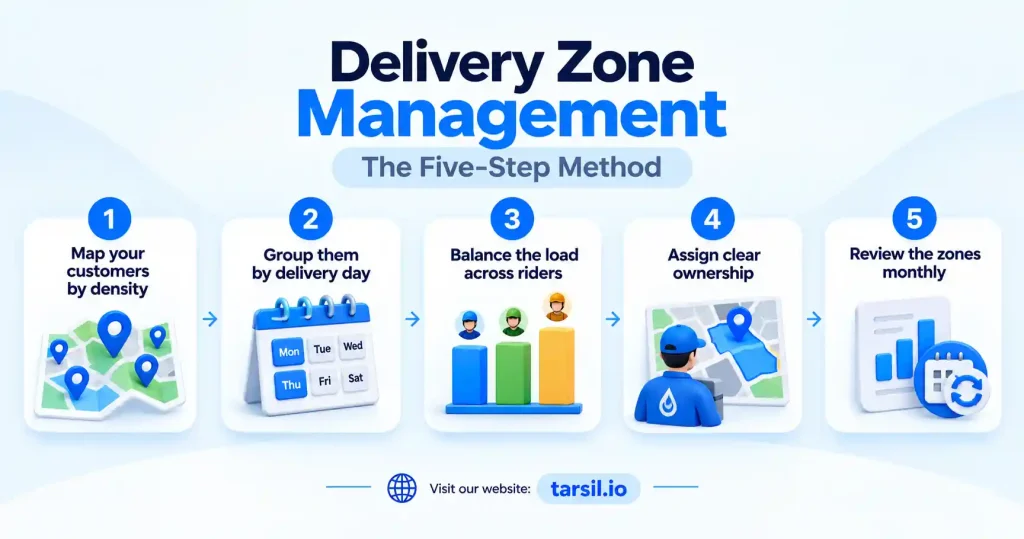
Good delivery zone management follows five steps, in order. Skip one and the zones tend to drift within weeks.
1. Map your customers by density
Plot where your customers actually are. Clusters and gaps jump out fast, and those clusters become the natural heart of each zone.
2. Group them by delivery day
Some customers want Monday, others want Thursday. So build zones that make sense for the days they fall on, not just the map, because a tidy zone served on three scattered days helps nobody.
3. Balance the load across riders
Count the stops and the effort, not just the area. A small dense zone can carry more work than a large empty one, so aim for equal workload rather than equal size.
4. Assign clear ownership
Give each zone one rider who owns it. Ownership builds local knowledge, and a rider who knows his customers spots problems long before the office does.
5. Review the zones monthly
Customers join and leave every month. A quick monthly review keeps zones balanced, rather than letting them quietly slide back into overlap.
Territory Planning for Delivery: Handling the Human Side
Here is the part most guides skip entirely. Territory planning for delivery is not just a mapping exercise; it is a people problem wearing a map.
Why riders defend “their” customers
Riders build real relationships on a route. A regular customer offers tea, remembers a rider’s name, tips well at Eid. So when you move that customer to another zone, the rider hears it as losing something personal, not as a tidy operational tweak.
How to change a zone without breeding resentment
Explain the why before the what. Show the rider how the new zone cuts his driving, evens his day, or lifts his collections. Involve him in the redraw where you can, and keep the workload genuinely fair across the team. When a change feels fair and explained, riders accept it; when it feels arbitrary, they resist it for months.
Rider Route Assignment: Making Zones Stick Day to Day
Zones only work if the daily rider route assignment actually follows them. A beautiful map means nothing if riders wander outside it by Wednesday.
So assign each day’s route strictly within its zone, and make cover simple when someone is off. Because zones are already clear, a stand-in rider can pick up a colleague’s area without a fifteen-minute briefing. That is the real test of good zoning: the business barely notices when one rider takes leave.
Daily Visit Planning: Turning Zones Into a Repeatable Schedule
Once zones exist, they feed a proper schedule. Daily visit planning decides who gets served, on which day, by which rider, and it turns a chaotic week into a predictable one.
New customers then slot into the right zone and the right day automatically, instead of landing wherever there was space. Over time, that rhythm is what lets you add customers without adding chaos.
Signs Your Zones Have Drifted
A few warning signs show up before the fuel bill does.
- Two riders regularly work the same street on the same morning.
- One rider finishes by early afternoon while another runs late every day.
- New customers keep landing in nobody’s clear zone.
- Coverage falls apart the moment a single rider takes a day off.
Where Tarsil Fits
Tarsil builds zone-wise routing and daily visit planning into the wider system, so each customer sits in a defined zone connected to the right rider, day, and schedule. You can see how zoning and visits work together on the features page.
That structure is what finally settled Bilal’s two riders in Lahore. Each got a clear zone, the overlap stopped, and the tea-and-tips arguments stopped with it.
The Bottom Line
Draw the lines once, and draw them fairly. Give each rider a zone he owns, explain every change, and review the map each month.
Do that, and zone-wise delivery planning turns a city full of overlapping routes into a calm, predictable operation your riders actually trust.
Want to map your zones without the arguments?
Start Your Free 14-Day Trial → Draw your first zones and assign a rider in minutes.
FAQs: Zone-Wise Delivery Planning Questions Operators Ask
What is zone-wise delivery planning?
It divides your service area into clear zones, assigns each zone to one rider, and schedules deliveries by area. Every customer sits in exactly one zone.
How does delivery zone management reduce costs?
Clear zones cut overlap, so riders stop driving the same streets twice. Less overlap means less fuel, fewer wasted hours, and fewer missed stops.
How do I handle riders who don’t want their zone changed?
Explain the reason before the change, show how it helps them, and keep workloads fair. A change that feels fair gets accepted; an arbitrary one gets resisted.
How is rider route assignment different from zoning?
Zoning draws the boundaries. Rider route assignment is the daily job of sending each rider through his zone in the right order.
How often should I review my zones?
Monthly is a good rhythm. Customers join and leave constantly, so a quick monthly check keeps zones balanced before they drift.
Does zone-wise planning work across the GCC, Africa and Pakistan?
Yes. Operators in Abu Dhabi, Al Ain, Dubai, Nairobi, Lagos, and across Pakistan all use zone-wise delivery planning to keep routes clean and fair.