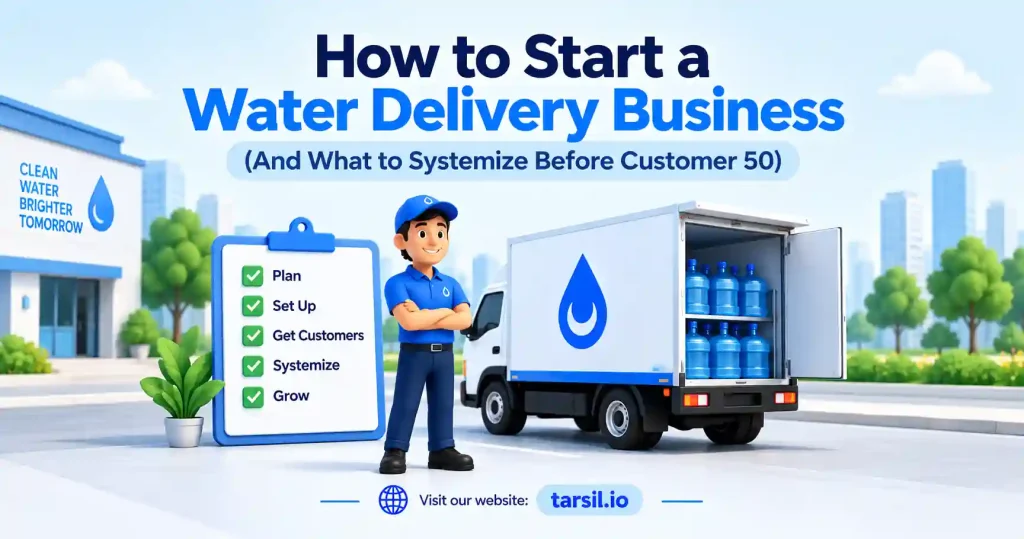
Learning how to start a water delivery business is the easy part. Daniel proved that in Nairobi. He had a van, a bit of savings, and a neighbourhood that kept running out of clean water, so the opportunity felt obvious.
What he didn’t have was a clear picture of everything sitting between that idea and a route that actually turned a profit. Sourcing, licensing, containers, pricing, first customers, and the moment the whole thing stops fitting in a notebook. Each step looks small on its own, yet together they decide whether the business survives its first year.
So this guide walks the full journey, in order, and then flags the one thing most new operators wish they had set up sooner.
Before You Start a Water Delivery Business: Is the Demand Real?
Validate demand before you spend a rupee, dirham, or shilling. Plenty of people want water; far fewer will order it on a repeat schedule.
That distinction matters more than anything else, because the entire model depends on recurring orders, not one-off sales. Look for customers who need water every week without fail: households, offices, salons, small clinics, construction sites. When you find a cluster of those in one area, you have found a real business. A scattered list of occasional buyers, on the other hand, is a hobby that burns fuel.
Starting a Bottled Water Business: Sourcing Your Water and Containers
Every water business rests on two supply decisions, and this is where starting a bottled water business gets real. Get these right early, since they are expensive to change later. (If you have been searching for how to start a water bottle business, this is the same decision under a different name.)
Sourcing water for your bottled water business
You either produce the water yourself or buy it from a supplier. Running your own plant gives you control and better margins over time, but it demands real capital and constant quality management. Buying from an established supplier lowers your upfront cost and hands the quality burden to them, though it thins your margin per jar. Neither choice is wrong; they simply suit different starting budgets.
Choosing containers when you start a water delivery business
Your container is your most reused asset, so pick the format your market already expects. That might be a 19-litre jar, a 5-gallon bottle, or a 20-litre can, depending on where you operate. Whatever the size, plan to track every one of them from day one.
The container decision in depth: Water Jar Delivery Software: Running 19L and 5-Gallon Jar Routes Without Losing Count
Licensing and Water Quality: The Water Supply Business Setup Nobody Enjoys
Now the part people avoid, and shouldn’t. Every country regulates drinking water and business registration differently, so treat this section as a checklist to verify locally, not a rulebook.
At minimum, find out how your region licenses a water supply business, what water-quality testing it requires, and how often. Because you are selling something people drink, safety is not optional, and the World Health Organization stresses that suppliers should actively manage water safety from source to customer (WHO drinking-water guidance). Your local authority will set the exact standards, so confirm them before your first delivery, never after a complaint.
Water Delivery Startup Costs: What You Actually Need to Budget For
Startup budgets fail when they only count the obvious. Break your water delivery startup costs into three honest buckets.
One-time water delivery startup costs
These cover your vehicle, your initial container stock, and any plant or filtration equipment if you produce your own water. Buy fewer, better containers rather than a cheap batch you replace within a year.
The jar float: the startup cost most people forget
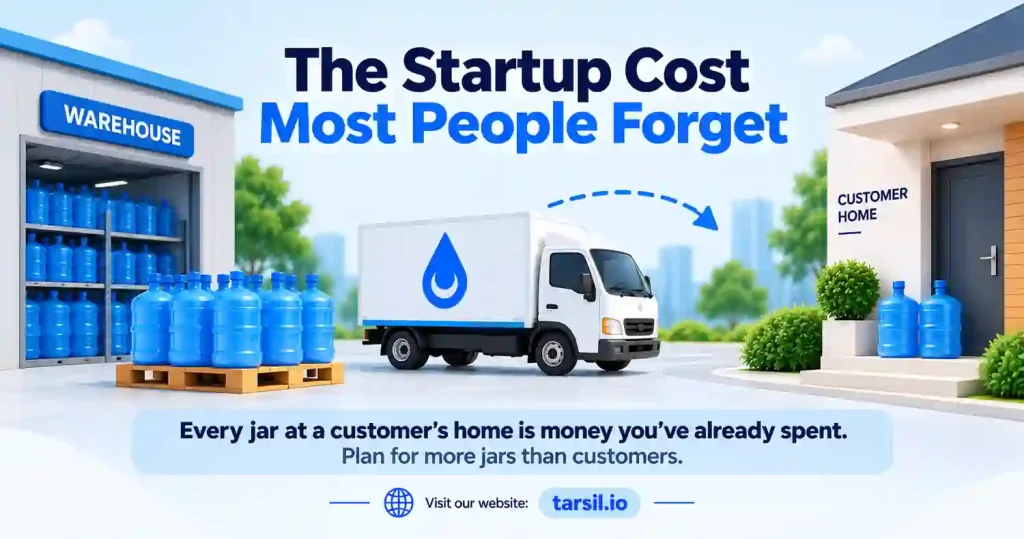
Here is the cost that surprises almost every new operator. Every jar sitting at a customer’s home is money you have already spent but cannot use, and you need enough containers in circulation to cover every customer at once. That pool of containers, the jar float, ties up real capital, so budget for far more jars than you have customers.
Ongoing running costs
Fuel, staff wages, refills and maintenance make up your ongoing spend. Price these in your local currency against your delivery volume, and make sure your per-jar price comfortably covers them with margin to spare.
Writing a Simple Water Delivery Business Plan
You don’t need a thick document. A useful water delivery business plan answers five plain questions instead.
Who exactly do you serve? What do you charge, and does that cover your costs with margin? How do you deliver, and on which days? How do you collect payment, and how do you track who owes what? And finally, how do you plan to grow without drowning in chaos? Answer those five honestly, and you have a plan worth more than most twenty-page templates.
Getting Your First Customers When You Start a Water Delivery Business
Chase density, not just numbers. Ten customers on one street beat thirty scattered across the city, every single time.
So when you sign your first customers, concentrate them in a tight area. A dense first route keeps fuel low, finishes fast, and leaves room to add neighbours cheaply. Word of mouth also travels faster within a cluster, since satisfied customers talk to people nearby. Build the route deliberately from the start, rather than saying yes to every distant caller and stitching an impossible round together later.
Why routing decides your margin early: Water Delivery Routing Software: Why Route Planning Quietly Decides Your Margin
What to Systemize in Your Water Delivery Business Before Customer 50
Here is the insight nobody hands new operators, and the reason this section exists.
A notebook works beautifully at ten customers. You remember every order, every balance, every jar. By around fifty customers, though, that same notebook quietly betrays you. Quantities blur, balances get disputed, jars go uncounted, and you cannot recall who paused deliveries last week. The business hasn’t grown too big; your tracking method has simply hit its ceiling. Set up proper records before that wall, not after, because fixing the mess later costs far more than preventing it.
The systems a growing business needs: The Operational Systems Behind a Water Delivery Business That Actually Scales
Where Tarsil Fits Into Your Water Delivery Business
Tarsil is what replaces the notebook when it starts to strain. It holds your customers, standing orders, routes, jars, and collections in one place, so growth stops creating chaos. You can explore how it all connects on the features page.
The smart move is to set this up before customer fifty, not after a painful month of disputes. That is exactly what let Daniel in Nairobi cross his first hundred customers without ever losing track of a jar or a balance. A 14-day free trial, with no credit card, makes that easy to test early.
The Bottom Line
Validate the demand, sort your supply and licensing, budget honestly, and build a dense first route. Then set up real systems before customer fifty, not after the notebook fails.
Do those things in order, and learning how to start a water delivery business becomes a plan you can actually follow, rather than a gamble you hope pays off.
Ready to build on solid ground from day one?
Book a Demo → See what replaces the notebook in just two minutes.
FAQs: How to Start a Water Delivery Business
How do I start a water delivery business?
Validate recurring demand, sort your water supply and containers, check local licensing, budget honestly, and build a dense first route. Then systemize before you hit fifty customers.
How much does it cost to start a water delivery business?
Costs fall into one-time spend, the jar float, and running costs. Price each in your local currency; the jar float is the one most new owners underestimate.
Do I need a licence to start a bottled water business?
Almost always, yes, but the rules vary by country. Confirm your local licensing and water-quality requirements before your first delivery, not after.
How do I find my first customers?
Target a tight cluster of repeat buyers, like homes and offices on the same few streets. Density makes your first route cheap to run and easy to grow.
Should I buy my own water plant or use a supplier?
A supplier lowers your upfront cost; your own plant improves margins later but needs capital and quality control. Match the choice to your starting budget.
When should I move from a notebook to software?
Before roughly fifty customers. A notebook works when you are small, yet it breaks quietly as orders, balances, and jars pile up faster than memory.
Does this apply across the GCC, Africa, and Pakistan?
Yes. Operators in Nairobi, Lagos, Dubai, Riyadh, and across Pakistan all follow the same steps to start a water delivery business, adjusting only local rules and container sizes. Wherever you are, the process of how to start a water delivery business stays the same.