
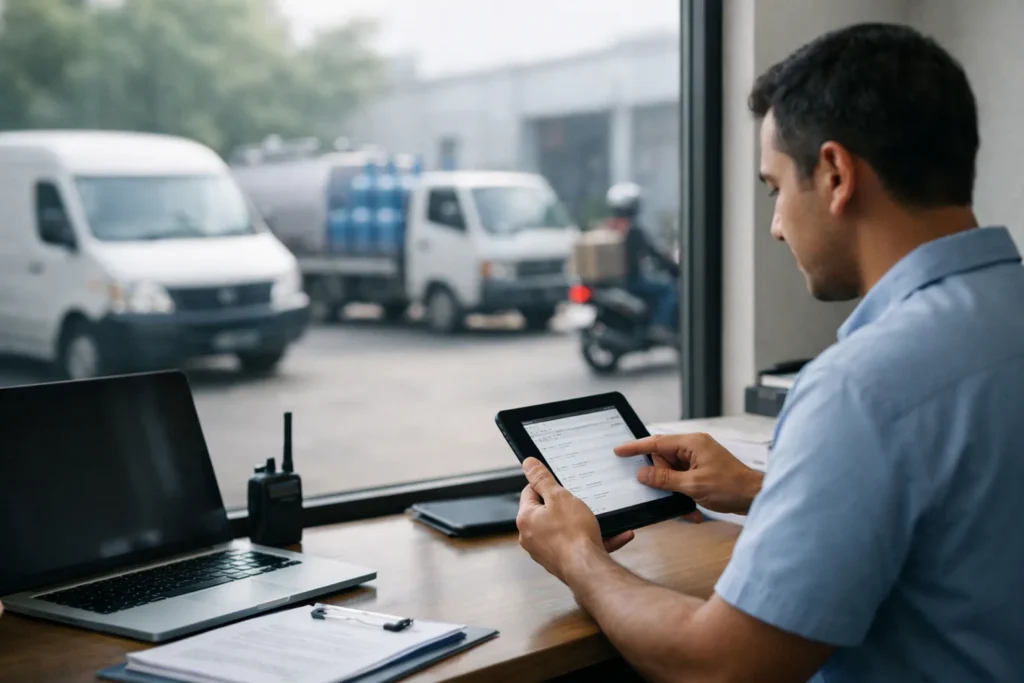
The best delivery tracking software depends on what your business delivers, how you plan routes, and what drivers must record at each stop. A water supplier collecting empty bottles has different needs from a courier carrying parcels. Milk delivery businesses may manage recurring household orders, while LPG distributors need clear cylinder movement records and proof of delivery.
Several established brands serve this market, but they approach delivery management differently. Comparing their approaches can help you select software that fits your daily work instead of adding another disconnected system.
Onfleet for general last mile delivery
Onfleet is widely associated with last mile delivery management. Its platform includes route planning, driver dispatch, live tracking, customer notifications, and delivery confirmation tools. Dispatchers can view active drivers and monitor assigned jobs from a central dashboard.
This type of platform may suit courier services, retailers, pharmacies, and other businesses that deliver separate orders to many addresses. Before choosing it, water, milk, and cylinder distributors should check how the system handles reusable containers, recurring deliveries, cash collection, stock movement, and customer balances. General delivery tracking does not always cover these industry specific workflows.
Tookan, Track POD, and OptimoRoute
Tookan combines dispatch management, route planning, driver apps, and customer communication. It supports several field service and delivery models, so it may suit businesses that need task assignment as well as live driver visibility. Operators should review how much setup is needed to reflect their order cycle and whether drivers can complete common actions quickly on a mobile device.
Track POD places strong emphasis on electronic proof of delivery. Depending on the selected setup, delivery teams can record signatures, photos, notes, and job status updates. These records can help when customers question whether an order arrived or when managers need to review a driver’s completed stops.
OptimoRoute focuses on route planning and scheduling for delivery and field service teams. It may be useful when a dispatcher must assign many stops while considering working hours, vehicle capacity, and delivery time windows. Businesses with fixed subscription routes should confirm that planned schedules can also handle missed deliveries, temporary pauses, extra quantities, and sudden address changes.
Routific is another brand often considered for route planning and dispatch. Its suitability depends on whether your main challenge is creating routes or managing the broader commercial workflow around each delivery.
Tarsil for water, milk, and LPG operations
Tarsil takes a sector specific approach. It combines live delivery tracking with operational tools for water, milk, and LPG cylinder businesses. This distinction matters because tracking a driver on a map is only one part of running a recurring delivery service.
For example, a water delivery business may need to see what a driver loaded, what the driver delivered, how many empty bottles the driver returned, and whether the driver collected payment. A milk supplier may need to manage standing orders, skipped days, quantity changes, and customer balances. An LPG distributor may need visibility into full and empty cylinder movement across vehicles and customer accounts.
A general fleet tracking platform may show vehicle locations without linking those events to orders, inventory, collections, or account records. Tarsil is intended for operators in Pakistan, the Gulf, and Africa whose work includes these recurring delivery patterns.
How to judge the brands fairly
Start with a normal working day rather than a feature checklist. Follow one order from customer entry through dispatch, driver assignment, delivery confirmation, payment recording, stock return, and account updates. Ask each provider to show how its system handles that complete sequence.
Driver usability deserves close attention. A mobile app with too many fields can slow stops and encourage drivers to enter information later. Test the app under the network conditions your routes actually encounter, and check what happens when connectivity drops.
Managers should also review permissions, activity records, customer notifications, proof of delivery options, route changes, and reports. If your business uses returnable bottles or cylinders, confirm that the software records both items sent out and items brought back. For subscription deliveries, test paused service, changed quantities, missed stops, credits, and additional orders with realistic customer accounts.