
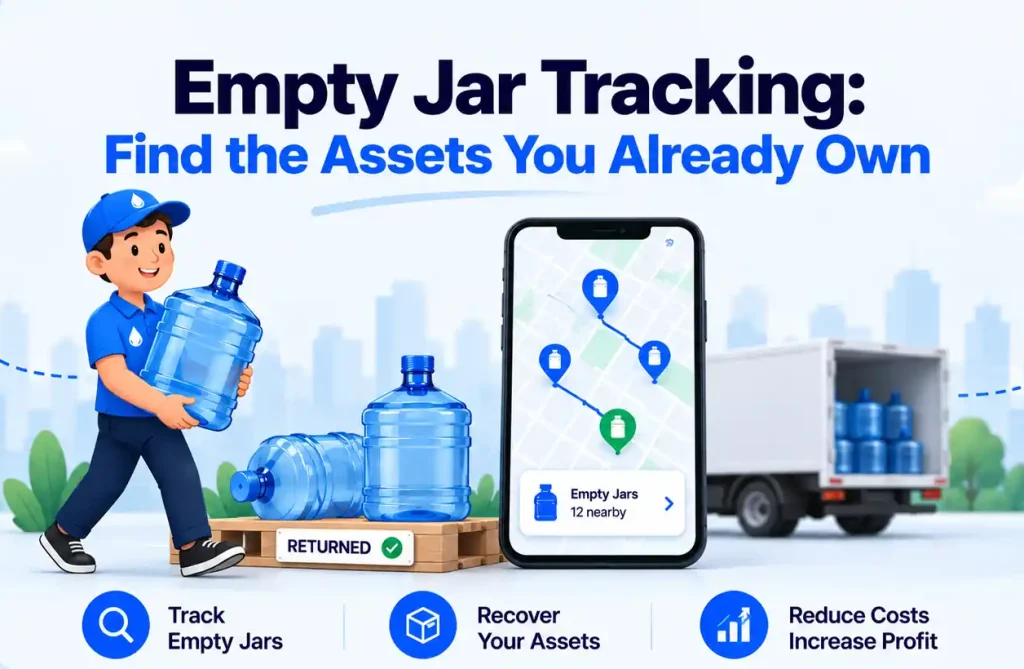
Empty jar tracking sounds like a small detail, right up until a warehouse count stops matching reality. Kwame runs a water business in Accra, and this month his stock count came up short again. Somewhere across his customer base, jars are sitting unreturned, and nobody can say exactly how many.
That gap is not a rounding error. Because each container costs real money to buy, every jar that never comes back is a small, silent loss, repeated across hundreds of customers.
So, this guide walks through what empty jar tracking actually means, how to reconcile a jar count properly, and what an unwatched year of losses adds up to.
Every Untracked Jar Is Money You Already Spent
A jar is not stock in the usual sense. Once it leaves your warehouse, you have already paid for it, and you only get that value back if it returns.
So, when a container disappears, the business loses twice. First, it loses the jar itself. Then, because the deposit tied to that jar often never gets collected either, it loses a second time on paper that it can never close out.
What Is Empty Jar Tracking?
Empty jar tracking records, for every customer, how many containers were issued, how many came back, and what deposit is held against the difference, so a business always knows where its own assets are.
You will also hear this called water jar tracking or returnable asset tracking. Whatever the label, the goal stays the same: a running balance you can trust, not a guess based on memory.
This idea is not new. Deposit-based return systems have been used for decades across many industries specifically because a refundable deposit gives people a reason to bring a container back (deposit-refund system overview).
A water business runs the same logic, just without the formal scheme behind it—which is why automated tracking is a core focus in our [Complete Operating Guide to Water Delivery Software for Bottled, Jar and 19L Delivery Businesses].
The Empties Reconciliation Loop: Issued, Returned, Held, Written Off
Proper empties reconciliation follows four stages, and most businesses only track the first one properly.
-
Issued: what leaves the warehouse
Your team must log every jar that goes out on a route against the customer receiving it. Otherwise, there is no starting number to reconcile against later.
-
Returned and held: what comes back, and what’s still out
As jars return, the system should subtract them from that customer’s balance automatically. So at any moment, you can see exactly how many jars each customer currently holds, not just how many were ever delivered.
-
Written off: when a jar is officially gone
Eventually, some jars never return. You should deliberately mark a written-off jar with a reason, rather than quietly forgetting it. Because that decision affects both your asset count and the deposit tied to it, it deserves a proper record, not silence.
What an Unreconciled Year Looks Like at 400 Customers
Picture a business with 400 customers, each holding two or three jars on average. Even a small monthly slippage, say two percent of jars never returning, adds up fast across a full year.
At that rate, roughly 100 jars could vanish annually, unnoticed because no single loss looks alarming on its own. Yet the compounding effect is real: fewer jars in circulation means less capacity, more replacement spending, and deposits nobody can properly refund or collect. Run this same math against your own customer count, and the number rarely stays comfortable.
Water Can Tracking Software: Why the Loss Is Worse With Heavier Containers
Across Nairobi and Accra, many operators run 20-litre cans rather than smaller jars. So, water can tracking software matters even more in these markets, because each lost can costs more to replace than a lighter equivalent.
The reconciliation gap is the same shape as anywhere else, but the price of ignoring it scales with the container. A business running heavier cans simply cannot afford the same slippage a lighter-jar operator might absorb without noticing.
Bottle Deposit Management: Where Tracking and Deposits Meet
A jar count on its own only tells half the story. Good bottle deposit management ties that count to the money each customer holds against their unreturned containers.
Without that link, a customer can dispute a deposit refund, and nobody can prove who is right. With it, the answer sits in the record, not in an argument.
Signs Your Jar Count Has Already Drifted
A few warning signs show up long before a full audit does.
Stock counts never quite match what the paperwork says. Customers dispute balances that nobody can confirm either way. Riders guess quantities instead of checking a real number. (Often, chaotic inventory in the field starts with chaotic route management—which is why [water delivery routing software quietly decides your margin]). And somewhere on the books, a written-off jar total sits unexplained
Where Tarsil Fits
Tarsil keeps a live jar balance for every customer, connected directly to deposits and reporting, so nothing depends on memory or a paper count. You can see how container tracking fits the wider system on the features page.
That single change is what finally closed the gap in Kwame’s Accra warehouse. His stock count now matches reality, because every issued jar and every return updates the same live record. Tarsil operators typically report around 27% lower operating costs from fixes like this one, though the number worth trusting is the one you measure in your own business.
The Bottom Line
Treat every jar as money out the door until it comes back. Reconcile issued, returned, and written-off counts on a real schedule, not once a year by accident.
Do that consistently, and empty jar tracking stops being a mystery and starts being a number you actually control.
Want to see your real jar balance for the first time?
See How Tarsil Works → Two minutes shows you where the gap actually sits.
FAQs: Empty Jar Tracking Questions Operators Ask
What is empty jar tracking?
It records how many containers each customer holds, how many have been returned, and what deposit is applied to the difference, so nothing depends on memory.
How is water jar tracking different from a delivery log?
A delivery log only shows what went out. Water jar tracking also shows what came back, which is the half most records miss entirely.
What does bottle deposit management have to do with empties?
Deposits should match the jar count exactly. Without that link, refund disputes have no record to settle them fairly.
How much can untracked jars actually cost a business?
Even a small yearly slippage compounds across hundreds of customers. Run the math on your own customer count, and the total rarely stays small.
Does water can tracking software work for heavier containers too?
Yes, and it matters more there. Heavier 20-litre cans cost more to replace, so the same tracking gap costs more per unit lost.
How often should empties reconciliation happen?
Continuously is ideal, through live balances rather than a periodic count. At minimum, reconcile monthly, since that rhythm is what makes empty jar tracking reliable instead of a once-a-year surprise.