A water delivery app only helps your business if riders use it. Miguel learned that the hard way in Johannesburg. He rolled out a polished app to his riders last year, yet within two weeks, half of them had drifted back to scribbling deliveries on paper and entering them later.
The app itself worked fine. The riders, though, quietly refused it. So, the office ended up reconstructing each day from memory anyway, which was exactly the problem the app was meant to solve.
This guide looks at the same problem from the rider’s side, and it explains what a delivery app has to get right before anyone on a route will trust it.
A Water Delivery App Fails on Adoption, Not Features
Most app decisions get made in the office, where reporting and dashboards feel important. Riders live somewhere else entirely, standing at a gate with one hand full.
So when the office’s wish list collides with the rider’s reality, the rider always wins in the end. He simply stops using the tool that slows him down. As a result, a feature-rich app nobody opens is worth less than a simple one everybody uses.
What Is a Water Delivery App, From the Rider’s Side?
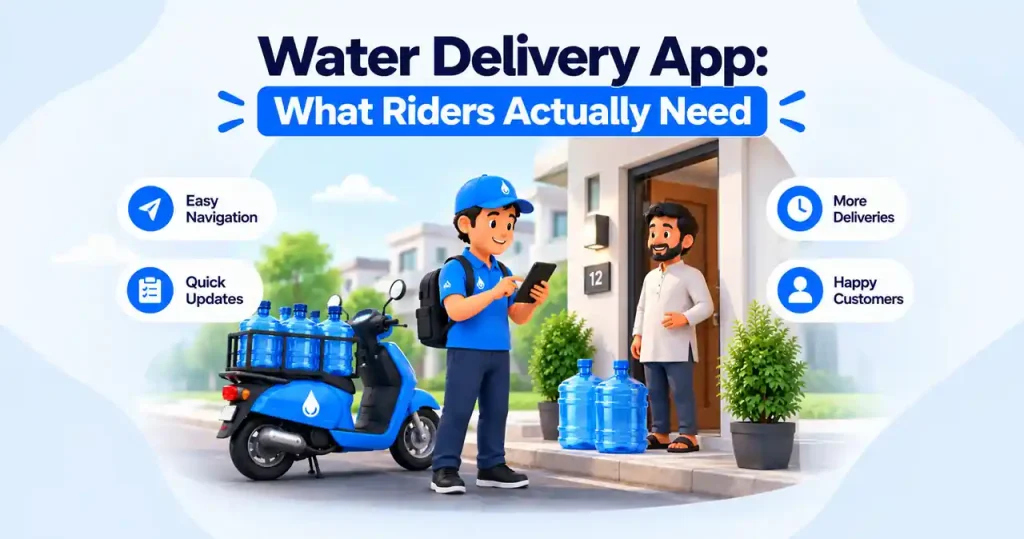
A water delivery app is the mobile tool a rider uses on the route to see the day’s stops, confirm each delivery, record the container returned, capture payment, and move to the next customer. Judged from the rider’s side, it succeeds only when it makes those five steps faster than paper, not slower.
You will also hear it called a water delivery mobile app or a water delivery driver app. The name varies, but the rider’s job behind it stays constant.
Good design here follows a well-known usability principle: the tasks people do most often should require the lowest possible effort, or what UX researchers call a low interaction cost.
A delivery happens dozens of times a day, so it has to be the fastest action in the app—a critical factor to weigh when deciding whether to [build your own water delivery app or buy a platform].
The Water Delivery Driver App Test: Taps Per Delivery
Count the taps. That one number predicts adoption better than any feature list.
-
Why eleven taps kill adoption
Imagine a rider confirming a delivery through eleven separate screens while a customer waits and two more jars need carrying. He will do it twice, maybe three times, then abandon it. Because every extra tap multiplies across a hundred stops a day, a slow flow becomes unbearable fast.
-
What a good delivery app for riders does in three
A well-built water delivery driver app confirms a standard delivery in about three taps: open the stop, confirm what was delivered, record payment. Anything the app already knows, such as the usual order, it should fill in automatically. Consequently, the rider spends his attention on the customer, not the screen.
A Rider App for Delivery Business Has to Work Offline
Signal drops constantly on real routes. It happens in basements, in stairwells, on rural stretches outside Nairobi and Lagos, and even in patches across Dubai and Riyadh.
(Running operations in the Middle East? Read our complete breakdown: Water Delivery Software: The Complete Guide for Bottled & 5-Gallon Water Businesses in the GCC)
So a rider app for a delivery business must capture the delivery offline and sync once the connection returns. Otherwise, the rider hits a dead zone, the app freezes, and he falls back to paper at the worst possible moment. A tool that only works with full signal isn’t built for fieldwork.
Language: The Water Delivery Mobile App a Rider Can Read
Riders across three regions speak many different languages. A rider reading an interface in his second or third language will hesitate, and hesitation on a busy route turns into mistakes.
Therefore, a water delivery mobile app should let each rider work in a language he reads comfortably. When the words are clear, the rider stops guessing, and the error rate on the whole route drops.
Proof at the Door: Signatures, Receipts and What the Rider Records
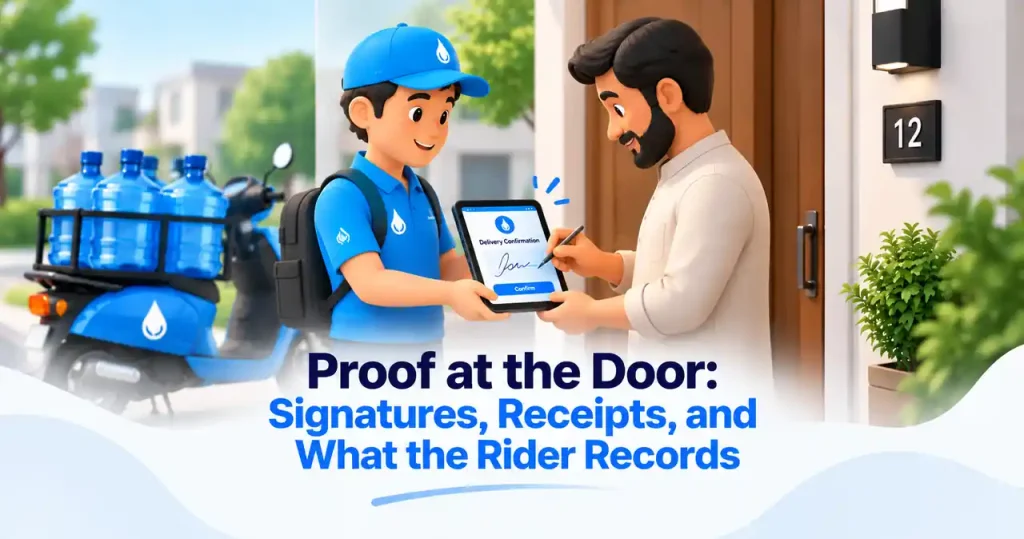
Every delivery needs a record, yet the record cannot slow the rider down. Good apps solve both at once.
-
Electronic signature or confirmation
A quick signature or tap-to-confirm on the phone proves the delivery happened, to that customer, at that moment. So a later dispute gets settled by the record, not an argument.
-
Receipt printing and cash recorded at the gate
Many customers still want a printed receipt, and most still pay cash. A good app prints from a small Bluetooth printer and logs the payment right there, so nothing waits until evening to be remembered. That single habit closes the gap where cash usually goes missing.
Where a Water Delivery Tracking App Fits (and Where It Doesn’t)
A water delivery tracking app for customers sounds appealing, and sometimes it helps. For recurring routes, though, it matters far less than the connection between the office and the rider.
A household that gets water every week rarely wants a live map. It wants the delivery to arrive and the bill to be right, which depends on the rider’s app, not the customer’s.
Where Tarsil Fits
Tarsil builds the rider’s app around exactly these needs: few taps per delivery, offline capture that syncs later, multiple languages, electronic signature proof, and one-click receipt printing to a Bluetooth printer. You can see how the rider app connects to the wider system on the features page.
That combination is why Miguel’s riders in Johannesburg finally stopped reaching for paper. The app fit their day instead of fighting it, so they actually kept using it.
The Bottom Line
Buy for the rider, not the dashboard. Count the taps, test it offline, and check it in the rider’s own language before you commit.
Get those right, and a water delivery app becomes the tool your team reaches for instead of the one they quietly work around.
Want an app your riders will actually use?
Start Your Free 14-Day Trial → Hand it to one rider for a week and watch.
FAQs: Water Delivery App Questions Operators Ask
What is a water delivery app?
It is the mobile tool a rider uses to see stops, confirm deliveries, record containers, and take payment on the route. It works only when it beats paper for speed.
Why do riders stop using a water delivery driver app?
Usually because it takes too many taps or fails without signal. When the app slows them down, riders quietly return to paper and enter it later.
Does a rider app for a delivery business need to work offline?
Yes, absolutely. Signal drops on real routes, so the app must capture the delivery offline and sync once the connection comes back.
Can a water delivery mobile app support more than one language?
It should. Riders across regions speak different languages, and an app each rider reads easily cuts hesitation and mistakes on the route.
What proof should the app capture at the door?
A signature or confirmation, a printed receipt where wanted, and the payment logged on the spot. That record settles disputes without an argument.
Is a water delivery tracking app worth it for recurring routes?
Rarely as a priority. For repeat customers, a reliable water delivery app for the rider matters far more than a live tracking map for the customer.