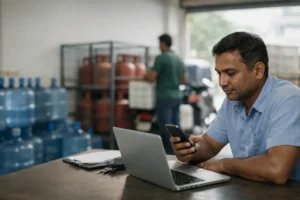

LPG cylinder deposit tracking stopped being simple for Majid, an Abu Dhabi distributor, when a restaurant asked about its balance. He knew the restaurant held six cylinders. But he could not say how much deposit to hold, or how much to refund.
The cylinder count, the deposit money, and the unpaid gas invoices were three separate records. Yet his notebook blended them into one number.
This guide explains LPG cylinder deposit tracking step by step. It covers the three records, refill exchanges, extra cylinders, and a full worked customer statement.
Then it shows how refunds work and how to reconcile balances. It also covers commercial customers in the UAE and GCC, and where Tarsil fits.
This guide draws on independent desk research and the Tarsil team’s workflow analysis. All figures here are illustrative, not customer data or market rates.
What Is LPG Cylinder Deposit Tracking?
LPG cylinder deposit tracking means recording the cylinders a customer holds and the deposit money held against them. Gas invoices stay on their own record. Take a customer with 4 cylinders and a 40 deposit on each. That puts 160 on deposit. Then two more cylinders at 50 each add 100. So the account shows 6 cylinders and 260 on deposit.
Why LPG Cylinder Deposit Tracking Becomes Difficult
Most deposit errors start when records drift apart. Four causes open the gap:
- Handoffs that nobody records.
- Deposits collected at an old rate.
- Partial returns with no matching refund.
- Customer and driver records kept in separate places.
So small gaps pile up until nobody trusts the balance.
Three Records in LPG Cylinder Deposit Tracking: Cylinders, Deposits and Invoices
Keep three records for every customer, and never merge them into one balance. This is a working framework, not an industry standard.
LPG Cylinders Held by the Customer
Count this one by cylinder size. It rises with each additional cylinder and falls with each return.
LPG Cylinder Deposit Money Held for the Customer
Record this one when you collect the money. It may have to go back to the customer, so keep it separate from gas sales.
Unpaid Gas Invoices Beside LPG Cylinder Deposits
Gas charges form a third record under LPG delivery billing. A customer can owe for gas and still have a full deposit on file. The deposit shows what you may have to refund. The invoice shows what the customer owes you.
Refill Exchange vs Additional Cylinder in LPG Cylinder Deposit Tracking
A one-for-one exchange swaps an empty for a filled cylinder. The customer holds the same number, so the deposit normally stays as it is. But an additional cylinder raises the count by one, so it normally brings a new deposit. Your contract decides both cases, so write the rule down. Without it, staff either charge a second deposit on a plain refill or skip one on an extra cylinder.
How to Track LPG Cylinder Deposits Step by Step
Run the same four steps for every customer.
Open the Customer Account and Record the First LPG Cylinder Deposit
Record the customer, cylinder size, quantity, deposit amount, and date. Give the customer a receipt or reference number. And note the rate collected, because rates can change later.
Record Each Delivery and Exchange in LPG Cylinder Deposit Tracking
Log filled cylinders delivered and empties collected on every visit. The difference is the net change in cylinders held.
Record Extra Cylinders and Additional LPG Cylinder Deposits
When the net change is a plus, collect and log a deposit for each extra cylinder. Then link that deposit to the delivery.
Record Returns and Refunds in LPG Cylinder Deposit Tracking
Log each return against the customer’s account. Then log the refund as its own entry, with a date and a reference.
How to Calculate LPG Cylinder Deposits and Outstanding Cylinders
Consider a restaurant customer in Abu Dhabi. The amounts are illustrative, not market rates.
| Event | Cylinders held | Deposit held | Gas invoice owed |
| Opening balance (4 cylinders, 40 deposit each) | 4 | 160 | 0 |
| Deliver 3 filled cylinders (gas at 60 each) | +3 | no change | +180 |
| Collect 1 empty cylinder | −1 | no change | no change |
| Collect 2 additional deposits at 50 each | no change | +100 | no change |
| Customer pays part of the gas invoice | no change | no change | −100 |
| Closing balance | 6 | 260 | 80 |
Of the 3 filled cylinders, 1 was swapped for the empty one, so it needed no new deposit. The other 2 were additional, so they brought 2 deposits.
- Cylinders held: 4 + 3 − 1 = 6.
- Deposit held: 160 + 100 = 260.
- Gas invoice owed: 180 − 100 = 80.
So gas payments never change the deposit balance.
How LPG Cylinder Deposit Refunds Work
AccountingCoach describes a customer deposit as money a business receives before it earns it. The business must then deliver or return the money. A cylinder deposit secures the cylinder and does not prepay gas. Still, the same caution applies: that money may have to go back. How you record it depends on your contract and local rules, so check with your accountant.
Full and Partial LPG Cylinder Deposit Refunds
Say the restaurant permanently returns 2 of its 6 cylinders. That is a partial refund. The other 4 cylinders keep their deposits on file. Still, the restaurant owes 80 for gas. If the contract allows offsetting, show the refund and the payment as two entries, not one net figure.
Refunding the LPG Cylinder Deposit Actually Collected, Not Today’s Rate
Refund the amount you collected, not today’s rate. If the 2 returned cylinders match the newer deposits, the refund is 100, and 160 remains on deposit. If they match the older ones, the refund is 80, and 180 remains. So your contract should say which deposits a return clears.
Pending, Disputed and Damaged LPG Cylinder Deposit Refunds
Mark a refund pending until someone checks the return. Hold a disputed one until the customer statement, delivery proof, and return record agree. A damaged cylinder needs a recorded inspection before any deduction, which must follow your contract. Record who approved each refund and when.
How to Reconcile LPG Cylinder Deposits With Customer and Delivery Records
Daily and Monthly LPG Cylinder Deposit Tracking Checks
Each day, compare cylinders held with the delivery and return records. Each month, check that the deposit held matches the recorded deposits for the cylinders held. Have a supervisor sign off. Then share a monthly statement with each customer. Cylinders held, deposit held, and gas owed should sit on separate lines. So any disagreement surfaces early.
Investigating LPG Cylinder Deposit Mismatches
Start with the last delivery and return slips. Then look for a missing deposit, a refund with no return, or a rate change. Record the cause before you adjust anything.
LPG Cylinder Deposit Tracking for Commercial Customers in the UAE and GCC
Restaurants, hotels, and dealers can hold many cylinders across several sizes and sites. So track each size and each site as its own line. And keep dealer deposits apart from retail ones, since dealers can carry different credit terms. Remember that deposit rules and customs differ by emirate and country, so check current requirements with your local authority.
Manual vs. Digital LPG Cylinder Deposit Tracking
A notebook can work for a handful of customers. But every extra customer, size, or branch adds balances to reconcile by hand.
| Area | Manual (notebook or spreadsheet) | Digital system |
| Customer balances | Rebuilt from slips | Updated as records change |
| Deposit entries | Written on receipts, copied later | Logged once per transaction |
| Refunds | Calculated by hand | Linked to returns and the original deposit |
| Audit trail | Memory and handwriting | Dated entries showing who recorded them |
| Mismatch checks | Searching old paper | Filtering by customer and date |
But some operators also tag cylinders with IDs or QR codes. Those help prove which cylinder came back. Still, quantity-level tracking works without them. And while dedicated LPG cylinder delivery software only records what your team enters, it removes the need to reconcile three different notebooks by hand
Where Tarsil Fits Into LPG Cylinder Deposit Tracking
As a complete system for LPG cylinder delivery management, Tarsil brings customers, orders, cylinders, deposits, deliveries, drivers, and billing into one platform. Cylinder deposits and customer cylinder balances sit directly alongside your delivery and billing records. So your team works from one customer account instead of three notebooks.
Still, your team sets the deposit rules and approves refunds. Tarsil keeps the records those decisions rely on.
Book Your Free Demo Today → See how this would work for your own LPG delivery business.
FAQs About LPG Cylinder Deposit Tracking
What is LPG cylinder deposit tracking?
It means recording the cylinders each customer holds and the deposit money held against them. Gas invoices stay on a separate record.
Do you charge a new deposit on every refill?
Usually not. A one-for-one exchange leaves the number of cylinders unchanged, so the deposit normally stays. An additional cylinder normally needs its own deposit, but your contract decides.
How do you calculate a partial refund?
Refund the deposits recorded for the cylinders actually returned. Use the amount collected, not today’s rate, and follow your contract.
What if the deposit balance and the cylinder count disagree?
Check the last delivery and return slips first. Then look for a missing deposit, a refund with no return, or a rate change. Get sign-off before adjusting.
Should gas invoices and deposits share one balance?
No. A customer can owe for gas and still have a full deposit on file. Keep each as its own record so neither hides the other.
Can software help with LPG cylinder deposit tracking?
Software can keep cylinders, deposits, and invoices in one account that updates as work happens. But it records only what your team enters, so you still need checks.