

LPG cylinder inventory management stopped feeling simple for Hamdan, a distributor in Sharjah, on one ordinary Monday. His sheet opened the day with 250 filled cylinders. By evening, it showed 250 again. Yet the floor count said 248.
Between those two numbers, 100 cylinders had arrived, and 80 had gone out on trucks. Another 30 had left for a second branch. Then 10 had come back unsold. Still, nobody could say whether the two missing cylinders had vanished, slipped through a miscount, or stayed in transit.
This guide explains LPG cylinder inventory management step by step. It covers stock types, receipts, transfers, vehicle loads, and a worked stock movement ledger.
Then it shows how to reconcile a physical count and investigate a shortage. It also lists common problems with fixes, a daily checklist, UAE and GCC notes, and where Tarsil fits.
This guide draws on independent desk research of published LPG industry guidance and on the Tarsil team’s workflow analysis. All figures here are illustrative examples, not customer data.
What Is LPG Cylinder Inventory Management?
LPG cylinder inventory management means recording every cylinder by size, condition, location, and custody as it moves. It covers the warehouse, delivery vehicles, other branches, and cylinders held by customers. So the aim is not one big total. The aim is several balances that show where each cylinder sits and who is responsible for it. Then a manager can answer one question at any hour: how many filled cylinders can we sell right now?
Types of LPG Cylinder Inventory: Condition, Location and Custody
Every cylinder has a condition, a location, and a person responsible for it. Mixing these into one status gives you a total nobody trusts. So record condition and custody separately. This is a working framework, not an industry standard.
Filled LPG Cylinder Inventory
Filled cylinders are ready to sell. Count them by cylinder size and by location. But a filled cylinder on a truck is not available to a walk-in customer. It needs its own line.
Empty LPG Cylinder Inventory
Empty cylinders need refilling. Count the empties in your warehouse and, separately, the ones customers still hold. An empty at a customer’s door is not warehouse stock until it comes back, which is why strict LPG cylinder return tracking is essential to prevent losses in the field.
Damaged, Quarantined and Inspection-Pending LPG Cylinder Stock
Some cylinders fail a check or wait for one. Keep damaged, quarantined, and inspection-pending cylinders out of saleable stock. And if they stay in the filled count, you promise cylinders you cannot deliver.
In-Transit, Vehicle-Held and Customer-Held LPG Cylinders
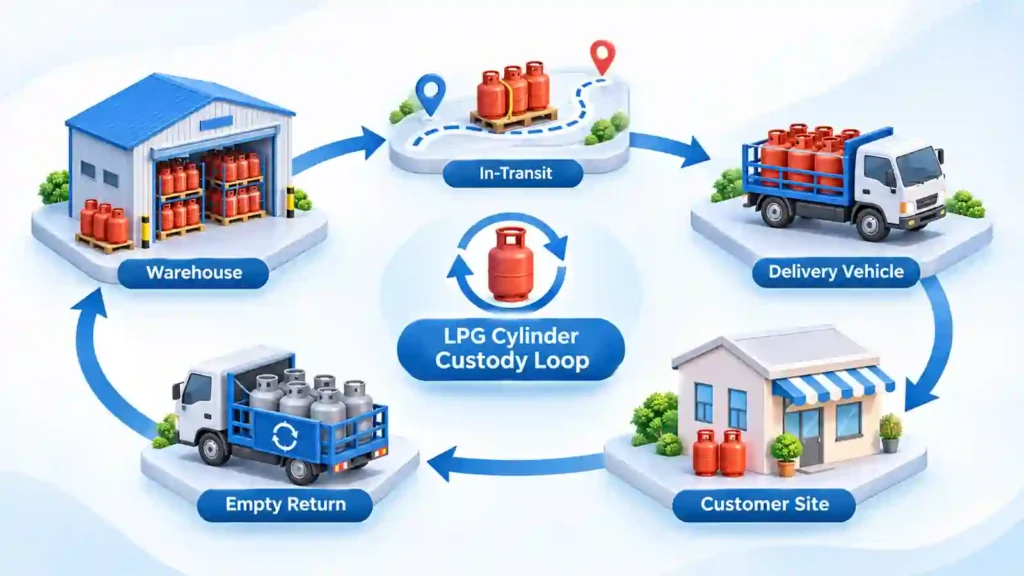
These describe where a cylinder is and who has it, not what condition it is in. Knowing exactly who holds a specific asset at any given time is the foundation of how LPG cylinder tracking actually works. A cylinder on a truck, in a transfer, or on a customer’s shelf still exists. Yet it sits outside the warehouse balance. Give customer-held cylinders a balance for each account.
LPG Cylinder Inventory Management: Recording Receipts and Branch Transfers
Recording Incoming LPG Cylinder Stock
Log every receipt on the day it arrives. Capture the date, source, cylinder size, quantity, and the person who confirmed the count. And note each cylinder’s condition at the gate, so a damaged delivery never joins the filled balance. Because disputes are easy to settle at the gate, count before the driver leaves.
Managing LPG Cylinder Stock Transfers Between Branches
A transfer touches two ledgers. The sending branch lowers its balance when cylinders leave. But the receiving branch adds them only after it confirms the count. Until then, show them as in transit, so no cylinder counts twice.
LPG Cylinder Inventory Management During Dispatch and Vehicle Loading
Dispatch is the critical handover point between warehouse tracking and active LPG cylinder delivery management. It moves cylinders from the warehouse balance to a vehicle balance. So it is a transfer, not a loss or a sale. Without that distinction, a loaded truck looks like a stock shortage at the warehouse.
Recording Vehicle Loading in LPG Cylinder Inventory Management
Record each load by vehicle, rider, cylinder size, and quantity. Separate the cylinders booked for customers from any extra ones carried for walk-up sales. Then the warehouse and the rider sign off on the same number.
Reconciling LPG Cylinder Inventory on Vehicles After Deliveries
At return, a vehicle should close to zero. Truck 2 left with 28 filled cylinders. It delivered 22—which feed directly into LPG delivery billing—and returned 6 unsold. So 22 plus 6 equals 28, and the truck closes at zero. If the total falls short, recount before you blame the rider. But empty collections need their own record, separate from filled stock.
LPG Cylinder Inventory Management Ledger: Tracking Every Stock Movement
A stock movement ledger lists every change to one balance, in order. Here is Hamdan’s Monday at his Sharjah warehouse. The figures are illustrative. The table covers filled cylinders only, so empties, vehicle-held and customer-held cylinders sit outside it.
| Warehouse movement | Filled cylinders |
| Opening warehouse stock | 250 |
| Filled cylinders received | +100 |
| Loaded onto delivery vehicles | −80 |
| Transferred to another branch | −30 |
| Undelivered filled cylinders returned | +10 |
| Expected warehouse closing stock | 250 |
| Physical warehouse count | 248 |
| Variance | −2 |
Start with opening stock. Add receipts, inbound transfers, and filled returns, then subtract loads, outbound transfers, and quarantine moves. Here, 250 + 100 − 80 − 30 + 10 gives 250 expected units. A physical count of 248 leaves a variance of −2.
The 10 returns include the 6 from Truck 2. And the 80 loaded cylinders left the warehouse balance but remain company stock. So those two missing cylinders need an investigation before anyone edits the ledger. Keep a separate ledger like this for empties and for customer-held cylinders.
How to Reconcile Physical Counts in LPG Cylinder Inventory Management
Calculate Expected Closing LPG Cylinder Stock
Do this before anyone walks the floor. Take the opening balance, apply every recorded movement, and write down the expected figure. Because counting first tempts a team to force the numbers to agree, the order matters.
Compare Physical LPG Cylinder Stock Counts With Recorded Balances
Count by cylinder size and by condition, not just in total. And count at a fixed time, after you log the day’s receipts and loads. Then compare each line with the ledger. Busy yards can try cycle counting, which AccountingTools explains as counting a small amount of inventory each day.
Investigate LPG Cylinder Inventory Discrepancies
A variance is a question, not a verdict. So work through the same sequence each time:
- Recount by cylinder size and condition.
- Check the receipt cut-off time.
- Then verify vehicle unloads against rider sheets.
- Confirm the other branch accepted every transfer.
- And inspect the damaged and quarantine area.
- Record the cause and get a supervisor’s approval before adjusting the ledger.
In Hamdan’s illustrative case, the recount found two cylinders that had failed inspection and sat in the quarantine corner. Because nobody had logged the move, the ledger still counted them as filled. So the fix was a quarantine entry of −2, not a loss write-off. Then the expected stock fell to 248 and matched the floor count.
The same AccountingTools page says each error found deserves an investigation into its cause. So never adjust first and explain later.
Common LPG Cylinder Inventory Management Problems and How to Solve Them
These six problems can distort LPG stock records. And each has a practical fix.
| Problem | Why it happens | Fix |
| Weak custody records | Handovers go unrecorded between warehouse, vehicle, and customer | Record every handover by location and person |
| Empties not matched | Rider-declared collections never meet warehouse counts | Compare both numbers daily and investigate gaps |
| Damaged cylinders counted as saleable | Condition is missing from the stock record | Hold damaged and inspection-pending stock on separate lines |
| Transfers counted twice | Both branches show the same cylinders | Show them as in transit until the receiver confirms |
| Mixed cylinder sizes | Only one total exists | Count and record by size |
| Extra vehicle stock hidden | Walk-up stock rides along unrecorded | Log booked, extra, and returned cylinders separately |
One working hypothesis, not a measured result: slow cylinder circulation can tie up capital in extra cylinders.
LPG Cylinder Inventory Management in the UAE and GCC
Distributors with more than one branch or site hold stock in several places at once. The ledger logic in this guide works the same in Sharjah, Riyadh, or Muscat. What changes is the rule set around storage, licensing, and safety. And those rules differ by emirate and by country. So check current requirements with your local authority before changing how you store or record cylinders.
Daily LPG Cylinder Inventory Management Checklist
Run these nine checks at close of business.
- Confirm opening balances by cylinder size.
- Log every receipt with its source and condition.
- Then record each vehicle load and rider.
- Match each transfer sent with the one received.
- And log filled cylinders that came back unsold.
- Count the floor by size and condition.
- Compare the count with the expected closing stock.
- Investigate every variance before you touch the ledger.
- Finally, get supervisor sign-off on the day’s balances.
Manual vs. Digital LPG Cylinder Inventory Management
Paper and spreadsheets can work for one yard and a couple of trucks. But past that, every extra branch or vehicle adds another set of numbers to reconcile by hand. Yet the higher cost is the evening spent rebuilding totals.
| Area | Manual (paper or spreadsheet) | Digital system |
| Stock visibility | Totals rebuilt at day’s end | Balances by location as records update |
| Branch transfers | Two sheets matched by phone call | One transfer record with send and receive steps |
| Vehicle counts | Rider slips checked on return | Loads and returns logged per vehicle |
| Audit trail | Handwriting and memory | Dated entries showing who changed what |
| Exception investigation | Searching through paper | Filtering by date, size, or vehicle |
| Reporting | Compiled by hand | Generated from the same records |
Still, software only records what your team enters, and it does not remove the need for a physical count.
Where Tarsil Fits Into LPG Cylinder Inventory Management
As a complete LPG cylinder delivery software, Tarsil brings customers, orders, cylinders, deposits, deliveries, drivers, and billing into one system, with reports on top. Riders log delivered and collected quantities from the driver app at each stop. So the warehouse does not reconcile from memory at day’s end.
Still, Tarsil supports your process and does not replace it. Your team counts the floor, investigates variances, and approves adjustments.
Book Your Free Demo Today → See how this would work for your own LPG delivery business.
FAQs About LPG Cylinder Inventory Management
What are the main types of LPG cylinder inventory?
Filled, empty, and damaged or inspection-pending cylinders describe the condition. Vehicle-held, in-transit, and customer-held cylinders describe location and custody. Track each view on its own ledger.
How do you calculate closing LPG cylinder stock?
Start with opening stock. Add receipts, inbound transfers, and filled returns, then subtract loads, outbound transfers, and quarantine moves. Compare the result with the physical count.
What should you do when the physical count is short?
Recount by size and condition first. Then check receipt cut-offs, vehicle unloads, and branch transfers. Adjust the ledger only after a supervisor approves the recorded cause.
How should you record damaged LPG cylinders?
Move them out of filled stock into a separate damaged or quarantine line, with the date and reason. Never count them as available for delivery. Review inspection-pending cylinders on a fixed schedule.
Is a cylinder on a delivery truck still part of inventory?
Yes. It has left the warehouse balance but still belongs to the business. Record it as vehicle-held until the rider delivers it or returns it.
Can software help with LPG cylinder inventory management?
Software can keep balances, transfers, and handovers in one record that updates as work happens. But it records only what your team enters, so you still need a physical count.