LPG cylinder return tracking became Omar’s biggest headache three months into running his delivery operation in Dubai. His riders dispatched 40 filled cylinders one Monday morning, delivered 34 and brought back only 29 empties. Nobody could say where the other five had gone: still with customers, sitting on a truck, or actually missing.
That gap is normal for a growing LPG business, not automatic proof of theft. Most of it comes down to custody. It means knowing exactly who holds each cylinder at every point between the depot and the customer’s kitchen. If you are setting up your logistics from scratch, it helps to first understand exactly how LPG cylinder tracking actually works end-to-end.
This guide walks through why empty cylinders go missing and how to calculate what’s actually outstanding. It also covers how to reconcile what a rider says they returned against what the warehouse actually receives. Then it covers overdue cylinders, deposits, and a daily closing routine.
Then it compares manual tracking to a digital system. It also looks at where Tarsil fits for businesses managing this across the UAE and the wider GCC.
What Is LPG Cylinder Return Tracking?
LPG cylinder return tracking means recording every filled cylinder that leaves the depot. It matches that record against every empty cylinder that returns, by customer and rider. It covers customer holdings, rider custody between stops, and the warehouse’s end-of-day physical count.
That’s narrower than complete LPG cylinder delivery management, which covers everything from initial orders to final billing, as well as depot stock and incoming filled cylinders from the supplier.
Why Empty LPG Cylinders Go Missing
Most missing cylinders trace back to one of five causes.
| Cause | Warning Sign | Corrective Action |
| Unrecorded customer exchange | Customer insists it was returned, no log entry exists | Record every exchange at the point of delivery |
| Delayed rider collection | An empty sits at the customer’s premises for days | Set a collection window and follow up on it |
| Rider handover gap | The rider’s count differs from the warehouse receipt | Compare both counts before closing the day |
| Mixed cylinder sizes | The wrong size gets logged against the wrong customer | Record cylinder type with every transaction |
| Unlogged branch transfer | A cylinder moves between branches with no transfer note | Log inter-branch transfers like any other delivery |
None of this means the cylinder is gone for good. Instead, it means nobody has reconciled the record yet. A supervisor reviewing the table each week usually spots the same one or two causes repeating. Still, it’s often tied to a specific rider or route.
How to Track Filled and Empty Cylinder Movements
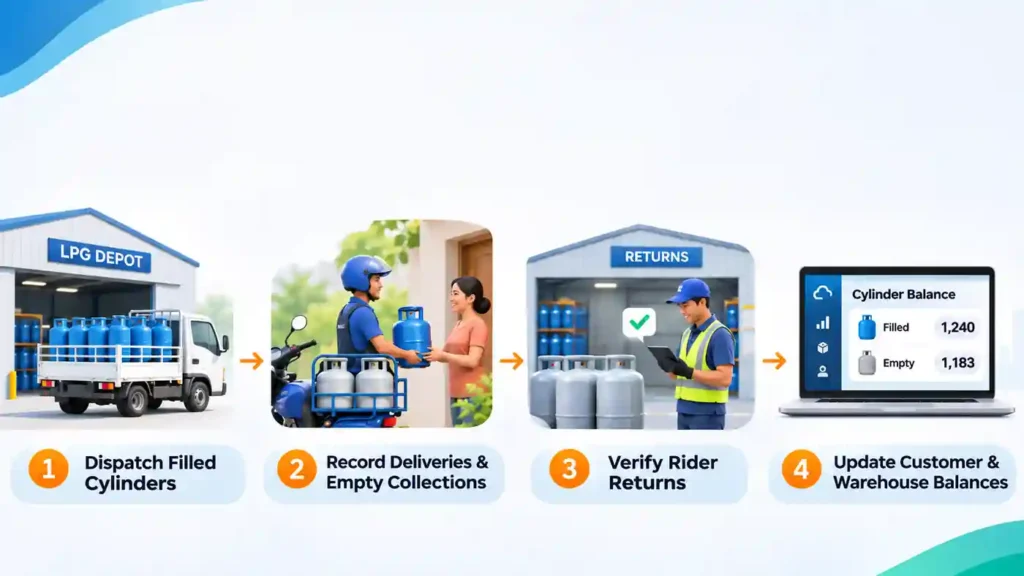
Four points in the cycle each need their own record.
1. Record Filled Cylinders at Dispatch
Log the quantity and type loaded onto each rider’s vehicle before it leaves the depot.
2. Record Deliveries and Empty Collections
At each stop, record what’s delivered and what’s collected as two separate numbers, not one net figure.
3. Verify Rider-to-Warehouse Returns
When the rider returns, count what actually comes off the vehicle against what they reported collecting.
4. Update Customer and Warehouse Balances
Then update the customer’s outstanding balance and the warehouse’s empty stock from that same transaction, which ties directly into your broader LPG cylinder inventory management to track every stock movement
How to Calculate Outstanding LPG Cylinders
The formula is simple: opening outstanding, plus cylinders issued, minus empties returned. For one customer, an opening balance of 10, plus 8 filled cylinders issued, minus 6 empties returned, leaves 12 outstanding. Still, the real number depends on the exchange terms agreed with that customer.
A one-for-one swap account should rarely carry more than one or two cylinders at a time. Track this per customer, not as one combined number across the whole route. Instead, a single account’s balance gets lost inside the combined total.
How to Reconcile Rider Returns in LPG Cylinder Return Tracking
This is where most discrepancies actually surface.
Compare Issued, Delivered, Collected and Returned Quantities
| Movement | Quantity |
| Filled cylinders loaded | 30 |
| Filled cylinders delivered | 25 |
| Filled cylinders brought back | 5 |
| Empties collected from customers | 22 |
| Empties physically received at warehouse | 20 |
Twenty-two collected against 20 received leaves a two-cylinder gap to investigate.
Investigate Discrepancies Before Recording Losses
AccountingTools describes the same logic for a physical inventory count. Compare the count against the record, then find out why they differ before adjusting anything. So treat a gap like this as a question first. Check the rider’s route log and call the last two customers on it. Then look for a delivery that has no matching collection entry. Write it off only after checking every lead.
How to Handle Overdue and Unreturned LPG Cylinders
A customer holding a cylinder for three weeks isn’t automatically a loss. Instead, check the agreed return terms first, since some commercial accounts legitimately hold several cylinders at once. Then review the handover record, and contact the customer or the rider who made that delivery directly. Then log what you find and set a follow-up date, rather than closing the question with a guess.
Managing LPG Cylinder Deposits and Refunds
Keep the cylinder count and the deposit ledger separate, even though they’re connected—we cover this process fully in our guide to LPG cylinder deposit tracking and managing customer refunds. A returned cylinder clears the physical custody balance. The deposit refund is a separate financial transaction, tracked on its own line. Refund the deposit only after confirming the returned cylinder has no damage and is the right type. Otherwise, the balance ends up wrong on both sides of the ledger.
In the UAE, deposit amounts vary by distributor and cylinder size. So treat any AED figure here as an illustration, not a market rate.
LPG Cylinder Return Tracking in the UAE and GCC
UAE households and small businesses usually run on a simple one-for-one exchange, logged at the door. Commercial accounts, like restaurants, often hold several cylinders under an agreed limit instead of exchanging one at a time. Multi-branch operators across the wider GCC face an extra layer.
Then a cylinder issued from one branch can come back to another, and that transfer needs its own record. A commercial account might run on a 20-cylinder limit, for instance. Still, it won’t trigger an alert until holdings exceed that agreed number. Still, distribution and safety rules differ by emirate and country. So check local regulations directly rather than assuming they’re the same everywhere.
Daily LPG Cylinder Return Tracking Checklist
- Record opening cylinder counts for the depot and each vehicle.
- Confirm dispatch quantities against what each rider actually loaded.
- Then match delivery and collection entries from the day’s route.
- Count empties physically received at the warehouse.
- Investigate and log every discrepancy before closing the day.
- Get supervisor sign-off on the final count.
Following these in order catches most gaps before they turn into next week’s dispute. Assign one person to own the exception list, not the whole team collectively. A named owner means every unresolved gap has someone accountable for closing it, not just logging it.
Manual vs. Digital LPG Cylinder Return Tracking
A notebook can track cylinder returns for a small operation. Past a handful of riders, matching everyone’s numbers by hand gets slow and error-prone
| Task | Manual | Digital |
| Customer return balance | Spreadsheet or paper updates | Centralized customer movement history |
| Rider handover | Separate slips or messaging | Logged dispatch and return events |
| Daily closing | Manual cross-checks | Consolidated transaction records |
| Deposit reconciliation | Separate money ledger | Linked account context, where supported |
| Dispute investigation | Find and compare documents | Review time-stamped transaction history |
Still, the system only works if riders actually log every handover.
Where Tarsil Fits Into LPG Cylinder Return Tracking
Tarsil tracks cylinders, deliveries, drivers, and LPG delivery billing in one system, recording empty cylinders in and out for each customer. Riders log delivered and collected quantities from their driver app at the point of delivery. If you’re evaluating your tech stack, check our breakdown of which LPG cylinder delivery software includes driver apps built specifically for this workflow. So the warehouse isn’t reconciling from memory at day’s end.
The same record also feeds the daily reconciliation, so a supervisor isn’t rebuilding the day’s totals from separate slips. Still, it supports the record-keeping; investigating a specific discrepancy depends on your own team checking it.
See How Tarsil Works → See how cylinder tracking, rider delivery, and billing work together.
The Bottom Line
LPG cylinder return tracking comes down to one habit: record every handover, and investigate every gap before writing it off. Most missing cylinders turn out to be a logging problem, not theft.
Book Your Free Demo Today → See how this would work for your own cylinder delivery business.
FAQs About LPG Cylinder Return Tracking
How do LPG distributors track empty cylinder returns?
They log filled cylinders at dispatch, then record deliveries and collections separately. Then they match the rider’s count against what the warehouse physically receives.
How do you calculate outstanding LPG cylinders?
Add filled cylinders issued to the opening balance, then subtract empties returned. The result is what’s still outstanding with that customer.
What causes missing LPG cylinders during delivery?
Most cases trace back to unrecorded exchanges, delayed rider collection, handover gaps, or a branch transfer that was never logged.
How often should LPG cylinder returns be reconciled?
Daily, at the end of each route. Catching a gap the same day is far easier than tracing it back weeks later.
How are LPG cylinder deposits managed when customers return cylinders?
The physical cylinder count and the deposit refund are tracked separately. Returning the cylinder clears the custody balance, and the refund is its own transaction.
Can LPG cylinder returns be tracked without RFID or QR codes?
Yes. Consistent manual or digital logging of dispatch, delivery, and collection quantities works without any tagging technology. It just depends on disciplined data entry.