

A Peter grew his dairy delivery route in Nairobi from sixty households to almost four hundred. The register that worked fine at sixty started lying to him somewhere past two hundred. He didn’t replace his milk delivery system because some salesman talked him into it. Instead, he replaced it because the register could no longer tell him who owed what.
That gap between “still runs” and “still works” is where most small dairies live far longer than they should. A register is cheap, it’s familiar, and honestly, nobody wants the hassle of replacing something that still technically works. But growth exposes exactly where the register falls short.
What Is a Milk Delivery System?
A milk delivery system is software that runs a dairy’s daily operations in one place. It covers standing orders, daily quantity changes, routes, rider assignments, billing, and collections.
Instead of the paper register and the separate spreadsheets most small dairies patch together, it keeps everything connected. The result is one record everyone can trust.
You’ll also hear this called a milk management system, or one of several options covered in our Milk Delivery Software: The Complete Guide to Daily Routes and Monthly Billing. Some call it a dairy delivery system instead. The names change depending on who’s selling it. Still, what doesn’t change is the job: one record for a growing dairy, instead of several.
Where a Register Still Beats a Milk Management System
A register deserves some credit before this article takes it apart. Because, honestly, it earns it.
It costs nothing beyond a notebook. Every rider already knows how to use it — no training, no login, nothing to explain. And at a small enough scale, it’s different. Under fifty customers on one route, a careful owner can hold the whole business in his head. So the register becomes backup at that size, not the system of record.
Still, the problem isn’t the register itself. It’s the point where the business outgrows what one notebook, one memory, and one owner’s attention can carry.
Five Places a Register Breaks as a Milk Delivery System Grows
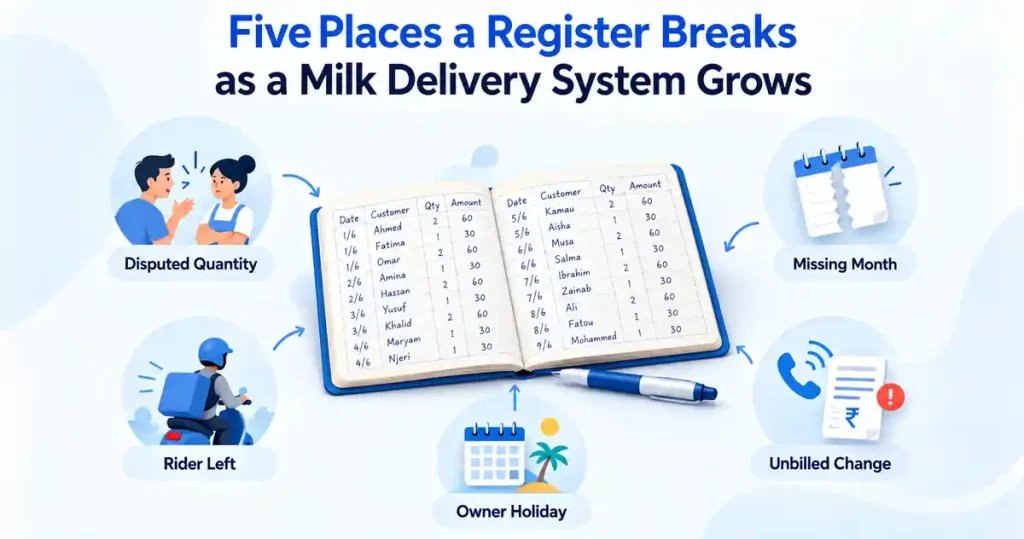
Growth doesn’t break a register all at once. Instead, it breaks at five specific points, and Peter’s dairy hit every single one of them within eighteen months.
1. The disputed quantity
A customer swears she always gets two litres. The register says one and a half, in handwriting nobody can quite date anymore. So neither side can prove the other wrong. Then the argument drags on until the dairy either eats the cost or loses the customer.
2. The missing month
One page gets torn, soaked, or just goes missing — and an entire month of billing history goes with it. There’s no backup copy of a notebook. Once it’s gone, that revenue is gone too. Nobody can reconstruct what thirty days of deliveries actually added up to.
3. The rider who left
One rider knows which households pay late, which gate code works, who doubles their Friday order. That rider quits without notice. Nobody ever wrote that knowledge down anywhere a system could hold onto it. Instead, it leaves with him, and the next rider starts from zero.
4. The owner’s holiday
Peter couldn’t take a week off for two years. He was the only person who could read his own register fast enough to settle a billing dispute. Yet a business that can’t survive its owner’s absence isn’t really a business yet. It’s a dependency, dressed up as one.
5. The customer nobody billed
A standing order changes on a Tuesday phone call. Someone scribbles it on a loose scrap of paper, and the scrap never makes it into the register. So the customer keeps getting the new quantity delivered all month and never gets billed for the difference. Nothing forced that change to travel from the phone call to the ledger.
Milk Management System or Just a Bigger Notebook?
Once a register starts failing, the first instinct is to make it bigger. More pages, a second notebook, eventually a spreadsheet somebody updates after hours when nobody’s watching.
None of that is a real milk management system. It’s the same register with more surface area to lose things on. A spreadsheet still depends on one person remembering to open it, update it correctly, and back it up.
And it still can’t stop a quantity change from slipping through the gap between a phone call and the ledger. Nobody designed the notebook to handle this, so making it bigger won’t fix the gap.
Where Tarsil Fits
Tarsil runs as a milk delivery system built around exactly the five failure points above. One record holds every standing order, every quantity change, every rider, and every bill. It’s visible the moment someone enters it, not the next time someone opens a notebook.
Still, more than 400 delivery businesses across Pakistan, the GCC, and Africa already run on it. That’s probably the best proof this isn’t theoretical. Take a look at the connected system on the features page.
See what replaces the register, step by step.
Start Your 14-Day Free Trial → No credit card required. Most dairies go live within three to four minutes of signing up.
Signs Your Milk Distribution System Has Already Outgrown Paper
Run through these honestly, because most owners spot at least one.
- You have settled a billing dispute by guessing rather than checking a record.
- A rider’s departure has ever cost you customer knowledge you could not recover.
- You have taken fewer than two full days off in the past year.
- A customer’s order changed, and nobody ever billed them for the difference.
- Nobody but you can answer “who owes what” without checking the register yourself.
So two or more of these means your milk distribution system has already outgrown what paper can carry. Whether you’ve admitted that to yourself yet or not.
The Bottom Line
A register isn’t wrong for a small dairy. But it’s wrong for a dairy that’s already grown past it. Still, most owners only notice once the cost has already landed on their desk. A lost month, a missed bill, a week they couldn’t take off.
Peter’s dairy runs on nearly four hundred standing orders now. Instead, none of them lives on a page anyone can tear or lose. That’s the real difference a milk delivery system makes. Not fewer mistakes — mistakes that simply can’t happen anymore.
Ready to see what a real milk delivery system looks like?
Book a Free Demo → Bring your busiest month. We’ll show you exactly where it would have broken on paper.
FAQs: Milk Delivery System Questions
What is a milk delivery system?
It is software that runs a dairy’s standing orders, routes, riders, billing, and collections in one record, replacing the register and the spreadsheets most growing dairies end up patching together.
How do I know if I’ve outgrown a paper register?
Disputed quantities, a lost month of records, a rider who leaves with knowledge nobody wrote down, or billing that depends entirely on one person are all signs the register has already been outgrown.
Isn’t a spreadsheet enough once a register gets too big?
Not really. A spreadsheet still depends on one person updating it correctly, and it still cannot stop a quantity change from getting lost between a phone call and the ledger.
What’s the difference between a milk management system and milk delivery software solutions?
Little more than the label. Both describe the same job: one connected record for a dairy’s standing orders, routes, billing and collections, instead of several disconnected ones.
Can a small dairy wait before adopting a dairy delivery system?
Yes, often for quite a while. A register works well at a small enough scale — the real question is which of the five failure points above you are already hitting.
Does this apply the same way in Africa, the GCC and Pakistan?
The failure points are the same everywhere — a lost page costs just as much in Nairobi as it does in Lahore or Doha. Usually only the scale at which a dairy starts hitting them differs.