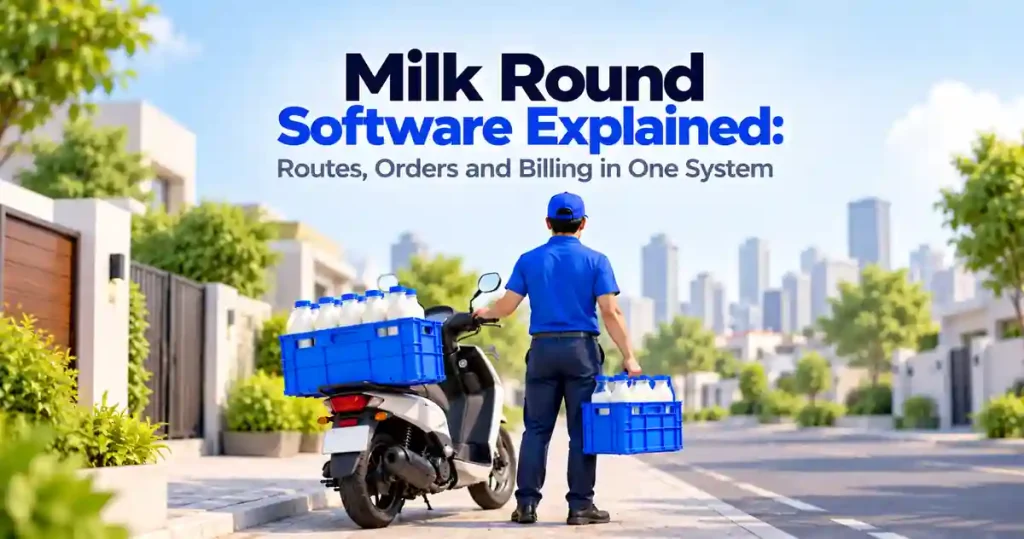
Milk round software exists to solve one worry every dairy operator has before they switch from paper: will digitizing the round change what actually makes it work? Samuel has wondered exactly that in Dar es Salaam, where his family has run a milk round for two generations. His grandfather rode a bicycle. Samuel now runs two vans.
The customers stayed the same. The trust at the door stayed the same. What changed is what he tracks, and how much of it used to live only in his head. So this guide explains what milk round software actually does, what survives the switch, and what habits it should finally let you drop.
What Is Milk Round Software?
Milk round software manages the daily route, standing orders, crate returns, and monthly billing. It connects what happens at the doorstep to the records behind it. It replaces the paper book a milkman once carried, without changing the route, the customers, or the trust that route was built on.
You will also see this sold as milk delivery software solutions or milk management software. Every label describes the same job: keep the round running exactly as it always has, just with a record that doesn’t depend on memory.
What Survives When You Digitize the Milk Round
Good software respects the parts of a milk round that already work. Three things should never change just because you added a screen.
The fixed daily route
Milk delivery has run on a fixed route since dairies first industrialized deliveries in the 1800s. That structure still works today. A tool worth buying keeps the route recognizable, not scrambled into something new every morning.
The trusted face at the door
Milk delivery is one of the last trades where the person on your porch is the same every single day. Software should support that relationship, never replace it with an app notification instead of a knock.
The standing order itself
A customer’s usual two litres, every Monday and Thursday, is the backbone of the business. Milk round software should hold that pattern securely, adjusting it only when the customer actually asks.
See how a connected system protects the round while fixing the paperwork.
Start Your Free 14-Day Trial → No credit card, live in minutes.
What Shouldn’t Survive: The Habits Milk Round Software Replaces
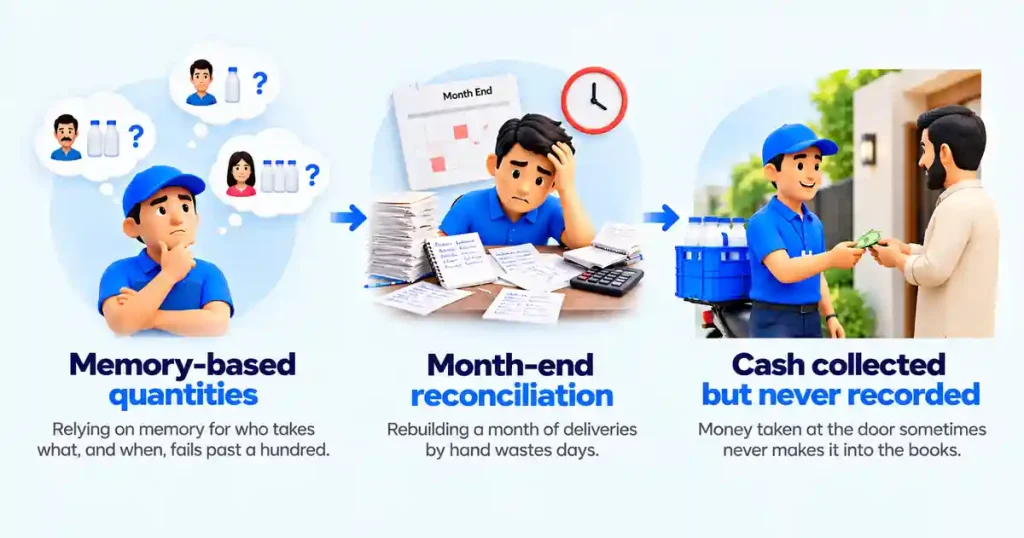
Three habits from the paper era deserve to disappear, and good software finally lets them.
Memory-based quantities
Relying on memory for who takes what, and when, works fine for twenty customers. It quietly fails past a hundred, because nobody’s memory scales with the round.
Month-end reconciliation from scratch
Rebuilding a month of deliveries by hand, from scattered notes, wastes days every single cycle. A proper system should already hold the answer the moment the month ends.
Cash collected but never recorded
Money taken at the door sometimes never makes it into the books, not through dishonesty, just through the sheer pace of a morning round. Recording it on the spot closes that gap for good.
What’s the Difference Between Milkman Software and Milk Round Software?
There isn’t really a difference. Milkman software and milk round software describe the same category from two different angles: one leans on the traditional trade, the other on the daily route it runs. You will also see it sold as a milk delivery system, which points instead to the technical platform underneath.
The tradition itself runs deep and spans continents, from horse-drawn carts in early industrial cities to the lechero tradition still practiced in parts of the Philippines today a global history of milk delivery. Whatever you call the software, it exists to carry that same daily promise forward.
Milk Management Software: What It Should Actually Track
Whatever name you use for it, good milk management software comes down to four areas, and testing each one tells you more than any feature list.
- Standing orders. Every customer’s usual quantity, held securely and editable without losing history.
- Routes. The daily sequence riders actually follow, not a static map nobody updates.
- Crates and bottles. What went out, what came back, tracked per customer rather than guessed at month-end.
- Billing. Every quantity change, skip, and hold from the month, rolled automatically into one accurate bill.
Milk App: What Your Rider Actually Needs
A milk app only earns its place if the rider on the route actually uses it. That adoption comes down to three things: speed, reliability, and honesty about cash
Speed at the doorstep
Confirming a delivery, adjusting today’s quantity, or marking a returned crate should take seconds, not a full stop while a customer waits on the step. A rider running a tight morning round abandons anything slower than the paper habit it’s supposed to replace.
Reliability when the signal drops
A rider walking into a stairwell or a block with patchy coverage still has to record the delivery. The app should hold that record locally and sync it the moment coverage returns, rather than losing it or sending him back to a paper slip.
Honesty about cash, on the spot
Recording payment the second it’s collected closes the gap described earlier in this guide. It ensures cash taken at the door actually makes it into the books.
Get those three right, and the app becomes something a rider reaches for naturally, not a tool the office imposes on him.
Milk Round Software Across the GCC, Africa and Pakistan
Milk rounds look different from Dar es Salaam to Dubai to Lahore, yet the daily promise never changes.
Across Africa, dense urban rounds in cities like Dar es Salaam and Nairobi still run early, often before the day’s heat sets in. In the GCC, dairies serving Dubai and Riyadh increasingly mix household rounds with institutional accounts, like labour-camp mess halls, on the same route.
Pakistan’s milk delivery, centred on cities such as Lahore, tends to combine both patterns, with tight urban density and long-standing household loyalty side by side.
Wherever the round runs, milk round software has to flex around local rhythms while keeping the billing logic identical underneath.
Where Tarsil Fits
Tarsil keeps the standing order, route, crate return, and monthly bill in one connected system. Nothing depends on a rider’s memory or a month-end scramble. You can see how these pieces work together on the features page.
That connection is exactly what Samuel needed in Dar es Salaam. Two generations of trust finally sit behind a record instead of a notebook, and the round still runs the way it always has.
Operators across Pakistan, the GCC, and Africa report an average of approx. 10x return in year one after making the same switch.
What Changes in Your First Month on Milk Round Software
Knowing what to expect matters more than any feature list, so here is what a real first month actually looks like.
Week one: loading the round as it stands today
You load your customers, their standing orders, and their crate balances exactly as they are now, mistakes and all. If your register has already grown messy, this is where it shows, and it’s worth being honest about the gap before you start, since a clean migration now saves a dispute later.
Week two: running the app alongside the paper book
Your rider carries both for a week or two, checking the app against the old habits until the numbers agree consistently. This overlap feels slow at first, but it is exactly what builds the trust that lets you retire the paper book for good.
Week three: the first digital billing cycle
This is the real test. Every quantity change, skip, and hold from the month should roll into one bill without you touching a spreadsheet. Compare it against what your old method would have produced, and the gap between the two is usually the clearest proof the switch was worth it.
Week four: retiring the notebook
By now, the round runs exactly as it always did, only the record behind it has changed. Some operators reach this point and start wondering whether a heavy enterprise system or custom-built app would serve them better long term.
If you are weighing your options, see our guide on online milk delivery software to understand what a small dairy actually needs that an ERP won’t give you.
The Bottom Line
Keep what already works: the route, the face at the door, the standing order. Drop what never should have survived this long: memory-based quantities, blind reconciliation, uncounted cash.
Get that balance right, and milk round software becomes the tool that protects tradition instead of replacing it.
Ready to modernize your round without losing what makes it work?
Book a Free Demo → We’ll show you how the switch actually feels day-to-day.
FAQs: Milk Round Software Questions Operators Ask
What is milk round software?
It manages the daily route, standing orders, crate returns, and monthly billing for a milk delivery business, replacing paper records without changing how the round runs.
What’s the difference between a milk round and milk delivery software?
None, really. “Milk round” describes the traditional daily route, while “milk delivery software” describes the modern platform running it today.
Does digitizing the round change how it actually runs?
It shouldn’t. Good software keeps the route, the customers, and the doorstep relationship exactly as they were, and only changes what you track.
What manual habits should I stop doing once I switch?
Relying on memory for quantities, rebuilding month-end totals from scratch, and letting cash collections go unrecorded. All three should disappear immediately.
Is this the same as milkman software or a milk app?
Yes, broadly. Milkman software and a milk app both describe pieces of the same category, just focused on the traditional trade or the rider’s phone.
How much does milk round software cost?
Pricing typically scales with routes, riders, or customers. Most platforms, including Tarsil, offer a free trial so you can test real numbers first.
Does it work outside the UK, across the GCC, Africa, and Pakistan?
Yes. Operators across Dubai, Dar es Salaam, Nairobi, and Lahore all run milk round software the same way, adjusting only local route patterns.