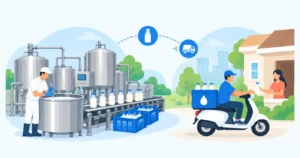
Zayd runs eleven delivery routes out of Riyadh. He started shopping for online milk delivery software the way most small dairy owners do — by taking whatever demo came up first.
All three ERP demos he sat through this year ended the same way. The sales team was polite. The screens looked impressive. Then someone asked how long implementation would take. The answer was always months, not weeks.
So that gap is where most small dairies get stuck. They search for online milk delivery software but land on pages built for factories. They assume this massive scale is simply what “proper” software looks like. Yet it is not.
A dairy running eleven routes needs something simpler: standing orders, daily quantity changes, and monthly billing, all from a phone or laptop. It does not need a production-planning suite with a delivery module bolted onto the side.
This guide separates the two, so you stop evaluating tools built for a business three times your size.
What Is Online Milk Delivery Software?
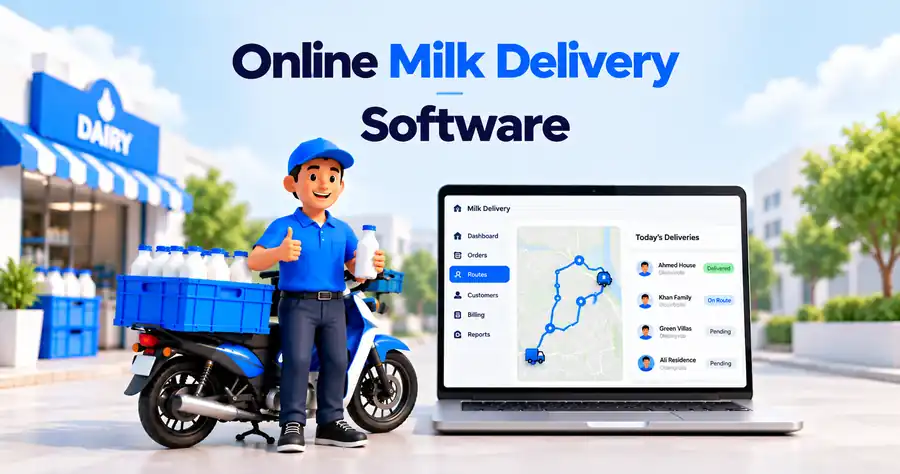
Online milk delivery software is a cloud-based system that runs a dairy’s daily delivery operation: standing orders, route planning, rider apps, billing and collections, accessible from any browser or phone rather than one office computer. It replaces the register and the paper round-book with a live system that every rider and every account can see at once.
You will also see it marketed as cloud milk delivery software or simply a milk delivery system. The label varies, but if you look at the broader category of milk delivery software, the job stays the same: get the daily round-off paper into something the whole team can access at once.
Do You Need Full ERP, or Just Online Milk Delivery Software?
Ask one question before you take another demo: does your bottleneck sit in production, or on the route?
Do you manufacture at scale, consolidate multiple legal entities, or run procurement across plants? If so, an ERP’s massive scope and timeline actually make sense.
But your actual daily fight might be simpler: who gets how much milk tomorrow, who paid last week, and which rider is running late. That is a delivery problem, not a manufacturing one. So online milk delivery software solves it directly, without making you solve the bigger problem first.
Why ERP Implementations Fail at Small Dairies
Zayd’s three demos all shared a pattern once he looked past the interface. Full ERP systems model a business more complex than his. That mismatch shows up in three places.
The rollout outlasts the problem it was meant to fix
An ERP implementation is a project, not a purchase. Someone maps every workflow and trains a team on features a dairy with eleven routes will likely never touch. So months pass before go-live. Meanwhile, the daily billing gap that started the search stays wide open.
The system assumes staff you do not have
ERP platforms expect a finance team, an IT administrator, and dedicated super-users who own the configuration. Yet a small dairy runs lean by design. So the software ends up half-configured, run by whoever has the patience, and the parts nobody set up properly become the parts nobody trusts.
The cost structure fits a different business
Licensing, implementation fees, and ongoing consulting are priced for a business with production, multi-warehouse inventory, and group accounting to justify them. So a delivery-only dairy pays for all of that scope and uses only a fraction of it.
What a Small Dairy Actually Needs From Milk Delivery Software for Small Dairy Operations
Strip the decision back to what daily operations actually require, and the list is short and specific.
- A standing order that can change today, not next billing cycle, when a customer asks for half a litre more.
- A rider app that works when the signal drops mid-street, then syncs once it returns.
- Automatic monthly billing that accounts for every quantity change, so nobody reconstructs a bill by hand.
- A live view of who paid, who owes, and which account is drifting into arrears.
- Onboarding measured in days, run by the owner or a single staff member, not a project team.
So score any platform against this list before you score it against a features brochure. Milk delivery software for small dairy operations wins or loses on exactly these five points.
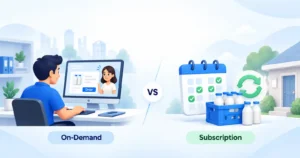
On-Demand Milk Delivery Software vs. Standing Orders: What Small Dairies Actually Run
Vendors often pitch on-demand milk delivery software as the modern choice, built around one-off orders placed through an app, the way a food-delivery service works.
But most dairy customers do not order that way. They want the same quantity delivered at the same time each morning, adjusted occasionally, not re-ordered daily.
So the real requirement is a system built around standing orders with easy exceptions. On-demand ordering can sit on top as an option for customers who genuinely want it — not as the default the whole business gets forced into.
What a Milk Delivery App Needs to Do for Riders and Owners
A milk delivery app is judged on two very different jobs, depending on who opens it.
For the rider, it needs to show today’s stops and quantities clearly enough to read at a doorstep before sunrise. To see exactly how this workflow functions in the field, check out our guide on how milk round software connects routes, orders, and billing in one system. It should log a delivery in one tap, and keep working even when connectivity is patchy on the way out of the city.
Meanwhile, for the owner, that same data needs to surface as a live route view, a billing feed, and a collections list — without exporting anything or calling the office to ask.
Buying Milk Delivery Software: A Short, Honest Checklist
Before any demo, write down three numbers: your routes, your average daily quantity changes, and how long month-end billing currently takes you. Then test each vendor against them directly.
Start by asking how long implementation genuinely takes, not how long the sales page claims. Then ask whether a standing order change today reaches tomorrow’s route without a support ticket.
After that, ask to see a rider’s screen with the signal turned off. And finally, ask what the platform costs once you add three more routes, in your own currency.
Where Regional Differences Show Up in a Milk Delivery System
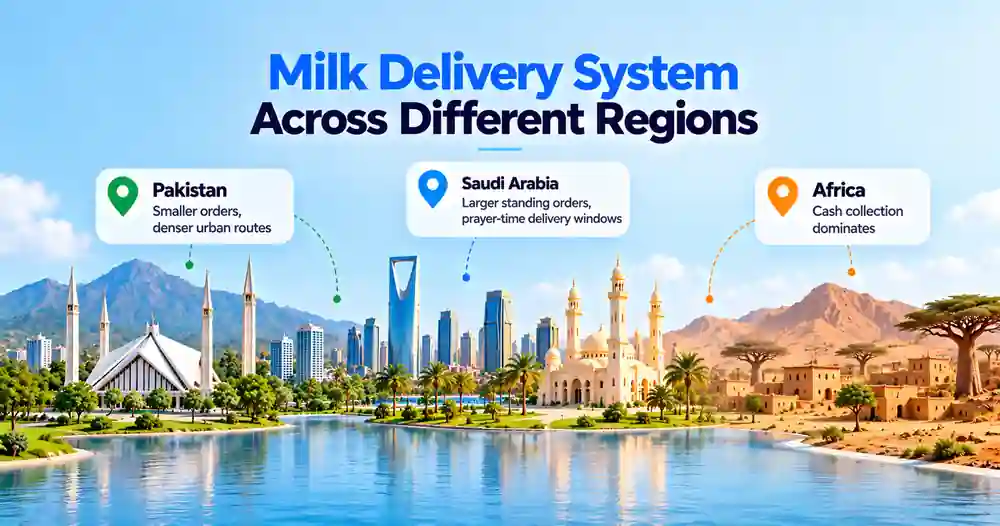 A milk delivery system built for one region rarely transfers cleanly to another without adjustment, and the gaps show up fastest at the edges of daily operations.
In Riyadh and Dammam, standing orders run heavier per household. Delivery windows also tighten around prayer times, so route timing has to flex around fixed points in the day.
Meanwhile, across parts of Africa, cash collection at the doorstep still dominates over digital payment, so a system built around card-on-file will fight the way money actually moves.
In Pakistan, by contrast, smaller per-order quantities and denser urban routes mean a platform tuned for wide suburban rounds wastes a rider’s morning. Still, none of this needs a different product — just one flexible enough to fit how a route actually runs, not just how a vendor’s home market runs.
Where Tarsil Fits
Tarsil runs as cloud milk delivery software built specifically for delivery operations like Zayd’s. Standing orders, rider apps, monthly billing, and collections are all live from day one — with no production or procurement module sitting unused in the background. So you can see the full connected system on the features page.
See it running on your own routes.
Start Your 14-Day Free Trial → No credit card required, and most dairies are live within three to four minutes of signing up.
What an ERP Actually Costs vs. What a Small Dairy Needs to Spend
The clearest way to see the mismatch is to put the two paths side by side, because the gap is not really about features. Instead, it is about how much of what you pay for actually gets used.
Where ERP money goes
Implementation fees come first, often before a single order has been delivered through the new system. Then training costs follow, for modules covering scenarios an eleven-route dairy will never trigger. Ongoing licensing comes next, priced against a company several times Zayd’s size.
That is the customer the platform was designed to serve, after all. So by the time it goes live, the bill reflects a business that does not exist yet, if it ever will.
In fact, Gartner’s own research predicts that by 2027, more than 70% of recently implemented ERP initiatives will fail to fully meet their original business goals — a warning aimed squarely at the scale of projects small operators keep getting pitched. Gartner: What IT Leaders Must Do to Avoid Disappointing ERP Initiatives.
Where the lean path spends instead
A delivery-focused platform charges for what a delivery business actually runs: routes, riders, billing cycles, and collections. So setup takes days, sometimes minutes, run by the person who already knows the business best. Instead, the money goes toward running routes better this month, not toward a rollout plan that stretches across the ones after it.
The Bottom Line
Match the software to the job you actually have. If production, procurement, or multi-entity accounting genuinely describe your business, an ERP’s scope earns its cost.
But if your daily fight is standing orders, a rider on the road, and a bill that closes on time, online milk delivery software solves that. And it does it without the months-long detour.
Zayd’s eleven routes did not need a system built for a factory. Instead, they needed one built for a route, and that is a smaller, cheaper, faster decision than most demos make it look.
Ready to see the delivery-first alternative?
Book a Free Demo → Bring your route count and your current billing time. We will show you exactly where the gap closes.
FAQs: Online Milk Delivery Software Questions
What is online milk delivery software?
It is a cloud-based system that runs a dairy’s standing orders, routes, rider app, billing, and collections from any browser or phone. So it replaces the paper round-book and the office register.
Do I need an ERP or just delivery software?
If your bottleneck is production or multi-entity accounting, an ERP fits. If it is routes, billing, and collections, delivery software solves it faster and at far lower cost.
How is this different from an on-demand milk delivery app?
On-demand apps center on one-off orders. Most dairies run standing orders with occasional changes, so that should be the default, with on-demand ordering available as an option, not the whole system.
How long does setup actually take?
Delivery-focused platforms like Tarsil are typically live within minutes of signup. By contrast, ERP implementations for the same job commonly run for months.
Can a small dairy really run its billing entirely online?
Yes. Standing orders, quantity changes, and collections all feed automatic monthly billing, so nothing gets reconstructed by hand at month-end.
Does this work the same way in the GCC, Africa, and Pakistan?
The core system stays the same, but route timing, payment habits, and order sizes differ by region, so a configurable platform adapts to Riyadh, Dar es Salaam, or Lahore rather than forcing one region’s pattern on all three.