

Why milk delivery customers leave rarely shows up as one big complaint. For Tariq, it showed up as a regular order that just stopped. He runs a milk delivery business in Jeddah with around 300 household accounts. One of his longest customers had ordered the same two liters daily for a year, then suddenly nothing.
That’s milk delivery customer retention in miniature: a pattern in your daily routes and monthly billing breaks, and nobody notices until the account is gone. Most cancellations don’t start as cancellations. Instead, they start as a missed delivery, a wrong invoice, or a pause nobody logged.
This guide walks through why that happens and how to catch it sooner. It covers early warning signs to track and a five-step workflow to recover an account before it’s gone. A short worked example shows how that plays out in practice.
Then it compares a manual, spreadsheet-based approach to a software-supported one. It closes by explaining where Tarsil fits in for keeping milk delivery customer retention under control.
What Customer Retention Means for a Milk Delivery Business
Customer retention means keeping a household or account ordering regularly, instead of pausing indefinitely or cancelling. The standard formula is simple: customers lost in a period, divided by customers at the start of that period. Then multiply by 100. Corporate Finance Institute’s explainer on churn rate draws a useful line between voluntary and involuntary cancellations.
A customer relocating is a common involuntary example. Still, a scheduled pause is not the same as a cancellation, and the two get confused constantly.
Why Milk Delivery Customers Leave: The Most Common Triggers
Four patterns explain most lost accounts.
Missed or Late Deliveries
A missed stop costs more trust than almost anything else in this business. Then a second missed stop in the same month reads as a pattern, not an accident.
Incorrect Bills and Unresolved Payments
A wrong invoice makes a customer question everything else about the account. If you are still relying on manual math, check our complete guide on monthly milk billing and how to calculate customer bills to prevent these errors. An unresolved dispute often ends in silence instead of a complaint.
Pauses or Quantity Changes Not Recorded
A customer who asks to pause for a week needs that recorded, not remembered. Instead, the order resumes incorrectly, or doesn’t resume at all. To fix this gap, read our complete breakdown on how to handle daily order changes without relying on manual notes.
Why Milk Delivery Customers Leave Without Warning
Most owners find out a customer left only when the account goes fully silent. By then, the real warning happened weeks earlier, buried in a spreadsheet nobody checked. Still, a planned pause during travel is not the same signal as three unexplained skips. One is normal. The other is an early sign of real customer loss.
Early Warning Signs a Milk Delivery Customer May Leave
Why milk delivery customers leave often comes down to one signal nobody caught in time. Here’s a simple way to read those signals before a customer actually leaves.
| Warning Sign | Possible Explanation | What to Verify | Recommended Action |
|---|---|---|---|
| Declining order volume | Household size changed, or dissatisfaction | Last 3 months of orders | Call to check in |
| Repeated missed deliveries | Route or rider issue | Delivery confirmation log | Fix the route, apologize |
| Invoice disputes | Billing error or miscommunication | Match invoice to delivery record | Issue a correction |
| No resume after a pause | Forgotten pause, or lost interest | Pause end date vs. today | Reach out directly |
Yet none of these alone means a customer is leaving. Together, two or more are worth a direct check-in.
A Five-Step Customer Recovery Workflow
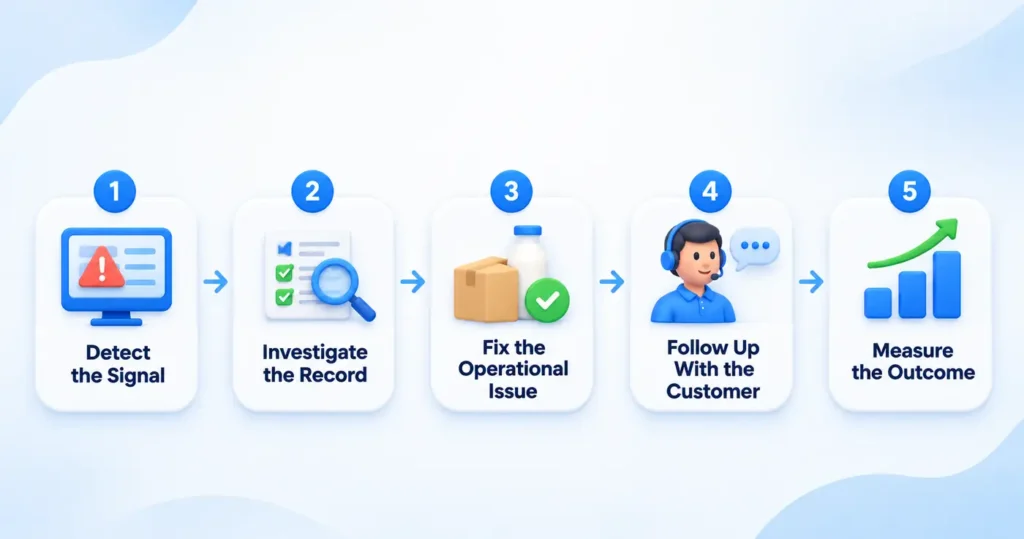
Five steps turn a warning sign into a saved account.
1. Detect the Signal
Someone has to actually look: a dispatcher reviewing missed stops, or billing flagging a dispute.
2. Investigate the Record
Instead, check the delivery log, the invoice, and the message history together, not separately.
3. Fix the Operational Issue
Correct the missed delivery, the wrong bill, or the unlogged pause before calling the customer.
4. Follow Up With the Customer
A supervisor should call or message once the team fixes the issue, not just the dispatcher.
5. Measure the Outcome
Then track whether ordering actually resumes over the next two weeks.
Worked Example: A Customer Who Nearly Cancels
Here’s how that played out for one of Tariq’s regular customers.
Week one: her order dropped from daily to three times a week, with no note on file. Week two: her invoice still billed the old daily rate, and she messaged once, then stopped responding. Then Tariq’s team matched the delivery log to the invoice and found the mismatch immediately.
So they corrected the bill, credited the difference, and called her directly to explain. She resumed her normal order within the week. Nothing here involved a discount or a guess; it came from checking the actual records.
Milk Delivery Retention in GCC and African Markets
In the GCC, most missed deliveries trace back to building access or apartment timing, not the milk itself. In parts of Africa, retention often depends more on consistent route access and clear credit records. Still, neither pattern is universal, and each market needs its own read of the data.
Manual vs. Software-Supported Customer Retention
A spreadsheet can flag a missed delivery. It just depends on someone remembering to check it.
| Task | Manual | Software-Supported |
|---|---|---|
| Spotting missed stops | Reviewed by memory or notebook | Visible in the delivery log |
| Capturing pauses | Written down, easy to lose | Logged against the account |
| Reconciling bills | Checked only on complaint | Matched to delivery records |
| Tracing communication | Scattered across chats | Kept with the account history |
Still, software only helps when the underlying data is complete, and someone actually acts on it.
Where Tarsil Fits Into Milk Delivery Customer Retention
Tarsil keeps orders, deliveries, billing, and customer messages tied to one account record. That makes a missed stop, a pause, or a billing error visible before a customer goes quiet. Yet it supports visibility and follow-up for the team, not automatic churn prediction.
See How Tarsil Works → See how orders, deliveries, billing, and messages stay on one account record.
The Bottom Line
Why milk delivery customers leave almost always traces back to one small signal missed weeks earlier. Catch that signal early, and most accounts never get close to cancelling.
Book Your Free Demo Today → See how this would work for your own delivery business.
FAQs: Milk Delivery Customer Retention
Why do milk delivery customers cancel their subscriptions?
Most cancellations trace back to a missed delivery, a billing error, or a pause that never got recorded correctly.
How can a milk delivery business identify inactive customers?
Compare each account’s recent order pattern against its normal volume, and flag anything that drops without an explanation.
Are skipped deliveries the same as customer churn?
No. A planned pause or holiday skip is normal. Repeated, unexplained missed deliveries are a real warning sign.
How do billing mistakes affect milk delivery customer retention?
A wrong invoice damages trust fast. Customers who dispute a bill and get no response often just stop ordering.
What should a business do after repeated missed milk deliveries?
Check the delivery log, fix the route issue, and follow up with the customer directly before the next billing cycle.
Can milk delivery software help reduce customer cancellations?
It can make missed stops, pauses, and billing errors visible sooner. It still depends on the team acting on that visibility.